

How many people pass through our lives, how many different destinies there are — surely beyond counting. I mean not only those who are our contemporaries, but also those who lived before us. Ever since I became a parishioner of the Church of the Great Martyr George the Victorious in the city of Samarkand, I have more than once heard about the remarkable people who served in this church. It seems that not so much time has passed since the period of which I will speak, yet finding eyewitnesses and hearing the story from their own lips proved far from easy.
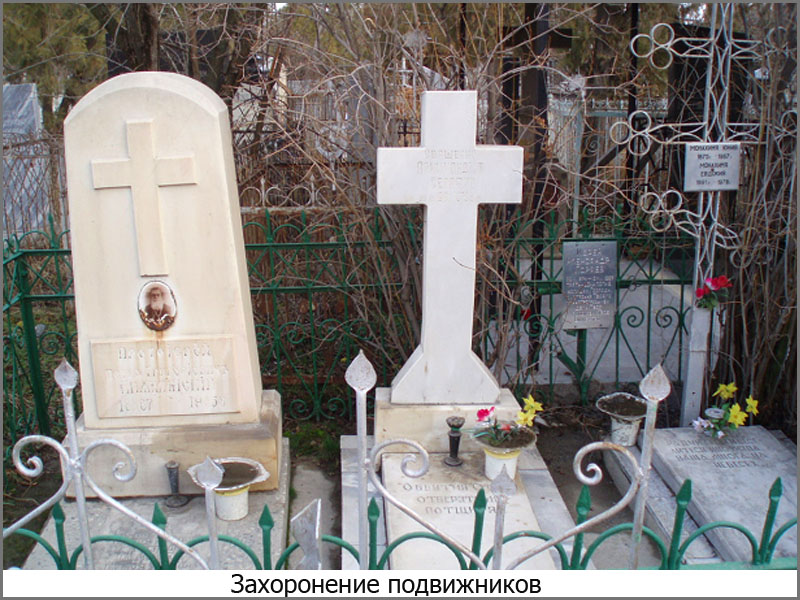
On the main European city cemetery of Samarkand, not far from the central entrance, within one enclosure stand three gravestones, beneath which lie four ascetics, of whom this account will speak. The greater part of their lives was given to the Church of the Great Martyr George the Victorious:
Archpriest Pyotr Knyazhinsky — 1867 — 1958,
Archimandrite Seraphim ( Sutorikhin ) — 1901 — 1979,
Nun Iunia ( Ulina ) — 1875 — 1967,
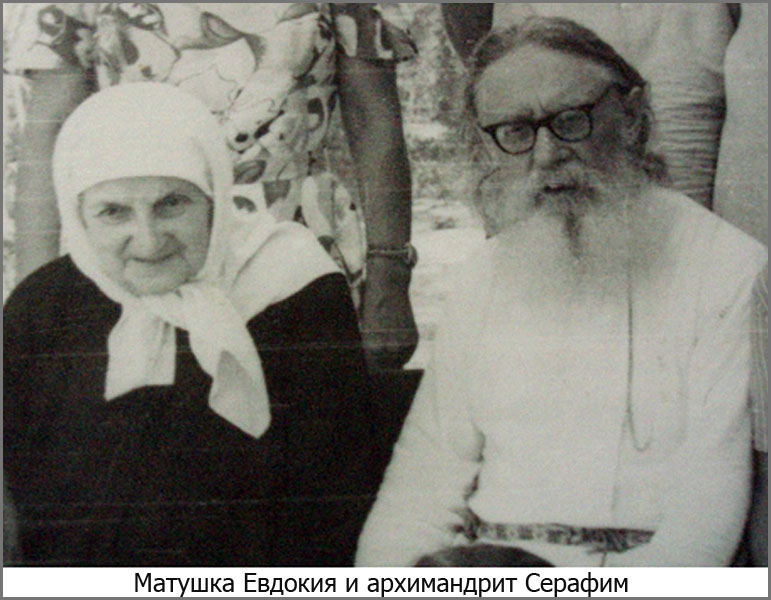
Nun Evdokia (Timasheva ), born Ekaterina Khvostova — 1891 — 1978.
The history of the Church of the Great Martyr George the Victorious, which changed its location three times, began in 1868.
At that time, on the territory of the citadel, where the Russian military garrison was stationed, the very first Orthodox church in the city of Samarkand was erected. The first rector of this church was a military priest by the surname of Vysotsky, N. G. True, this church did not stand for long. Later, to replace it, in 1882 a new, beautiful and more spacious church was built in the centre of the city, next to the building of the Officers' Assembly. It was built to a design by the engineer-architect V. A. Lemke for the military of the city garrison. Between the buildings of the church and the Officers' Assembly lay the church square, which was then the place for parades and festivities. The church building was made of raw, unfired brick and plastered. It held 600 people and was rich in vessels and vestments. On 21 July 1896, after a solemn moleben, the city's first history museum was founded in temporary premises in the church house. The building of this church operated continuously for 43 years. Until 1903 this church was under the authority of the Turkestan diocesan administration. Until 1912 it was already listed under the Administration of the Samarkand Military Commander, and from 1912 it was established as a field church of the 5th Turkestan Rifle Regiment. Throughout all these years the rectors of the Church of St. George were, as a rule, also deans of the military churches of the Samarkand Region.
On 1 April 1923 an exiled priest from the Tver Diocese, Alexei Konstantinovich Benemansky (later a hieromartyr), arrived in Samarkand. The NKVD commission had sentenced him to two years of exile in Turkestan. In his letters he writes:
“In Samarkand we unloaded onto the platform. Vasily Petrovich (Priest Kupriyanov) stayed behind to keep watch, while Boris and I went to the priest of the station church (of St. Nicholas), found him and asked him to let us leave our things in the watchman's lodge. He received us very kindly and gave us the so-called choir room by the lodge, where we dragged our things. We set off to look for the local father dean. We found him very soon. He turned out to be a very likeable priest — Father Evgeny Marchevsky, rector of the Church of St. George. He is a widower and lives with his only son, aged 17. The priest is very kind, and his house is open to everyone. Parishioners are with him all day long. He welcomed us warmly. His house is the headquarters for all the exiled clergy. Several people have already passed through his house, and at present he has with him the Bishop of Oryol, Daniel, a very likeable and cheerful hierarch, who in two weeks has managed to acclimatize completely.” “The next day (the Saturday of Pascha) I asked permission to serve, which the Lord helped me to do. Before the Liturgy I made my confession, and then I served, which made me very glad. There were many people. The following day, Sunday, I served the Liturgy again, and then we went to the GPU. There we learned that in all likelihood we would not be left in Samarkand but, on Tashkent's instructions, would be sent away to some remote aul, kishlak or settlement. Bishop Daniel is being sent to Panjakent — a large kishlak with the status of a district town, where there are only 12 Russians. Father Sventsitsky and Bishop Vasily of Suzdal were also exiled there.”[1] Father Alexei Benemansky was an open opponent of Renovationism, and judging by his letters, in at least two Samarkand churches — the Church of St. George the Victorious and the railway-station Church of St. Nicholas — there was as yet no Renovationism in 1923.”
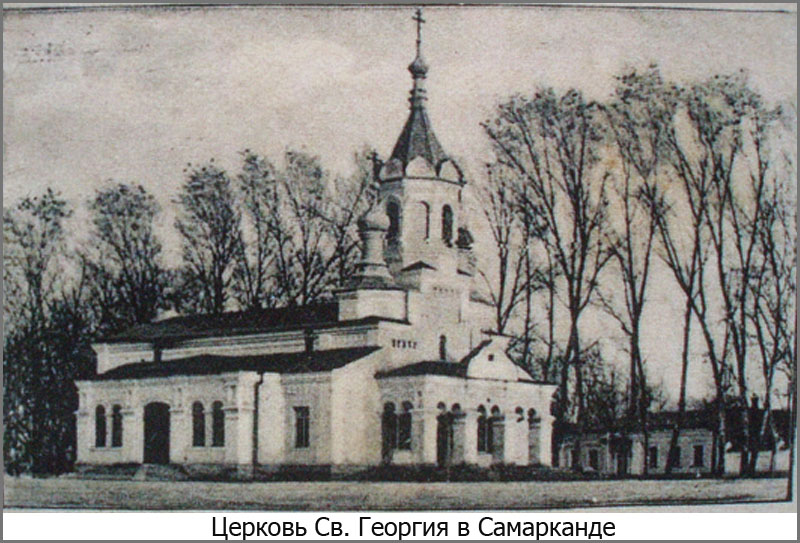
In 1924 the Church of St. George was closed, at first temporarily, and the community together with its rector, Father Evgeny Marchevsky, found themselves on the street.
On 20 May 1925, by a resolution of the Small Presidium of the Central Executive Committee of the Uzbek SSR, the church was closed for good and handed over to the military department. In the first days of August of that year the community was given the use of a small, old chapel in the central city cemetery. After that the community petitioned for the return of the property of the Church of St. George, and from 14 August they began to celebrate services in the new place. In December 1926, in order to make some arrangements, the community applied for permission to reconstruct the summer prayer house by the chapel, and by August 1927 it received permission to build. But, unfortunately, on the night of 27 to 28 April 1928 a fire broke out in the chapel, after which the faithful could no longer celebrate services in that place. On 31 May the community was given permission to hold services in a private house belonging to Lisina, at 37 Kladbishchenskaya Street. In 1929 the community moved to a new place — 19 Kladbishchensky Lane. The community again asked the authorities for permission to build a prayer house near the chapel on the cemetery grounds, but was refused. On 24 August 1929, under Priest Filipp Kalchenko, the community was issued a registration certificate. At that time services were held in houses rented, as a rule, from parishioners. From 1929 right up to 1937 the community made an agreement and rented premises from a citizen named Kibitkin. Under the existing law the community had no right to acquire premises for worship in its own name. Only in 1937 did the faithful find a way out of the situation. They then decided to acquire a dwelling near the city cemetery on Birlik Street and to register it in the name of a trusted private person. The community bought part of the dwelling in the name of Nun Iunia (Ulina). On 21 March Mother Iunia was given 300 roubles as a deposit for buying half of a house from Stolyarova. In this way the community bought part of the house, and on 4 December 1938 the whole house was bought out. On paper it all looked as though the community was renting this house from Mother Iunia. It was a small adobe house with a clay roof, which later became the foundation of the present-day Church of St. George[2].
A beginning had been made. And only half a year after the war, on 31 October 1945, the community was able to buy out this house and register it as its own property. Thus Mother Iunia became the founder and first warden of what was then still the Prayer House in honour of the Great Martyr George the Victorious.
In 1943 the community of the Prayer House of St. George, headed by its rector Pyotr Knyazhinsky, renewed its petitions for the return of the confiscated church building, but without success. The church square where that church had stood had long since been called Red Square.
Nun Iunia
Of Mother Iunia herself, what we know is that she was a nun of the Yelets Znamensky Convent.
At this monastery there was an icon-painting school for the instruction of the sisters, where, apparently, Mother Iunia learned this craft. Immediately after the revolution the Soviet authorities sought a pretext to close the Znamensky Monastery. At first the sisters were offered to form a labour cooperative. Then in March 1929 the monastery was closed by decision of the city soviet, and already in May of that year all the nuns were forced to leave their cells. Mother Abbess Antonia, who did not wish to leave the walls of the monastery, was tortured to death right in the convent. Like many monastics and clergy of that time, Mother Iunia also passed through the camps. When she was sentenced, she was 54 years old. In appearance she was of very frail build and small stature.
How and in what year Mother Iunia came to the city of Samarkand we do not know for certain. She herself did not speak about herself. But judging by her deeds, she gave her whole self to the service of God and was a true ascetic. From the little house bought in her name in 1937 a church was to be made. Here it must be said that from 1937 to 1944 the Central Asian Diocese had no bishop, no head and no administration. The God-fighting activity of the OGPU-NKVD reached its culminating point at that time. The diocese was going through a period of anarchy and schism, and on top of that came the active criminal activity of the Renovationists against the Orthodox who were faithful to Patriarch Tikhon. When Mother Evdokia came to Samarkand in 1938, it was still a prayer house and could hold only 10 to 20 worshippers, and instead of an iconostasis a plain little curtain hung there. According to the available information, it was the only surviving Orthodox, non-Renovationist parish in the Samarkand deanery. On 27 February 1946 the community was granted permission to build an extension for the Altar. With donations from the faithful and parishioners the community little by little began to acquire plots and small houses around the prayer house. The church grounds began to grow and in time to be built up. People recall that to obtain even the simplest building materials was in those days a real problem, let alone for a church. But prayer and hope for God's help were the foundation of their lives. And the church slowly rose and expanded. Gradually they raised the church to two storeys of windows and built guest rooms, an accounts office and a prosphora bakery, a baptistery, a kitchen and cells for the sisters, a bell tower at the entrance and many small service rooms. In October 1946 the new building was consecrated as a prayer house by the Right Reverend Bishop Gury.
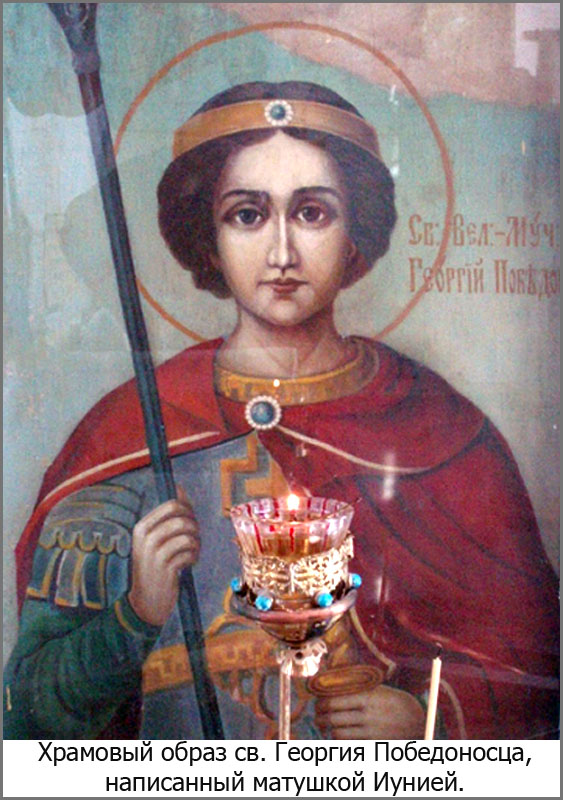
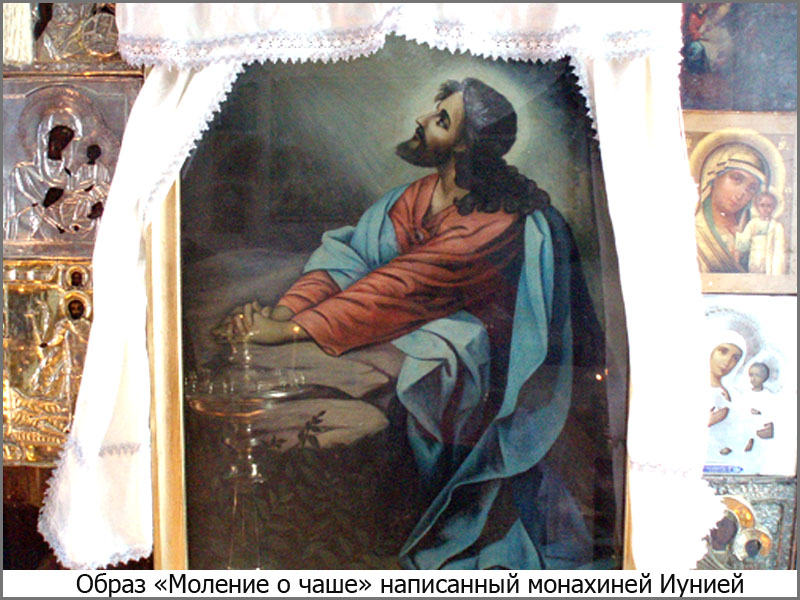
Mother Iunia painted icons in oil paints, which were then a great rarity, and she made the brushes for painting from her own hair. The images painted by her still hang to this day: the church's main icons on the iconostasis and the lectern — of the Great Martyr George the Victorious, of the Archangel Michael on the deacon's door, on the walls full-length figures of the Venerable Sergius of Radonezh and Seraphim of Sarov, of St. Peter, Metropolitan of Moscow (painted for the name day of Fr. Pyotr Knyazhinsky) and of St. Gregory, the Resurrection of Christ and pictures on Gospel subjects. In the choir areas: the Mother of God “Soothe My Sorrows” and “The Prayer for the Cup.” It is astonishing that Mother Iunia herself was already of quite advanced age when she painted icons for the church. She was then 60 to 75 years old. The images and pictures she painted have been well preserved to this day.
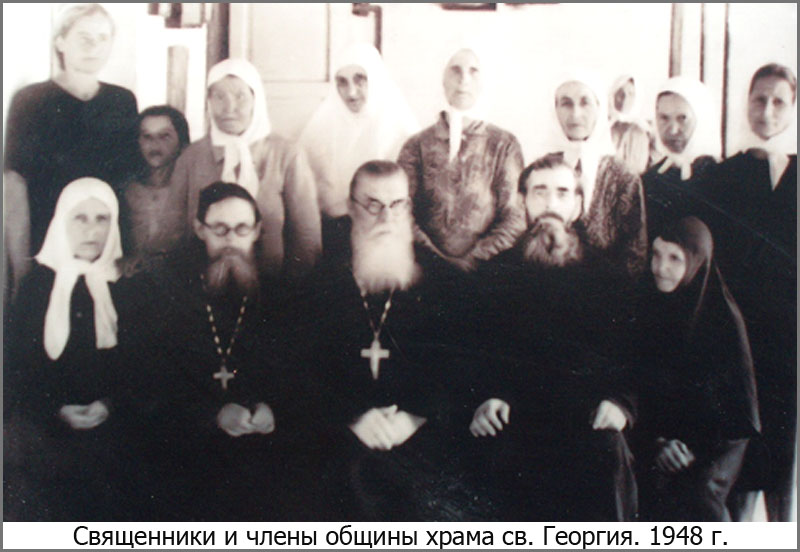
The prayer house was threatened with closure more than once. And once, when the church was threatened with yet another danger of closure, one of the women dreamed of the church building encircled by great, mighty chains. And to her puzzled question what this might mean, she heard a voice explaining that the chains were Mother Iunia's prayers to God. And in 1961, during the rule of Nikita Khrushchev, another wave of persecution of Christians began. The Samarkand commissioner for religious affairs took from Father Seraphim the certificate of registration, and although the church was not officially closed, services could not be held in it. The city authorities intended to place a kindergarten on the church grounds in the near future.
This was a terrible blow for the whole community. Now all that remained was to pray in private. And everyone stood to prayer, beseeching God to preserve the church. They prayed with tears day and night. For more than three years they struggled for the resumption of services in the church, and in the end they prevailed. By that time Mother could no longer walk. One morning Mother Iunia called her sisters and said to them: “Do you know what dream I had today?! The gates of our convent open — and our St. Great Martyr George the Victorious rides in. I was frightened. Then the Great Martyr George says: ‘Wait, I have a matter to attend to in my church.’ He enters the doors of the church, goes up to the Royal Doors and opens them. Then he says: ‘Now everything is in order.’ And after these words he leaves the church. Surely something is going to happen — perhaps our church will be opened?”
According to eyewitnesses, another event occurred that same day. Two men in military dress entered the office of the head of the Samarkand City Executive Committee and very sternly demanded that the church of the Great Martyr George be opened. The head was taken aback by such a visit and went out after them to ask his secretary who those two were. But she said that no one had entered or left his office. By the head's description, one of the visitors looked very much like the Great Martyr George himself. And indeed, the next day permission came for the church to be opened.
Years passed, and infirmities and illnesses began to visit Mother Iunia; she began to go blind and lose her hearing, and her legs had long refused to walk. Mother Evdokia looked after her. The layout of the rooms was such that the door from Mother Iunia's room opened directly into the church. Now this room is used as a sacristy. Before the start of a service Mother Evdokia would sit Mother Iunia up in bed and open the door of her room-cell into the church so that she could hear the service, and when it ended she would return and lay her down. Around 1958, going blind and immobile, Mother Iunia addressed Mother Evdokia, saying: “Sit me up, Mother.” She sat her up, adjusted the pillows and went to the service. In the evening, after supper, having read the evening prayers and all the monastic rules, she came to Mother Iunia to lay her down for the night. But Mother Iunia suddenly said: “Leave it, Mother. Do not lay me down.” So Mother Iunia sat for nine years without lying down, her knees drawn up to her chin. She sat before God, since she could not stand and did not wish to lie down before Him. She slept with a small pillow on her knees, resting her head on it, her arms wrapped around her knees. And when her legs had become completely rigid at the joints, she slept with her head lowered onto her chest. To the last minute of her life she kept a clear mind and took a lively interest in the life of the church, the services, its joys and misfortunes, going into all the small matters, all the details. She knew everyone who came to her. She recognized them by their voices, though she was by then completely blind.
My acquaintance Tatiana Sergeevna Khalova told me that in those years, while still a child, she used to come to services at the church with her father. And once during a service she went from the church into the neighbouring room-cell and, standing in the doorway, saw an elderly woman sitting with her kerchief pulled down over her eyes and many burning candles beside her. She called her by name and beckoned her to come to her: “Here is Tanechka, come to me.” She went up to Mother, marvelling at all that was happening, and Mother placed her hands over her head like a little house and began to pray. Tatiana Sergeevna said that to this day she remembers that special feeling, hard to describe — a feeling of lightness, peace and joy, and wonder that Mother had called her by name.
When the question was being decided in Father Seraphim's life — whether to stay in Samarkand or to leave — he decided to stay for the sake of the ailing Mother Iunia, in order to be with her in the last years of her life. Mother Iunia bore pain and suffering for many years without complaint. In her last years she received the Holy Mysteries of Christ every week. She was also sustained by the kindest attitude toward her of Father Seraphim, who visited her every day morning and evening, and when it was especially hard, also in the daytime. The priest supported her spirit, and because of this Mother Iunia's soul felt lighter. Mother Evdokia, too, was constantly at her side. She washed her, fed her, changed her bedding, and read all the rules and prayers into her ear, since she had begun to go deaf. She called the priest whenever it seemed to her that Mother Iunia was dying. “Do you think, Mother, that I am dying?” she once asked Mother Evdokia. “I will tell you, Mother, when I am dying.” And then one day Mother Iunia said to Mother Evdokia: “Mother, tomorrow is the Meeting of the Lord!” And she objected: “Oh, what are you saying, Mother. The Meeting of the Lord is in a week.” She thought that Mother had mixed up the date. “But I tell you,” Mother Iunia repeated insistently, “that tomorrow is the Meeting of the Lord.” So she gave warning of her departure, saying that her meeting with God would be tomorrow — her Meeting! The next day, 11 February, she passed away. And on the eve she had added: “Mother, do you know that if a person dies even one minute before midnight, that day will be the day of his death?” Thus she foretold the day and hour of her repose.
Mother lived 92 years. Unfortunately, not a single photograph of her has survived. Mother Iunia did not like to be photographed.
Nun Evdokia
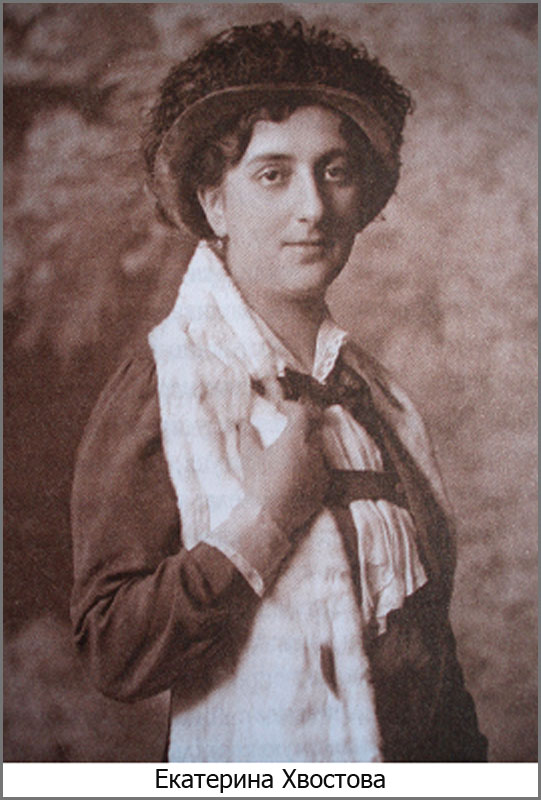
Ekaterina — such was Mother Evdokia's secular name — was born on 14 December 1891 in St. Petersburg, into an old noble family. Her father was Minister of Justice and of Internal Affairs of the Russian Empire under Tsar Nicholas II. Her parents, Alexander Alexeevich and Anastasia Vladimirovna Khvostov, instilled in their children from early years a firm faith, kindness and compassion. In 1915 Boris Timashev proposed to Ekaterina Alexandrovna. She hesitated greatly in making her decision, because her fiancé was far from faith in God. Then, following the rule established in the Khvostov family of deciding all the major questions of life by the blessing and counsel of the well-known elder, Fr. Alexy of Zosimova Hermitage (Solovyov), she turned to him for advice and blessing. Might she marry a man in whom there was no true faith? For her this side of life was the most important of all. Having heard her, Fr. Alexy said: “God will bless you to marry him. He is a good man. And do not insist on anything, but only make the sign of the cross over his back, unnoticed.” So, with the elder's blessing, she married, and secretly made the sign of the cross over her Borenka's back, as he had advised. And he became more and more a believer. And when he was dying in her arms of typhus, having briefly come to consciousness, he asked her to call a priest. With tears he confessed and received the Holy Mysteries and quietly departed in her arms. A year after the wedding, in 1917, a daughter was born to them, but she lived only a few days. They barely had time to baptize her with the name Anastasia, after which she died. Later Mother Evdokia often said: “How well the Lord Himself arranged my life: I was married as though I had not been, and He took my little girl to Himself, and opened to me the way to Himself through monastic tonsure, freeing me from all earthly ties.” The revolution began, and Mother Evdokia, together with her father, mother and younger brother Volodya, moved to the city of Yelets, where her father soon died, and after him, a year later, 19-year-old Volodechka died of meningitis. Long before the revolution her father had given the peasants, free of charge, all the lands of his estate “Krasnoe,” which was near Yelets, keeping for himself only the house and the garden beside it. Therefore in the hard days of the 1920s the peasants repaid good with good and helped him and his family in every way — each as he could. And when her father died, the same peasants carried his coffin in their arms for 12 kilometres from Yelets to the Khvostovs' ancestral estate, “Voronets,” and a year later they carried Volodechka there in the same way. The peasants not only carried the father's coffin in their arms but, having dug the grave, lovingly lined it inside with spruce boughs, thereby expressing their love and gratitude to him.
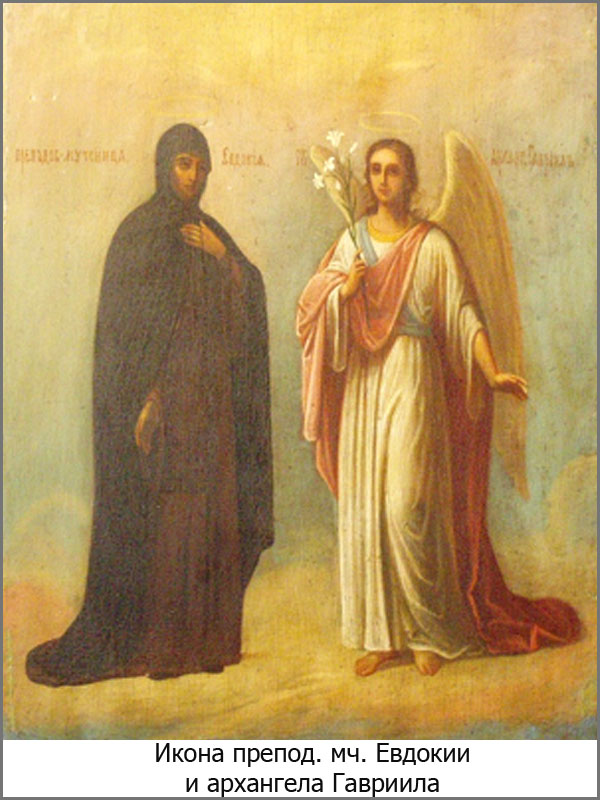
After the death of her father and little brother, in 1925 her mother was struck by paralysis, and for 7 years she lay immobile, in full consciousness and clear mind. At the beginning of her grave illness, with the blessing of Fr. Alexy of Zosimova Hermitage, she took monastic tonsure with the name Mitrofania, which she had dreamed of since youth. Nun Iunia was present at the tonsure, and they would later meet in a wondrous way in Samarkand. And Mother Evdokia was beside her mother all these seven years, to the last minute. These were hard and hungry years. Valuable things had to be sold or exchanged for food. It came to the point that she took her wedding ring to sell, but the Lord sent them money for their sustenance. To her nephew Alexei Petrovich Artsybushev Mother Evdokia told a very unusual story from that time: “Once I went to the market; I needed to buy something for Mama. And some tipsy little peasant pestered me: ‘Buy an icon, miss,’ and showed me some black board, not at all like an icon, and what was depicted on it could not be seen. Somehow I got rid of him, I don't remember how. And coming home, I told Mama what had happened. And she said to me: ‘Katenka, run quickly to the market, I beg you, find that peasant and buy this icon from him.’ I ran to the market, and that peasant was still there, shuffling about with this icon. I bought the icon from him, brought it home and showed it to Mama. And Mama said to me: ‘Wash it, Katenka, with warm water and soap.’ I began to wash it, and from beneath the age-old layer of soot and blackness there began to appear, and stood forth in full height, the Archangel Gabriel with a lily in his hand, and beside him, in monastic habit, stood the Venerable Martyr Evdokia. I joyfully showed this icon to Mama; she looked at it, then kissed it and, crossing herself, said: ‘Katenka! Here the Lord has sent you your monastic name.’ And at that time she already dreamed of tonsure, which she received after the death of her mother, who encouraged her in this intention and so wondrously appointed her monastic name.”
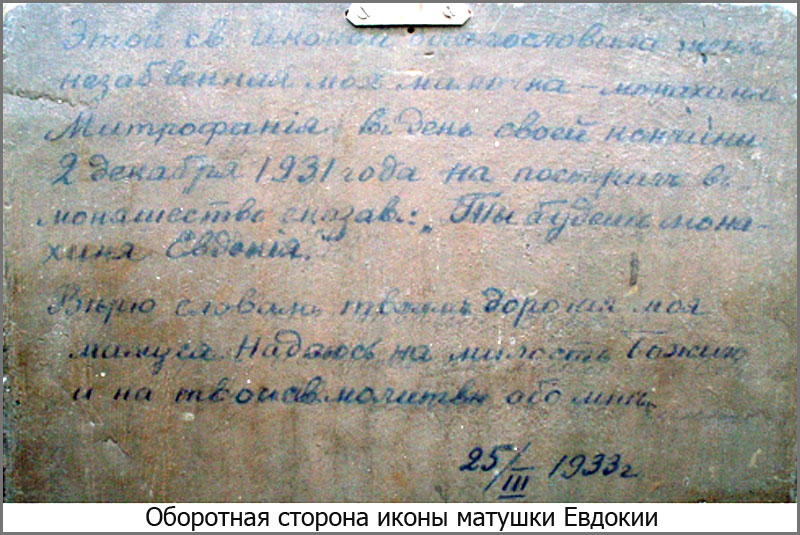
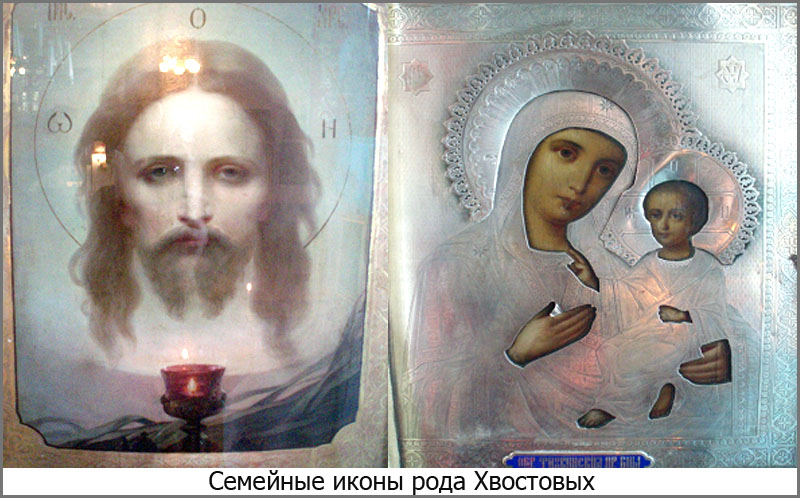
And again, having asked the blessing of the elder Fr. Alexy of Zosimova Hermitage, she made up her mind. She received her tonsure with the name Evdokia, on the feast of the Archangel Gabriel. And this icon, among many other icons of the Khvostov family, would later find its way to Samarkand, to the Church of St. George the Victorious, and would be beside her to the very end. Having taken tonsure after her mother's death, she remained to live in Yelets, wholly immersed in the spiritual life, and the life of the Church from then on became an inseparable part of her life. In the 1930s the Soviet authorities tried now to destroy religion and the Church, now to subordinate it to the state. The persecution of the Church, which had begun from the first days of the revolution, grew stronger and stronger in the 1930s. Monasteries and churches were closed, clergy and monastics were put in prison and exiled to camps. Artificial Church trials were staged with accusations of counter-revolution and of the Church's striving to restore the monarchy. During one such trial Mother Evdokia found herself in the dock among the clergy, headed by the Bishop of Yelets. Before her arrest she had managed to leave the family documents and the icons of the Khvostov family for safekeeping with an acquaintance. The icons were preserved and years later would end up in the Church of St. George in Samarkand, but the documents she burned out of fear. By the decision of an unrighteous court, many of the accused, she among them, were sentenced to the supreme penalty — execution by shooting. And how could it be otherwise? The daughter of a former tsarist minister, a nun — “counter-revolution” is already built into the very biography of such a person. But by the mercy of God the execution was commuted to ten years of camps. And in a cattle car Mother Evdokia travelled by stages to Siberia. And there, in Siberia, on the islands of the GULAG archipelago, she worked as a nurse in the camp infirmaries. She already had considerable experience, since from the war of 1914 until the revolution she had laboured much as a sister of mercy in the military hospitals of St. Petersburg. She herself said little about these years. She was released from the camp early, for impeccable conduct and good work. Upon her release she received an exile sentence of “minus 12,” which gave no right to reside in 12 major cities of the country. After this Mother Evdokia went to northern Kazakhstan, to Petropavlovsk. There too she lived near a church and looked after a blind woman. The local authorities persecuted her in every way and in the end ordered her to leave the city. It was 1938. The question arose before Mother: where to go? And she remembered that in 1916, when she was working in a hospital in St. Petersburg, a young officer, gravely wounded at the front, had died in her arms. His unhealing wounds gave off a strong stench, and no one but her dared to enter his ward. But Mother Evdokia grew accustomed to it: she fed him, washed him and dressed his wounds. He died. And before that he had given her the address of his sister, who lived in Samarkand, so that she would inform his sister in case of his death. The sister came, and learning that she had cared for her brother to the very end, said: “If it is ever hard for you in life, remember that in Samarkand you have a sister!” She remembered these words as she went through all the possible options in her head, and decided to go to Samarkand, hoping for God's help. She arrived in Samarkand — a strange city, strange people. What to do and where to begin? And she decided first of all to go to a church. She came, and an All-Night Vigil was being held. And she felt that Renovationists were serving in this church. She asked a woman, who confirmed that this church was Renovationist. There she also learned that there was another, non-Renovationist church in the city, near the cemetery. She went to the address given and found it. It turned out to be a prayer house, a small room, the altar fenced off by a little curtain, a priest serving the All-Night Vigil, few people. Mother Evdokia stood in a corner and with tears prayed to God, asking Him to help her, since she did not know where to go next or where to find shelter even for the night. And outside it was already evening, getting dark. The service ended, she went out into the yard, and suddenly someone stopped her, embraced her and said: “Ekaterina Alexandrovna, Ekaterina Alexandrovna! How did you come to be here?” She could not understand who was calling her by name. She peered into the face — before her stood Mother Iunia, a nun of the Yelets convent, well known to her. Back in 1926 she had taken part in the tonsure of her mother. But was this not a miracle, was this not the mercy of God, after so many years, and at such a moment, when she had nowhere to go, in a strange city, in a strange land, to meet a close person? So Mother Evdokia stayed to live and serve with Mother Iunia, to read and sing in the church of the holy Great Martyr and Victorious George. Later she began to keep the church's accounts, and many other duties lay on her as well. The life of the church and everything that filled, stirred and troubled it was her life. The problems of people, their sorrows and infirmities, overshadowed her own illnesses. Toward her own health she was completely indifferent; calmly she accepted everything as due, as though from the hands of God. But when it concerned others, she was ready to give her whole self for their health. Especially did she care “like a mother” for Father Seraphim, looking after him and guarding him like a guardian angel. Thus the hand of God led Mother Evdokia to this church. In time her family icons were sent from Yelets, and they remain to this day an inseparable part of our church. In the altar is the image of the Mother of God “Quick to Hear,” considered among us to be wonderworking. On the iconostasis is the image “Savior Not Made by Hands” with an unquenchable lamp, and the icons in the choir areas — small, but finely painted and in silver oklads.
Mother Evdokia herself was a remarkably peaceful and calm person. In her whole bearing there reigned a deep inner peace, which lived constantly in her soul and spread around her. The years passed inexorably, the end of her earthly journey drew near. Mother went blind, and Ninushka led her to the church and back. She was in her eighty-sixth year. Her spirit was vigorous, but her flesh was weak. In July 1978 Mother Evdokia was no more. In the church where she had laboured for more than forty years she lay in a plain coffin, wrapped in the mantle with the tonsure cross in her hands. Father Seraphim and the whole church, after the Liturgy, conducted the funeral service for the newly reposed nun — faithful to God and the Church until the grave. Mother Evdokia was buried beside Mother Iunia, with whom the Lord had so wondrously brought her together.
No one knows of Mother's last minutes; she lay in her little room in a state of oblivion, on her little bed before the icons. Father Seraphim with several of the faithful was performing the evening prayer rule in his cell. The door to Mother's room was open. Suddenly everyone heard the sound of some object falling in Mother's room. Entering, they saw an icon that had fallen out of its icon case, which was closed with a hook; in falling it had broken nothing, but only put out the burning lamp. Mother lay reposed. And on the floor lay that very icon which she, at her mother's request, had bought at the market in Yelets, on which were depicted the Archangel Gabriel with lilies and the holy Venerable Martyr Evdokia. [3]
Archpriest Pyotr Knyazhinsky
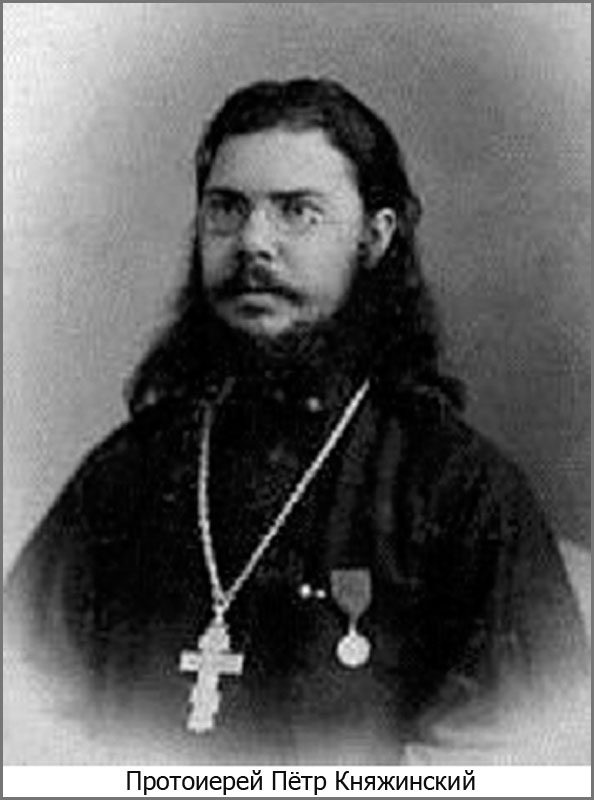
Father Pyotr was born in 1867, in a village of the Tambov Region, into the family of a priest, Grigory Stefanovich Knyazhinsky. The Knyazhinskys came from the peasants of the village of Knyazhye in the Shatsk district of the Ryazan Governorate. In 1888 Pyotr graduated from the Tambov Theological Seminary in the first category, and in September of that year he was appointed psalmist at the prison church of the city of Kozlov. In 1890, at the age of 22, he was ordained to the priesthood by Bishop Vitaly of Tambov (the source gives the day of his ordination as 30 February, a date that does not exist; the actual date has not been established). Vladyka Vitaly appointed the young priest to the Protection Cemetery Church in the city of Usman.
During his long priestly ministry Father Pyotr had three parishes: in the city of Usman he served as a priest for 38 years, in the city of Shatsk for 11 years, and in Samarkand he served for 16 years. He was married to Varvara Fotievna Nesmelova, a very beautiful woman of amazing inner purity, a person of high spirituality and culture. She too was a priest's daughter. They lived in a service apartment near the church. After the revolution this apartment was taken from them, and until the end of the twenties they lived in a wooden house on Engels Street. Later, when the persecution of the Church began, they were evicted from this house as well.
In Usman four children were born to them: Boris, Viktor, Sofia and Yury. They brought up their children very wisely, instilling in them a love for the fatherland. The house had a large library, and in the evenings Father Pyotr would take a book in his hands, often reading aloud to the children. Returning from inspection trips, he told his young children not fairy tales but real stories about where he had been and what people he had met. And then they all spread out the large map of the district together and traced his father's routes on it, learning the names of villages and hamlets, the direction of roads and rivers. It is unlikely that Father Pyotr was less busy than other fathers. Services at the Protection Church, trips and public activity took up much time, but he was always the best friend of his children and personally attended to their development and upbringing, guiding their interests. In general, everyone in the house had been taught from early childhood to love books. In the city of Usman Father Pyotr was the district supervisor of parish schools, then religion teacher at the girls' gymnasium, and a member of the district Zemstvo and the City Duma. By duty of his service he had to travel a great deal around the region. In 1905 Russia was in a state of war. Among the mass of people at that time thoughts of freedom and a new Constitution were stirring. In the city of Usman pogroms began, and Father Pyotr, together with the city Mayor F. V. Ogarkov and the board member Yustov, went out to meet the inflamed crowd and tried to oppose it. Father Pyotr spoke to the people for a long time, calming and admonishing them. In 1918 Father Pyotr was raised to the rank of archpriest, and in 1924 His Holiness Patriarch Tikhon awarded him the Mitre.
In 1928 Father Pyotr was arrested and sentenced at a Special Conference of the OGPU Commission under Article 58-10 of the Criminal Code of the RSFSR. The sentence was 3 years' deprivation of the right to reside in 12 cities of the Central Black Earth Region. In 1928 he was offered to choose a new place of residence. The place chosen was the city of Shatsk, where Father Pyotr served as rector of the cathedral church. In 1927 his eldest son Boris Knyazhinsky had left for Samarkand. In time, in March 1940, Father Pyotr himself moved to Samarkand and settled with him. At first he helped his son by taking care of the upbringing of his grandchildren, and from August 1942 he began to serve as a priest in the church of St. George the Victorious. His Beatitude Metropolitan Sergius, Patriarchal Locum Tenens, approved his candidacy for the post of rector of the Samarkand Prayer House of St. George.
Here one would like to say a few words about the priest's children. Boris Knyazhinsky graduated from the medical faculty of Moscow University and worked as a surgeon, then became a Candidate of Medical Sciences and an Honoured Physician of the Republic of Uzbekistan. In addition, he devoted his whole life to the history of his native city of Usman, opened a newspaper and a local history museum there, and wrote a book about the city's 350-year history. Father Pyotr's second son, Viktor, after the Great Patriotic War also came to Samarkand to his father and, in fulfilment of a vow, first took the rank of deacon and in 1955 served together with his father in the Church of St. George. Then, having been ordained to the priesthood, he served in the Central Asian Diocese, in the city of Andijan. The third son, Yury, entered the Moscow Conservatory, for which Father Pyotr himself blessed his son to change his surname and not to state in his autobiography that he was a priest's son. Having passed all the examinations as an external student, Yury became the musical director at the Maly Theatre. But then the Great Patriotic War came, and he went to the front and went through the whole war with his military wind band. After the war Yury Petrovich became a teacher and choir director at the Leningrad Theological Academy. The upbringing given by the parents was not in vain. Until the end of his life the children constantly visited their father, often coming to see him. Their bond was never broken.[4]
In Samarkand, as throughout the Central Asian Diocese, Renovationist priests predominated, and only in March 1944 was Archbishop Alexy (Palitsyn) of Kuibyshev sent to Central Asia by Patriarch Sergius. His main task was the liquidation of Renovationism. He was to receive the repentance of the Renovationist clergy and to re-consecrate the Renovationist churches. After Tashkent, Archbishop Alexy arrived in Samarkand on 30 March and received the repentance of the local Renovationist priests in the Church of the Great Martyr George the Victorious — the only non-Renovationist parish of the Samarkand deanery at that time. That day three 75-year-old priests concelebrated with the bishop: Archpriest Pyotr Knyazhinsky, retired Archpriest Mikhail Maslyuk and retired Priest Nikolai Kersky, who had never been Renovationists. Father Nikolai and Father Mikhail were forbidden to serve, but they prayed constantly at all the services in the Church of St. George as ordinary laymen.
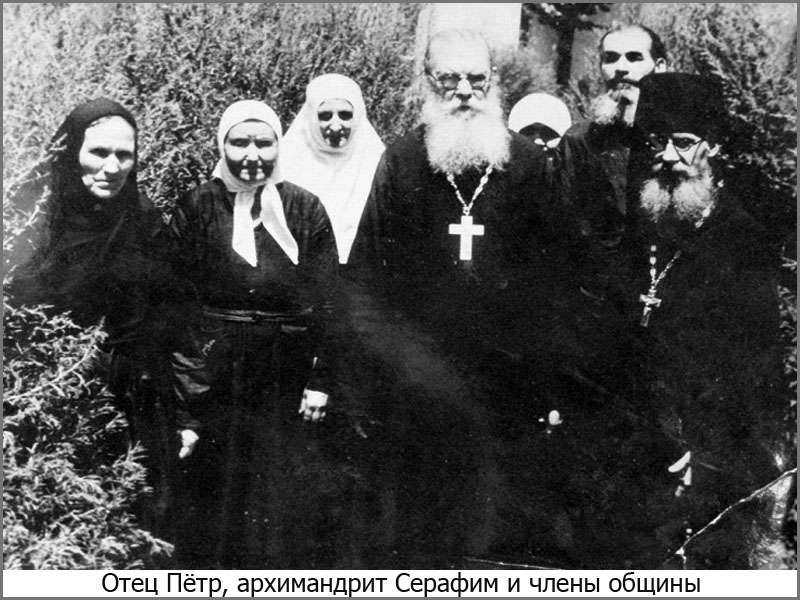
In 1945 the “Statute on the Administration of the Russian Orthodox Church” came into force, which put parish life in favourable conditions. From that time work began on the improvement of the Prayer House of St. George. Until then the prayer house occupied half of a residential house and it was cramped and wretched. In 1946, with the permission of the Commissioner for the Affairs of the Russian Orthodox Church, the community of St. George bought out the second half of the house for the prayer premises, with all its residential and outbuildings.
In all the work of rebuilding the church the active participation of the community's warden, Varvara Ignatievna Zvereva, was of very great importance. Along with special solicitude and care, she showed such valuable qualities as a sensible understanding of economic matters and of building. Under her the prayer house building was enlarged by the addition of an altar, the walls were raised, the roof was covered with iron, a canopy was built around the church, and so on. The work was carried out under special strain, because the necessary materials had not only to be found but also delivered to the workers in time. All the building concerns lay almost exclusively on the warden Varvara Ignatievna and were the subject of her anxious thoughts on sleepless nights and of all her running about all day long to various ends of the city. As a result of her thoughtfulness and foresight, all the work advanced without delay and with economy. Father Pyotr said of her that, despite her great importance in the work of improvement and building, Varvara Ignatievna was distinguished by special modesty, and that she was seen only while the work was under way. Besides the post of church warden, she also managed to bake prosphora for the church[5]. At the petition of Father Pyotr, who valued his warden very highly, Vladyka Ermogen, at a personal meeting with His Holiness the Patriarch, informed him about her and her labours. A high appraisal of her labours was the Patriarchal certificate sent to Varvara Ignatievna as a reward.
And here is what the Journal of the Moscow Patriarchate wrote in March 1947: “In Samarkand, many thousands of kilometres away from the Orthodox centre, the members of the community of St. George the Victorious, moved by ardent faith and devotion to the Russian Mother Church, managed in a short time to raise a beautiful prayer house-church. Until the spring of 1946 the community of St. George held services in premises which, by their small size, could not satisfy the needs of the local Christians. The building plan and the drawings of the new building were drawn up by the architect Aderkas, and the executors of this project were the believers themselves. On the day of commemoration of the Great Martyr George the Victorious, the rector of the community, Archpriest Pyotr Knyazhinsky, proposed to enlarge the existing premises — to add an altar and also to build several cell-rooms for the staff. The rector's proposal was accepted with enthusiasm by the members of the community, and after a fervent moleben literally the whole mass of the faithful set about the construction. Building material, paints, glass — everything needed for their church — the faithful brought to the church themselves. The building work went on from early morning until late at night and, finally, in October 1946 the solemn consecration of the new building took place. For all the faithful it was a real feast. The consecration was performed by the Right Reverend Gury, Bishop of Tashkent and Central Asia, who heartily congratulated all the builders, as well as the initiators of the construction: Archpriest Pyotr Knyazhinsky, Nun Evdokia Timasheva, Nun Iunia, the church warden V. I. Zvereva, and many others.”
In 1948, with the permission of Commissioner Stepanov and the City Communal Services Department, the community acquired the neighbouring house, specially for the residence of the priests. From this house were made the premises for the baptistery, the rooms where Father Pyotr and Father Seraphim lived, and also the “Bishop's room,” intended for accommodating the bishop and guests.
Above the “holy gates” for the entrance of worshippers a bell tower in the form of a tent roof was built in 1948. Three small bells and cast-iron semantrons hung on it, calling the Orthodox people to the service.
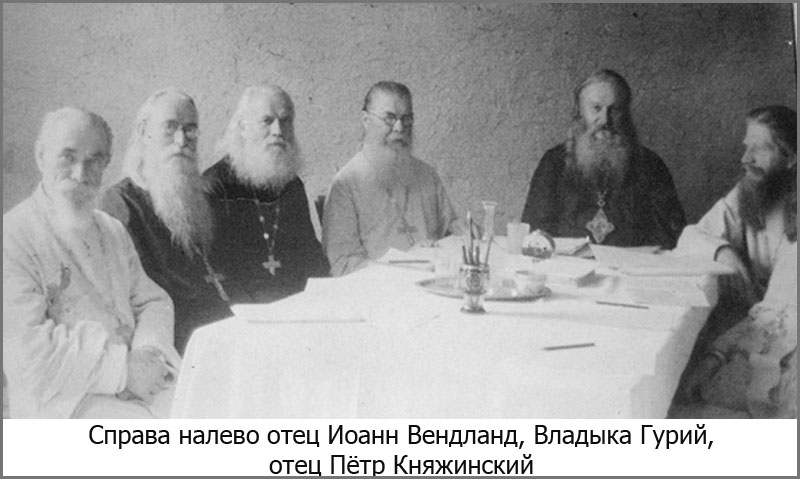
In 1950, for the 60th anniversary of his priesthood, Father Pyotr was awarded by His Holiness Patriarch Alexy I the right to wear a second pectoral cross. On 7 September 1952, for Father Pyotr's 85th birthday, Vladyka Gury, Archbishop of Central Asia, came to congratulate the jubilarian, and after the joint Liturgy he said that Father Pyotr's ministry — his prayer, his love of divine services, his wise and kindly word, his pastoral care for souls, his care for the church — gather around him many loving parishioners. In reply Father Pyotr thanked the Vladyka for his visit, attention and warm greeting, and thanked the priests and parishioners. “I love you all equally,” he said, addressing the parishioners. “To enter the church and see all of you is for me just like coming into a loving family. By your prayer and your love I live so long — that is the explanation of my longevity.”
Father Pyotr's priestly ministry was inseparably bound up with his preaching. Possessing the art of oratory and being widely erudite both in theology and in social and philosophical questions, Father Pyotr invariably drew the attention of parishioners to his instructions and enjoyed their gratitude, respect and love. Despite his advanced age and the infirmities that come with age, Father Pyotr put much labour into the work of church building and by his personal example raised the faithful to the work of improving the house of God.
In March 1954, because of his advanced years, Father Pyotr appealed to Vladyka Ermogen with a request to relieve him of the post of dean, leaving him in the post of rector of the Prayer House of St. George.
The year 1957 was a jubilee year for Father Pyotr — he turned 90. The celebrations coincided with the day of commemoration of the Vladimir Icon of the Mother of God. From the morning of 8 September the church was filled with worshippers. After the Liturgy, which the jubilarian himself celebrated together with Archimandrite Seraphim and the priests of the Samarkand deanery, with the singing of two choirs, a thanksgiving moleben took place. After the moleben Father Pyotr was honoured. Very many congratulatory speeches and good wishes were heard. A heartfelt telegram, full of warm words, from Bishop Ermogen was read out, expressing his regret at being unable to be present in person at the celebration. Archimandrite Seraphim also sincerely congratulated the dear jubilarian on such an important feast. A congratulatory telegram came from Vladyka Gury, and from many priests, monks and laypeople who knew Father Pyotr. It was evident from everything that very many loved, valued and respected him.
In the archives of the Church of St. George letters have been preserved, addressed to Father Pyotr and Archimandrite Seraphim from bishops, priests and monks. When one reads their letters and telegrams, one is struck by how warmly and in a friendly way they communicated, as if they were close relatives. In them one can see informal, sincere and trusting relations with one another.
On 25 May 1958 Father Pyotr fell ill. Immediately after the All-Night Vigil he had celebrated, he felt unwell and took to his bed. When Vladyka Ermogen learned of this, he expressed a wish to come from Tashkent to the sick man, but he was told that Father Pyotr was unconscious and could hardly respond to his coming. His son Boris came to him in Samarkand. Father Pyotr's wife, Varvara Fotievna, could not come from Usman, since her advanced age and health did not permit it. After a short illness, surrounded by his family and loved ones, Father Pyotr, never having risen, quietly reposed in God. Father Pyotr lived 91 years and died on 4 June. Of these he served in the Church for 65 years. During the years of his ministry he was awarded all the awards open to a priest.
The funeral service for Father Pyotr was conducted by the Right Reverend Ermogen, Bishop of Tashkent and Central Asia, together with Archimandrite Boris Kholchev, Hegumen Seraphim Sutorikhin and the numerous clergy of the city of Samarkand and the region, with an immense gathering of the faithful of Samarkand and of many other cities and settlements of Central Asia, who had come to say a last farewell to their beloved mentor and spiritual father. In his funeral address Vladyka Ermogen noted the great merits of the late Father Pyotr before the Orthodox Church, highly appraised his personal qualities, in which the gifts of a good administrator and a spiritual mentor were happily combined, and expressed his grief at the loss of a glorious colleague. Father Pyotr, in the Vladyka's opinion, was the most punctual and diligent of the deans of the diocese. After the coffin with the remains of the departed had been carried around the church, the funeral procession, going as a procession of the cross with numerous clergy and laity, headed by Vladyka Ermogen, set out for the Orthodox cemetery. After the last litia, performed with episcopal ministry, the coffin was lowered into the grave.
Many of those who visited the Samarkand Prayer House of St. George in those years remembered it as a special, grace-filled place where all its inhabitants treated one another with care, like members of one close and loving family. This island of grace, as many called this place, did not arise spontaneously, but thanks to the efforts of its rector, Father Pyotr, and those around him.
By decree No. 79 of Archbishop Ermogen of Tashkent and Central Asia of 6 November 1958, the Prayer House of St. George was given the title of a church. Father Pyotr did not live to see this joyful day by only five months. Unfortunately, many facts of his biography are not yet known to us. According to the recollections of people who saw Father Pyotr in person, he was kind and demanding, of himself as well as of others, and strictly watched over order and discipline in the church. 57 years have already passed since his death, and those few parishioners who knew Father Pyotr in his lifetime were then either children or very young people. But despite the scantiness of information about him, one thing is certainly known — Father Pyotr was a true priest and a genuine pastor.
I would like to conclude the narrative about Father Pyotr with the words he himself wrote to His Holiness the Patriarch: “My modest labours ‘here’ have been honoured beyond measure. But I am never free of the troubling thought of their assessment ‘there’ and by Him before Whom I stand open to His all-seeing Eye in my spiritual poverty, which does not correspond to the height of my ministry, and I become afraid…”
Archimandrite Seraphim (Sutorikhin)
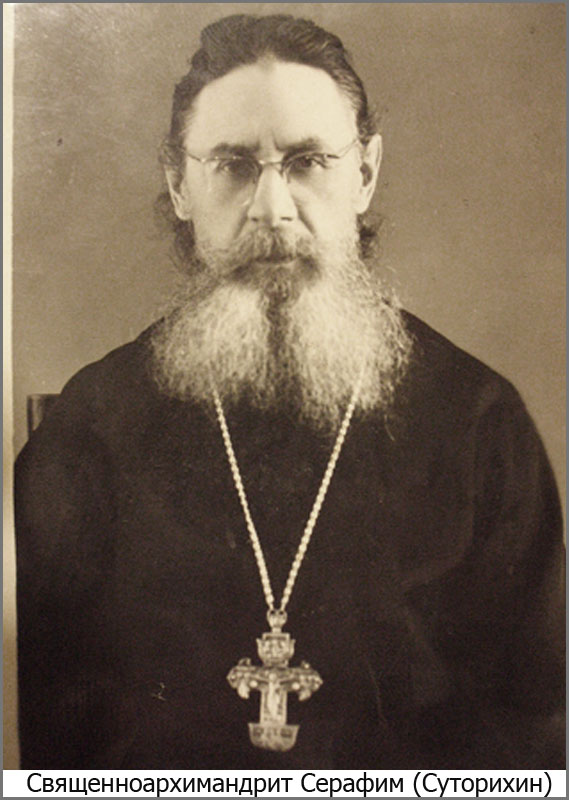
Of all the clergy of Samarkand, perhaps the name of Archimandrite Seraphim has been preserved in people's memory more than others, and those who were fortunate to meet him remember him with special warmth and gratitude. What was remarkable about Father Seraphim, who in his lifetime was a simple and modest man?
In his dealings with people he radiated joy and love.
A special period of spiritual upsurge in the Central Asian Diocese falls in the post-war time, and the great credit for this belongs to the bishops, Bishop Gury (Egorov) and Bishop Ermogen (Golubev). Many events in the life of Archimandrite Seraphim are connected with them. The Lord brought him to the Samarkand Church of the Great Martyr George the Victorious, to a wondrous island of grace created by the prayers and labours of the ascetics who lived here. Everyone seemed to have been waiting only for his arrival, and in time he stood at the head of this amazing “monastery in the world.”
He was born on 29 June 1901 in the village of Shestakovo, Slobodskoy district, Vyatka Governorate, into the family of Archpriest Mikhail Mikhailovich Sutorikhin, who was at that time priest of the Church of St. Nicholas in the same village.
Here one must tell a very interesting story that happened to Father Mikhail. When he was not yet married, Father John of Kronstadt was passing through their town and stayed in the very house where the then quite young Mikhail lived. Father John was besieged by a crowd of people wishing to talk with him or to receive his blessing, and Mikhail did not dare to approach the priest with his question. But during dinner Father John suddenly turned to Mikhail and himself resolved his question — whether to marry or to take monastic tonsure. Mikhail did just as Father John told him — first he worked for a year in a monastery, and on returning he married his chosen one, Anna Alexeevna, a complete orphan. Their marriage was truly happy and truly blessed. Throughout their whole life the spouses never raised their voices to each other; there was peace and harmony in the family. With the blessing of Father John of Kronstadt, Mikhail accepted the priesthood.[6]
Father Seraphim, named Sergius at birth in honour of the Venerable Sergius of Radonezh, was the fourth child in a family of five children. The boy was very gifted; in particular, he had a wonderful memory. He received his primary education at the zemstvo school in the town of Slobodskoy, and then his secondary education at the Slobodskoy Real School. During his studies Sergius performed the duties of an assistant in the church, and afterwards he moved over entirely to work in the church. He grew up at the church; from the age of 4 his father constantly took him along to services. At the age of 6 he began to serve in the church, gradually becoming accustomed to church singing, and read the Apostle at the Liturgy[7]. A little sticharion was sewn for him, and little Sergius helped his father during the service, handed him the censer and carried out the candle, and sang along in the choir. Relatives recalled that at home he often played at being a priest. He would put a towel on himself, tie a string to a mug and cense with it all around the house, singing something as he did so. In 1908 Father Mikhail was transferred from Shestakovo to the town of Slobodskoy, in the Vyatka Diocese, as rector of the Church of the Meeting of the Lord (where he served until his death in 1934), and the whole family moved with him. The young Sergius studied musical notation, studied chants and works of church composers, and at 14 he was already directing the left choir in the church where Father Mikhail served. In those years he studied the typikon well. He read a great deal: the works of the Holy Fathers, lives of the saints and theological books. From 1918, even before finishing the Real School, he had to perform the duties of psalmist in the church where his father served. Since the church, because of poverty, was unable to maintain a choir of singers, attention had to be turned to the development of congregational singing. With a view to continuing his education, in 1919, after finishing the Real School, he took a job at the local People's Pharmacy, where he worked as an assistant and bookkeeper until 1922, without leaving his service in the church[8]. In ten years of service as psalmist he managed to achieve quite good results. Father Seraphim himself recalled that time thus: “In this Church of the Meeting of the Lord I began to acquire skill in preaching the Word of God. In 1922 my father blessed me to deliver sermons during the divine service on catechetical themes, and from then on I preached without fail every Sunday and feast day”[9]. In those years not only priests but also laymen were permitted to preach. This time became for Sergius an excellent school: before each sermon he had to prepare and pray. In January 1924, for zealous service to the Church of God and for preaching the Word of God, Bishop Simeon of Cheboksary, who was then administering the Vyatka Diocese, tonsured him a reader, vesting him in the sticharion.[10]
At the age of 20 Sergius wrote a small work, “On the Architecture of the Churches of the City of Slobodskoy,” published in the collection “The Vyatka Region” for 1921, in which he gives a detailed description of the exterior and interior of the churches of Slobodskoy.
Sergius could not imagine any path other than serving the Church, and in 1924, with his parents' blessing, he went to Moscow to enter the theological seminary. But his cherished desire to receive a higher church education was never fulfilled.
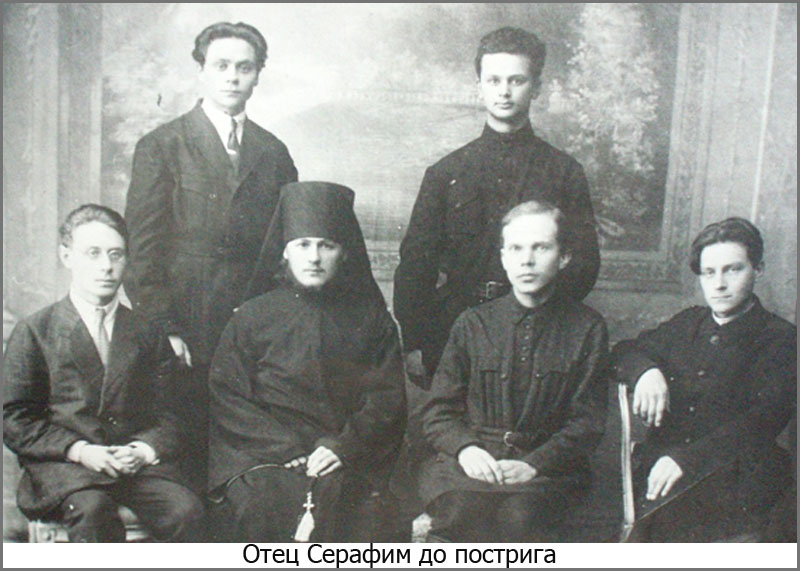
He came to Moscow with two friends, and they stayed not far from the centre of the city with an old woman. Sergius gave up the bed to his friends and settled himself on the floor. He could not sleep in the new place, and at about 4 in the morning he quietly went out into the city to wander around Moscow. It was summer, there were almost no people in the streets, and he saw that the occasional passers-by were all turning into a certain lane, and he decided to go the same way. How great was his surprise when he saw that he had come out to the chapel at the Resurrection Gate with the wonderworking Iveron icon of the Mother of God. A copy of the venerated image had been brought to Moscow by monks from the Panteleimon Monastery on Mount Athos. It was precisely here that Sergius had wished to come first of all on arriving in the capital. He entered the chapel; there was no one at the choir. He venerated the icon and stood before it in a corner. Then from the altar came the priest's exclamation: “Blessed is our God, always, now and ever and unto ages of ages,” Sergius looked around and, seeing that there was no one to sing, began to sing: “Amen. O Heavenly King…” So the two of them, he and the priest, sang a moleben before the Iveron icon. Later the singers came, and Sergius, staying on, sang with them all day. The priest and the choir director liked his voice, and he was offered a position as psalmist. To the offer he replied that he had come to study to become a priest, to which the priest said that he could be ordained anyway, and could study here too, taking part in the services. Sergius agreed. So one can say that the Mother of God Herself blessed him for service to the Church. All his life Father Seraphim venerated and loved the image of the Iveron Mother of God and said that many important events of his life were connected with it. True, it was not easy for Sergius to serve; services at the icon were held around the clock. He rented a corner nearby, next to the chapel. Often, especially at night, there was no one to read and sing, and then they would send for Sergius, and Sergius went to the services without complaint. And in addition, the chapel had a copy of the wonderworking icon for visits to the sick, and Sergius went with the icon, reading and singing. He had to sleep 3 to 4 hours a day, and that in snatches. Besides, he was often sent to obtain this or that for the needs of the chapel. Sergius became very tired at that time. So 2 years passed. In 1926 many churches began to pass under the control of the Renovationists. And when the turn came of the Iveron chapel, the priest who had taken Sergius into service advised him to return home to his father. Sergius went to Slobodskoy, where he helped his father and directed the choir. But the thought of the priesthood did not leave Sergius. In 1929 the Iveron chapel was closed and demolished in a single night. In the same year Father Seraphim received from friends, as a gift, a photograph taken of the main Iveron icon of the Mother of God with its oklad removed, before it was confiscated by the authorities. Having spent 15 years in the camps, he managed to preserve this treasured photograph. The famous Iveron icon of the Mother of God was lost, but years later specialists set themselves the aim of finding this image, and then the photograph belonging to Father Seraphim served as confirmation of the authenticity of this image, which is in the State Tretyakov Gallery.[11]
Here a digression is necessary, to tell about the Alexander Nevsky Brotherhood; this phenomenon was itself unique. It arose in 1918 at the Lavra, immediately after the revolution. At first one of the main functions of the brotherhood was the defence of the monastery against the godless, and later it came to play a central role in the creation and activity of the union of Orthodox brotherhoods of the Petrograd Diocese. In those same years the Alexander Nevsky Brotherhood tirelessly strove to draw representatives of various strata of the intelligentsia into the church milieu and to bring them closer to the learned monasticism. Many tasks faced the brotherhood: preserving the institution of monasticism, resisting heresies and schisms, seeking new forms of religious education, since all religious educational institutions were closed. And, of course, one of the brotherhood's main tasks was the training of young, educated clergy capable, in that hard time, of preserving Orthodoxy in a country where the spirit of God-fighting reigned. And this bore fruit: later many members of the brotherhood became martyrs and confessors for the faith. In general, the phenomenon of the brotherhood has not yet been appraised; many achievements of that time have not lost their relevance to this day and still await their hour.
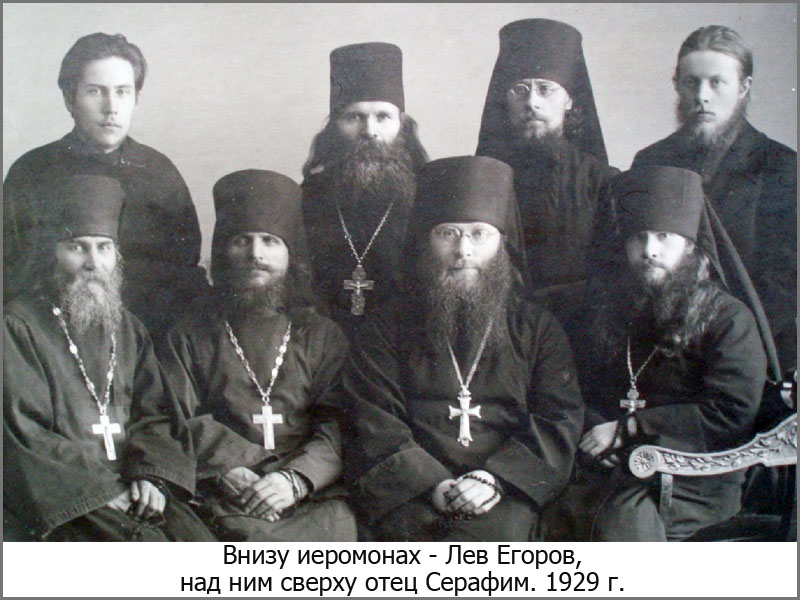
The founders of the brotherhood were three hieromonks — Gury and Lev (Egorov) and Innokenty (Tikhonov), three remarkable people. The young Sergius was to meet them, and this meeting greatly influenced his further life. He soon became a member of the brotherhood himself, and even headed a youth circle. By self-education he raised his knowledge to the level of the seminary course. In 1927 Sergius learned of the existence in Leningrad, at the Estonian church, of Higher Theological Courses, whose rector was Archpriest N. Chukov. With the blessing of Bishop Viktor of Glazov, who was administering the Vyatka Diocese, he entered these courses, but managed to study only one year. In 1928 the Theological Courses were closed, and afterwards Sergius laboured in the church of the Feodorovsky Metochion in Leningrad[12]. There he continued his study of musical notation under the well-known choir director and church composer Fateev and directed the choir. Those who sang and served with him then preserved the warmest memories of the priest.
At this same time Sergius became acquainted with Hieromonk Gury Egorov (the future Bishop of Tashkent) and Veniamin (the future Bishop of Kirov and Slobodskoy). The story of their acquaintance is interesting. The Alexander Nevsky Lavra was then in the hands of the Renovationists, and the brethren who remained faithful to Orthodoxy had scattered in all directions. People lived in attics and cellars; Sergius spent the winter in an unheated watchman's lodge at a church. Only a few churches remained Orthodox at that time, among them the Feodorovsky, whose rector was then Archimandrite Lev (Egorov). And when he lost his place in the lodge and had nowhere to spend the night, Hieromonk Gury, seeing his plight, said that he would take Sergius to a place where a certain remarkable man lived. They went, climbed up to some attic, and Hieromonk Gury introduced Sergius to Vladyka Veniamin. The Vladyka received him kindly, and they began to live together. Sergius slept on an iron bench at the Vladyka's head. From that time they were bound spiritually. The Vladyka became his spiritual father, and Sergius was to the Vladyka like a son of his own. At that time Father Mikhail came to Leningrad and told his son that it was time to decide: either to marry and become a priest, or to take monastic tonsure. Sergius proposed to a girl from the choir, but she was afraid to become a priest's wife and on that ground refused him.[13]
According to Father Seraphim's own recollections, his acquaintance with the church world of Leningrad led him to decide on tonsure. In spring, on 12 April 1929, with the blessing of Metropolitan Seraphim (Chichagov) of Leningrad, Archimandrite Lev Egorov tonsured Sergius a monk at the Feodorovsky Metochion with the name Seraphim, in honour of the Venerable Seraphim of Sarov. On 14 April 1929 Bishop Sergius (Zenkevich) of Kargopol ordained Father Seraphim hierodeacon at the Feodorovsky Metochion. Besides the regular services, Hierodeacon Seraphim carried out the duties of sacristan and directed the choir. A year after his tonsure the rector of the metochion, Archimandrite Lev Egorov, laid on him the obedience of directing the choir of singers, which he fulfilled until moving to another church. On the rector's recommendation, on 4 April 1931 Metropolitan Seraphim (Chichagov) of Leningrad and Gdov ordained him hieromonk[14]. After his tonsure Father Seraphim served in the Feodorovsky church. In 1932 the Metropolitan appointed him rector of the Tikhvin Church in the settlement of “Lesnoe,” near Leningrad, but he stayed here only a short time, just two weeks. In February 1932 he was arrested and sentenced by a resolution of the OGPU Troika to five years of imprisonment under Article 58 (paragraphs 10 and 11)[15]. Father Seraphim felt that they must come for him — he did not go to bed, his things were already packed. The priest served his term in the Svir corrective labour concentration camp until 28 December 1936, working at logging. There he froze his hands and feet, and they hurt him all his life afterwards. In general, the priest's endurance and patience were amazing; he knew how to bear pain as few can and never showed or said that he was in pain. In the barracks he unfailingly kept the monastic rule, standing in a corner and praying; at first they jeered at him, then grew used to it. There was one archimandrite with him; they served together and performed the services for the faithful. On feast days they gathered in the forest, prayed and sang. Father Seraphim told how one Pascha stuck in his memory: they served in the forest, everyone sang “Christ is risen,” and then they broke the fast with millet porridge, and that it was some amazing joy and grace.
After his release from imprisonment he returned to his homeland, Slobodskoy. Soon, at the personal request and wish of the parishioners, he was appointed by Archbishop Cyprian of Kirov and Slobodskoy to the vacant post of priest at the Catherine Cathedral of the city of Slobodskoy. But again not for long: on 12 July 1938 he was arrested again and by a resolution of the special collegium of the regional court of the Kirov Region of 19 November 1938 was sentenced to 10 years of imprisonment. The priest served his second term on the Pechora in the Komi ASSR, in the Northern Railway Camp, working there as a tally clerk and pharmacist[16]. On 18 February 1943, the day of commemoration of St. Theodosius of Chernigov, a tree fell on Father Seraphim during work and crippled him. After this event, on 14 April 1943, the priest was released as incapable of work. Father Seraphim again returned to Slobodskoy, and in August 1943 Bishop Veniamin of Kirov appointed him rector of the Trinity Cathedral in the village of Bystritsa, Orichi district, in the Kirov Region[17]. The priest set parish life in order and created and trained a good choir. From 1943 to 1947 he served daily. At Pascha in 1944, on the recommendation of Bishop Veniamin, he was awarded a golden pectoral cross for pious service to the Church of God, zealous fulfilment of pastoral duties and the liquidation of the Viktorian schism, since he had brought back the greater part of the church community that had split away during the time of Renovationism. During the years of the Great Patriotic War, by his patriotic sermons among the parishioners, he called for the defence of the native fatherland and collected many funds and donations for military needs and for the help of orphaned families. For these labours in 1947 Father Seraphim was awarded the medal “For Valiant Labour in the Great Patriotic War of 1941–1945.” From 1945 to 1948, by election of the clergy, Father Seraphim performed the duties of spiritual father of the clergy of the Orichi district deanery in the Kirov Region.[18]
While serving in Bystritsa, Father Seraphim learned that the Trinity-St. Sergius Lavra was beginning to revive and that Archimandrite Gury (Egorov), known to him from the Alexander Nevsky Lavra, had been appointed its superior. He wrote a letter to Archimandrite Gury: “From the Journal of the Moscow Patriarchate and from our Vladyka I learned of your present ministry and was very glad. Perhaps the Lord will pass me from one brother to another? The Trinity-St. Sergius Lavra is nearer, and the Venerable Sergius is my heavenly patron, whose name I bore before monasticism, and you are there the organizer of the monastery — a father to whom it is closest for me to turn, after Father Lev (Egorov). Our Vladyka Veniamin has blessed me to turn to you. If you find it timely and useful for the salvation of my soul that I enter your monastery at the present time — bless it! Wearied by life in the world, in need of spiritual guidance, I most humbly ask Your Reverence to receive me into the number of the brethren of the Trinity-St. Sergius Lavra under your care”[19]. But these hopes were not destined to come true. This letter was written in July 1946, and a month later Archimandrite Gury was appointed bishop of the Central Asian Diocese, and he began to call Father Seraphim to him in Tashkent. Vladyka Gury wrote to him: “The need for such a man as you is enormous. We cannot find anyone suitable for the left choir of our Cathedral. This must be not merely a choir director but an inspirer of the divine service and of congregational singing. With this work (which, I know, is well known to you) is combined another ministry — that of sacristan of the Cathedral. I await you as a teacher at the Theological and Pastoral Courses and intend to appoint you a member of the Diocesan Council. So you must work in Tashkent. Church need requires this — it is necessary for you as well. Help to make the Cathedral services exemplary. Our Cathedral sets the tone and example for the 66 parishes of our diocese.”[20]
In 1948 Bishop Gury wrote to Bishop Veniamin of Kirov and Slobodskoy asking him to release Father Seraphim to labour in the Central Asian Diocese, which was by then in a state of decline. Bishop Gury set himself the aim of gathering like-minded people around him for the revival of spiritual life in the diocese. In reply, Archbishop Veniamin of Kirov and Slobodskoy wrote to Bishop Gury: “It is with great regret and sorrow that I give my consent to Hieromonk Seraphim’s transfer to your Diocese. I am losing the best of my fellow workers in ‘God’s Field,’ but may God’s will be done.”[21] In November Father Seraphim was released at his own request with the right to transfer to another diocese, and he set off for Central Asia.
When Father Seraphim arrived in Tashkent, he was offered the post of diocesan secretary at the bishop’s side, but he asked for a place where he could serve every day and be closer to the people. Granting Father Seraphim’s request, Bishop Gury sent him to the Church of the Great Martyr and Victorious George in Samarkand, where he was to serve for 30 years.[22] On 3 December 1948 Father Seraphim arrived in Samarkand with a small suitcase, just in time for the All-Night Vigil on the eve of the feast of the Entry of the Most Holy Mother of God into the Temple. The batiushka immediately took his place in the choir and began to sing with everyone else. After the Vigil the rector of the church, Father Pyotr Knyazhinsky, went up to the unknown hieromonk and, thanking him, said that the bishop had long been promising to give the Church of St. George a second priest.
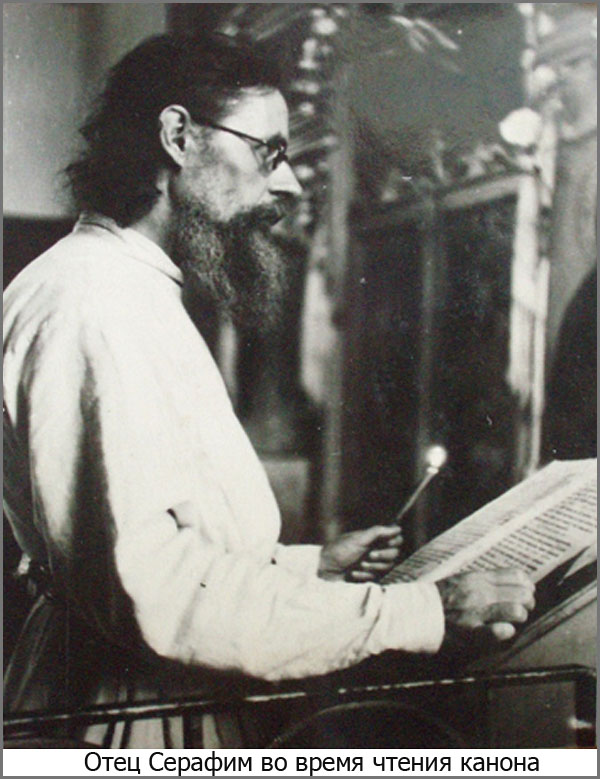
Father Seraphim replied that he was that very priest whom the bishop had sent: “I ask that you love and favour me.” Father Pyotr answered that we would be favourable to him, but love must be earned. The batiushka very soon earned that love: he won everyone over by his attentiveness and care, by his readiness never to refuse anyone, with no thought for himself. He earned it by his cheerful and sociable character. A few weeks after his appointment Father Seraphim wrote to Bishop Gury from the Samarkand church: “I ask for your Grace’s blessing on my new place of residence! Glory to God, I have been registered. Now I have calmed down a little. I thank God, and I thank you, Holy Vladyka, for having settled me here. I am still taking everything in, getting to know everyone around me. And my first impression is that I want to give thanks for everything. Father Pyotr received me most warmly and shows me fatherly care in everything. The matushkas likewise show great concern for my settling in. Father Pyotr’s tender, thankful disposition, both during the services and at prayer in his cell, and so throughout the day, is very touching and pleasant to me, for I have grown quite numb in my literalistic, rubrical self-satisfaction. I like the church. The services could be embellished somewhat. The courtyard, however, makes no especially good impression; more trees need to be planted.”[23]
Having arrived in Samarkand, the batiushka did not break his ties with the Vyatka Diocese and his former spiritual children. He did not forget his former flock and regularly sent Paschal greetings to the church’s address, and his congratulations always arrived on time.
At first Father Seraphim served in the Church of St. George as the second priest, helping the elderly Father Pyotr. It was as if he had no cares of his own: he lived by the joys and troubles of his parishioners and spiritual children. It is no exaggeration to say that in time the batiushka knew practically his entire parish; there was hardly a home he had not visited, entering into the details of its life.[24] Very often he was called to administer Unction or Communion at home, and he went to them on foot. He only asked to be given guides to show him the way to the sick person. Father Seraphim knew of those in need and helped them, for in those years many lived on the edge of poverty. He said that we must seek out such people and give them our love, and contribute our mite. The batiushka often received money transfers from benefactors and various people. But the money did not stay with him: on his table lay a whole stack of blank money-transfer forms, and every time his faithful helper Nina Sakmarkina, when going into town, sent the batiushka’s money to the addresses. He sent it to the families of priests who were in prison or had been deprived of the right to serve by the commissioners, and distributed it to the poor and needy, and to monasteries. Old parishioners told me that when their families were in difficult circumstances, they would find envelopes of money in their mailboxes, and later guessed that this was help from Batiushka Seraphim.
Father Seraphim was greatly tormented by his sore legs. The years spent in the camps and his injury made themselves felt. However much the batiushka was ill, however he suffered from the trophic ulcers on his legs, he always joked, always cheered everyone up; his soul was always smiling and went out to meet everyone, like the soul of a child longing to give his affection and love to those around him. He was always Paschally joyful. By his very appearance he instilled in the human soul — sinful, restless, worn and soiled by sorrows and by life — hope, the joy of being, and consolation. The services in the church were held without days off, according to the monastic rule, without abbreviations, and the whole atmosphere there was monastic as well — a remarkable island of grace in the world.
The batiushka hurries to church, the service begins: he sings, reads and speaks the exclamations himself, with only the altar server, Nun Rafaila, assisting him. For him this was truly joy and life. Father Seraphim served not formally but with incredible spiritual uplift, with tears in his eyes, heartfeltly. Even when he was not celebrating the services himself, he was still in church and sang in the choir. And how the batiushka loved feast days! He had the rarest quality — the ability to create a festive atmosphere. As all the parishioners loved such days, the batiushka had instilled this love in them. The icons in the church were decorated with fresh flowers. Everyone looked forward to the feasts and actively prepared for them, and each made his contribution. Being an expert in church singing, with a good voice and an excellent ear, he taught the people to sing almost the entire Liturgy and a great deal of the chants of the All-Night Vigil. Therefore at festal services, when the church was full, the service was a service of the whole people. The people took part in it, and this was especially solemn — a feeling of prayerful unity arose. The whole church sang with him. Father Seraphim paid very great attention to church singing, tried to make the choir sing harmoniously and beautifully, wrote out the music himself and drew those capable of singing to the choir. After the service the numerous requests for services began. Father Seraphim loved to baptize and especially to marry. Before performing the Sacraments he held talks; he baptized adults only after a long preliminary talk and questioning. Many, after the batiushka’s talks, afterwards became parishioners of the church. In the first years of his ministry, at the bishop’s request, Father Seraphim travelled a great deal to the parishes of the diocese and helped to set up church singing. At that time he also took an active part in the “Diocesan Herald” published by Bishop Gury, and wrote many articles for it himself. At Pascha in 1950 Father Seraphim was awarded a certificate by His Holiness Patriarch Alexy, which hung under glass in his cell.
His first five years of ministry in Samarkand coincided with the ministry of Archimandrite Hermogenes (Golubev), who was rector of the neighbouring church, the Cathedral of the Protection of the Mother of God. During those years they came to know each other well. When travelling to Tashkent, Father Seraphim regularly stayed with Father Boris Kholchev. He himself used to say that he and Father Boris confessed to each other.
In 1953 a sad event occurred: during Great Lent Father Seraphim’s mother, whom he loved very much, died. He grieved greatly that he had not been able to travel to her funeral. On 12 July 1953, by the blessing of His Holiness Patriarch Alexy, in time for the holy day of Pascha, Hieromonk Seraphim was raised by Bishop Hermogenes to the rank of Hegumen. Over the whole time of his ministry Batiushka Seraphim was awarded four Patriarchal certificates. In 1954 he was appointed first as acting dean in place of Father Pyotr, and two years later he was confirmed in this post.[25] In April 1956 he was appointed a member of the Diocesan Council.
In June 1958 the elderly rector of the Church of the Great Martyr George, Father Pyotr Knyazhinsky, died, and the whole community wrote a letter to Bishop Hermogenes in Tashkent, in which they made a fervent request — to confirm Father Hegumen Seraphim as rector of the orphaned parish: “Father Hegumen Seraphim not only knows the names of almost all the parishioners from young to old, but he also knows our souls, since for 10 years he has been the spiritual father of almost our entire community. In the person of Father Seraphim, dear and beloved by all, we fear to lose him, our intercessor and a well-wisher to all, whose loss would weigh heavily on the spiritual life and cohesion of our community.”[26] In November of that year the bishop confirmed Father Seraphim as rector. And in the same year, on the recommendation of Bishop Hermogenes, the batiushka was awarded by His Holiness Patriarch Alexy a cross with decorations. On 31 May 1959 Bishop Hermogenes raised Father Seraphim to the rank of Archimandrite. In the same year, in the 30th year of his monasticism, the batiushka began to suffer a grave heart illness, which did not leave him until the end of his days. Two non-healing wounds opened on his legs, because of which he was forced to conduct services standing on one leg, in very severe pain. When it became really bad, he allowed himself to sit during the moleben.
And in January 1961, before Great Lent, a new trial came: Father Seraphim was summoned by the commissioner for a conversation. He told the batiushka that he needed information on the income and attendance statistics of all the Samarkand churches. A month later he summoned Father Seraphim again and, now in raised tones, began to demand that he not admit young people to the church. Father Seraphim considered such actions impossible for a priest, citing the legislation. Realizing that it was useless to influence Father Seraphim either by persuasion or by pressure, the commissioner resolved the matter otherwise. Summoning the batiushka a third time, he took away his certificate of registration, listing for him a series of absurd accusations, saying that Father Seraphim was luring young people into the church, engaged in extortion, and had illegally acquired a house for the church and the clergy, and so on. At the end of the conversation the commissioner declared to Father Seraphim that there was no place for him in the Central Asian Diocese. This happened on 11 March 1961, a few weeks before the bright feast of Pascha.[27]
After such a turn of events Father Seraphim was left without a post and could no longer serve. It was a terrible blow both for Father Seraphim and for the nuns who served at the church and for all the parishioners. A battle for the church began, since the authorities planned to use the church building as a kindergarten. Now Archimandrite Seraphim was listed at the Church of St. George prayer house as a hired choir director.[28] The batiushka wrote a petition addressed to the Patriarch, the parishioners wrote letters to various bodies, and the church warden went to Moscow with papers and documents to appeal to the Council for Religious Affairs. The point was that officially the church had not been closed, but no priest was being given. By Father Seraphim’s blessing services were held in the church, except for the Liturgy. The batiushka himself would enter the church, stand in a corner and pray tearfully, taking what was happening very hard. Yet in his cell, in secret, he continued to celebrate the Liturgy every day on the antimension. But the city authorities expressed displeasure that he continued to live in Samarkand and tried to bring pressure on him through Bishop Gavriil. In this very difficult period of Archimandrite Seraphim’s life he wrote to the bishop in Tashkent that he was in low spirits and felt a need for rest, and that he wished to visit his homeland. In conclusion he wrote: “But who will remain here? There is no choir, there is no one responsible and able to lead the service. The church will fall. All these considerations compel me to remain here.”[29] Closer to autumn, after the feast of the Dormition of the Mother of God, Father Seraphim took leave on the bishop’s advice and went to his homeland. He stayed with his only surviving sister at that time, who lived in the city of Kirov. There Batiushka Seraphim lived all winter and tried to visit the local commissioner in the hope of obtaining a place in one of the parishes. But he was refused.[30]
After he was deprived of registration, he could serve either as a chanter or as a choir director, but not as a priest. The uncertainty tormented Father Seraphim, and in the end he decided, after all, to return to the Samarkand church. One circumstance influenced this decision. In a letter to the bishop, Matushka Evdokia wrote that Batiushka Seraphim could not leave for another place until he had laid to rest the much-suffering elder, Matushka Iunia, and that this was precisely the main reason that kept him in Samarkand.[31]
Only at the end of December 1962 did Bishop Gavriil send Father Seraphim to serve temporarily for the Christmas feasts in the town of Kagan. In March 1964 Father Seraphim and all who lived in the church courtyard were summoned to the city council and, under threat of the case being handed to the court, were told to vacate the premises they occupied within five days. The point was that the authorities had then raised the question of merging the Church of St. George parish with the Protection parish. But Batiushka Seraphim and the nuns decided not to leave the territory of their church enclosure.[32]
So that services might continue in the church, the dean, Archimandrite Claudian (Modenov), proposed urgently ordaining to the priesthood a young deacon from the Cathedral of the Protection, Father Alexander Kerimov. Father Alexander began to serve in the Church of St. George, but he travelled to Moscow twice a year to take seminary examinations. In November 1964 Matushka Evdokia resolved to write a letter to Bishop Gavriil, in which she asked him to allow Father Seraphim to serve, at least replacing Father Alexander in his absence, and later to keep Father Seraphim as second priest.[33]
Four years of wanderings and waiting passed, and at last, by the bishop’s order of 29 March 1965, the retired Archimandrite Seraphim was temporarily appointed second priest of the Church of St. George. The battle for the church had lasted more than three years, and in the end the parish held out and emerged from its trials more closely knit; people came to love their church — this island of grace — even more. One can imagine what joy and rejoicing there was among the parishioners and all of Father Seraphim’s spiritual children. And a year later Batiushka Seraphim was again restored to the post of rector of the church.[34]
Every day Father Seraphim recited one remarkable prayer of thanksgiving, in which he thanked the Lord for having granted him, by His great mercy to him, to walk the monastic path, for having granted him to be a priest, and for everything that had been sent that day. He kept his rule of prayer unfailingly, regardless of the state of his health. It was the batiushka’s custom that all who wished to pray could gather for the evening rule and for his blessing. Before it began a novice rang a small bell, and everyone gathered on the terrace. Then the batiushka invited everyone into the first room of the cell, stood before the icons in the corner, and all together sang “O Heavenly King,” the troparia to the Great Martyr George and to Venerable Sergius. The batiushka would commemorate the names of his loved ones and of all those present. Then everyone came up in turn to the batiushka; he held in his hands an icon of the Great Martyr George with scenes from his life, blessed each person and let them kiss it. After this everyone went into the batiushka’s cell for the rule. What reverence everyone had! All who wished could take part in the reading. All who attended these readings remembered them for the rest of their lives, with what joy and radiance they came out from there. At the end of the prayers the batiushka prayed for all who were present, naming each by name. After this everyone came to the batiushka for a blessing and kissed the crucifix lying on the lectern. Then Father Seraphim took the Iveron icon of the Mother of God and again blessed each person with the icon, letting them kiss it and calling each by name, almost always affectionately. What joy was kindled in hearts after such a blessing!
With what tenderness, love and care the batiushka treated children; he always rejoiced when they came to church, always asked their parents how the little ones were, remembered them all, and gave them treats. He would gather the children after the service, talk with them and lead them to the door of his cell. Then he would bring out either children’s books or sweets and give a gift to each. He also keenly felt the beauty of God’s world and loved fresh flowers very much. Under him the whole area around the church was abundantly planted with various flowers. Father Seraphim also collected information on the history of the Church of St. George and on the priests who had served in it. For all his busyness, the batiushka always found time for reading. He had a very good library of spiritual and classical literature, which his spiritual children could also use. He often called himself a cheerful monk, and he urged his spiritual children to rejoice more often in life, to live more simply and to be humble. After the batiushka’s departure, his altar server, Nun Rafaila, and the church warden recounted that when Father Seraphim stood in the altar kneeling and praying, his prayer was always fervent. During prayers in the altar he often wept; during the sermon and the reading of the Gospel he could not hold back his tears, so deeply did he feel in his heart what he spoke of. His sermons were inspired and filled with inner fire. Eyewitnesses recall that he knew the Gospel by heart, as well as the akathists and canons. On entering the church he placed 12 candles every day, before some icons constantly and before the rest according to a rule known only to him. After his repose a small box of money was left on the table in his cell, bearing the inscription “for candles.” From the day of the batiushka’s repose, money was taken from this box every day and 12 candles were placed with it, as he himself had done in his lifetime, and, interestingly, the money lasted exactly forty days. Toward the end of his life the batiushka went almost blind from tears.[35]
He felt his approaching end; his heart attacks were terrible. Each time it seemed that the last minutes had come. The batiushka endured — not a groan, not a complaint; for the last forty days he could not get out of bed — the attacks followed one after another — but he demanded that people be admitted to him for parting words and a blessing. At the feast of the Nativity of Christ in 1979 Father Seraphim caught a cold and as a result fell ill with pneumonia. During the attacks his shirt became wet, but he was embarrassed to speak of this to those who cared for him. He kissed the hands of all who changed his clothes and treated him. For the last few days the attacks came one after another, and those looking after him hardly slept. One of the wounds on his leg began to close, and the batiushka said that this was a sign of the end. On 20 February pulmonary edema began and bloody foam came from his mouth; at 12 o’clock at night he asked everyone to leave, saying that he wanted to sleep. Evidently he sensed his approaching end. When they came to him at about 2 o’clock, he was no longer breathing. This happened on 21 February 1979. The community lost its beloved batiushka — Father Seraphim.
By the instruction of Vladyka, Archbishop Bartholomew, priests were sent from Tashkent to accompany on his last journey the pastor who had given the greater part of his life to the service of the Lord and of people. The burial was performed by Archpriest Georgy Kaspersky and several Samarkand priests. The rector of the Samarkand Cathedral of the Protection, Hegumen Sergius (Ryabtsev), said at the funeral: “Father Seraphim always walked before the face of the Lord, teaching his numerous flock love for God and for people, and the daily awareness of God’s omnipresence.”
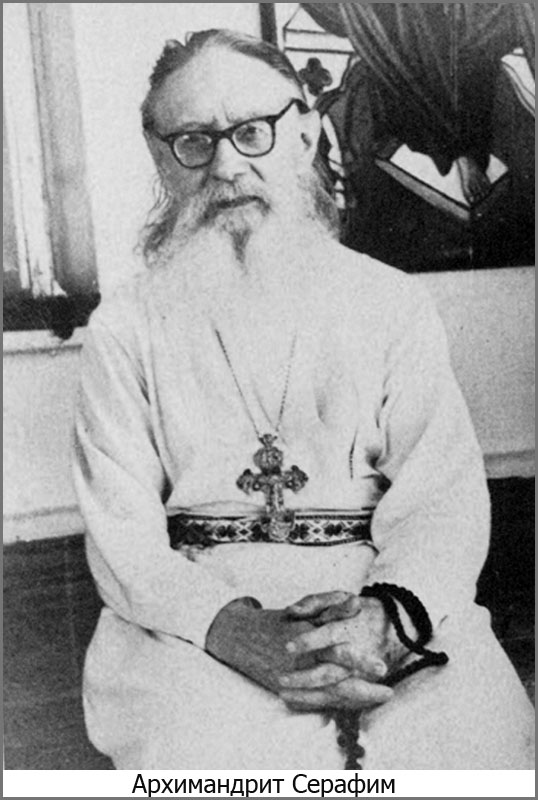
Father Seraphim was buried with the monastic rite. He was laid to rest in the cemetery not far from the church, in the same enclosure with people dear and close to his heart — Father Pyotr Knyazhinsky, a remarkable priest, Nun Evdokia and Nun Iunia, the founder and first warden of the Church of the Holy Great Martyr and Victorious George. All these people, who had passed through persecution, repression and the camps and found themselves in exile, did not merely survive but lived a full, genuine life. The batiushka left no testament, but perhaps not by chance a sheet of paper was found in his cell. Before his death he had placed under the glass on his table a sheet of paper with a poem of 1854 by the Russian poet Alexei Khomyakov, copied out in his own hand, which better than any testament instructs us and shows what inheritance we should receive from our dear batiushka, Father Seraphim.
“THE FEAT”
There is a feat in battle, and a feat in struggle too;
The highest feat is in patience, in love and in prayer.
If your heart aches before the malice of men,
or doubt has seized you in a chain of steel;
If earthly sorrows have pierced your heart like a sting,
take up the feat with faith, vigorous and bold.
The feat has wings, and you will soar upon them,
without toil, without effort, above earthly fears.
Above the roof of the dungeon, above the malice of men,
above the wails and cries of the proud earthly rabble.
There is a feat in battle, and a feat in struggle too;
The highest feat is in patience, in Love and in prayer! [36]
After dear Father Seraphim, beloved by all, was buried, the place of his burial became much visited by Orthodox Christians and Muslims alike. And all these years people continue to come to him with their troubles and joys, and many receive help after praying there. We are now gathering testimonies of cases of miraculous help from Archimandrite Seraphim.
Memories from early childhood
of Priest Viktor Panchenko.
“Archimandrite Seraphim baptized me in infancy. I remember myself from the age of three, I remember how on Sundays and feast days my grandmother and I regularly went to the Church of St. George, where Father Seraphim served. I remember his kind, ever so kind eyes, his quiet and gentle voice… All the parishioners loved him. Even the birds loved him. When he came out of the church into the little yard, little birds would settle on his frail shoulders (and he was not tall), and he fed them from his hands. I remember his instructions — not to hurt animals, especially little birds, for they too (animals) have little souls. Yes, I remember that for each of the children he had in his pocket either a sweet or a little cookie. And with what love he blessed people, especially little children! Everything pure that I have is from Batiushka Seraphim. I have carried respect and love for him through my whole life. Later, being a priest myself, I was repeatedly a witness to how Uzbek women came to his grave and prayed there, and I personally heard that some of them were healed of their illnesses.”
From the recollections of the right-choir director
Lyudmila Zhuchkova
Father Seraphim spent the greater part of his service to God in the Church of St. George in Samarkand. Throughout all those years the batiushka won gratitude and love by his attention and sensitive attitude toward his flock.
My dear mother, Olga Nikitichna Zhuchkova, was evacuated during the war with three children from Minsk to Samarkand. Since she loved children very much, she was taken on to work in a kindergarten, where she laboured for 40 years. Our family’s patron was and is St. George the Victorious. Olyushka — as Batiushka Seraphim called her — attended the Church of St. George. Mother loved God and praised Him every free minute. She sang in the left choir, and her voice rang like a little bell — she had a lyric soprano. At the sight of her the batiushka would say: “Olyushka has come — our little bell.” Batiushka Seraphim tirelessly taught the people to sing, giving this great attention. He studied the tones, prayers and so on together with everyone. Much music was written out by him himself. He gathered the right choir bit by bit, and for support he also organized a left choir from among the parishioners. The right choir sang on feast days and Sundays, while the left sang on weekdays as well. The choir was made up not of professionals but of enthusiasts, but the main thing was that everyone loved choral church singing. Thanks to frequent rehearsals, which Father Seraphim himself invariably attended, the choir sounded beautiful and well-honed. Despite his great busyness and poor health, he regularly attended our rehearsals.
Hegumen Seraphim baptized me in childhood and was himself my godfather. Already at the age of five he blessed me for the “kliros.” At that time, naturally, I understood nothing about singing. Specially for me a little bench was placed by the music stand so that I could see the notes, and they said: “Look! We are singing here!” After the service I would go up to the batiushka in tears, because I could not make anything out. But he would calm me and say: “Everything will work out for you; Moscow wasn’t built in a day. You will see, Lyudochka — you will be a splendid choir singer.” I, a child, was given one ruble for the evening and morning services. I did not want to take the money, but the batiushka said: “You labour, you try hard, and that should be rewarded.”
My grandmother, Anastasia Sklyarenko, was a singer in a Moscow cathedral. God always accompanied our family in singing, and we in our turn praised Him.
Batiushka Seraphim loved children very much. I would run with my girlfriends from school not home but to the church, to my godfather. He would sit us down at the table, set out tea and rusks, and after that our conversation began. The batiushka asked about our studies, about the day just past, joked affectionately. And before we left he would cut roses for us, and we ran home happy. On one’s name day the batiushka would certainly give the celebrant a large prosphora and a book by some “classic” author whom we were studying in the school programme. He gave me a book with the inscription: “To dear girl Lyudushka from Hegumen Seraphim.” How much joy we had then. And when on my 16th birthday I ran home, a big surprise was waiting for me — a brand-new “Belarus” piano. Later I learned that it was the batiushka who had helped my mother to acquire such an expensive gift for me.
After finishing school I had no dilemma about where to go to study. I graduated from the music college in the “choral conducting” class and, by Father Seraphim’s blessing, became the director of the right choir. Thanks to him I began to study music, and it became the work of my whole life. For me he was not only a godfather but also a Teacher and Mentor.
Batiushka Seraphim introduced a rule — on Tuesdays to sing and read the Akathist to St. George the Victorious, the heavenly patron of the church. And people came to offer praise to the Great Saint.
The right choir sang for pay. It once happened that the “Bass,” invited to sing from the opera theatre, began to complain about the low pay for his labours, and then the batiushka began to top it up from his own salary. “The bass! He is the ornament of the choir!” he would say. Batiushka Seraphim himself had a beautiful baritone, and he had perfect pitch and was extremely sensitive to any false note in the sound of the choir. Thanks to the batiushka’s refined taste and labours, singing in the church was always maintained at a proper level. “Only rehearsals,” he said, “can put everything right.”
Father Seraphim supported his parishioners in every way, both morally and materially, knowing his flock well. People strove to come to him for confession and were drawn to him. And they found in their batiushka attention, consolation and tenderness. He was a kind and responsive pastor to all the parishioners. All the people came to him with their pressing problems, and each received an answer to his question. Father Seraphim knew how to listen patiently to whoever came, and all disputes and conflicts that arose he resolved peacefully, taking into account the opinion of the parishioners themselves.
He was a very hard-working, diligent man, and it was unclear where he found the strength and when he rested. During singing the batiushka would put his sore leg on a little stool so that it would trouble him less. And in the last days of his life, when he was no longer able to serve, he listened to the service and the singing sitting by the window of his cell.
Tatiana Alexandrovna Kavelina.
Not long ago, on Radonitsa, I had the good fortune to meet an interesting woman. And, characteristically, this meeting took place near the burial place of Father Pyotr and Archimandrite Seraphim. The thing is that literally two metres from them there is a grave on whose fence an old wooden church cross is fixed. And always, when visiting the graves of the priests and nuns, I looked at this cross wondering who was buried here.
Alevtina Alexandrovna, as this woman was called, had come with her children to the grave of her mother, Tatiana Alexandrovna Kavelina. I could not restrain myself and struck up a conversation with her. Alevtina Alexandrovna told me that her mother had had the most direct connection with the church. For a number of years her mother was not simply an active parishioner but took the most active part in the life of the church. She related that after her death her mother’s body spent the whole night in the Church of St. George, that the Psalter was read, and the next day she was escorted with honours and prayerful chanting to this place, with a great gathering of people. Alevtina Alexandrovna also said that she personally remembers both Father Pyotr and the nuns Iunia and Evdokia, and Batiushka Seraphim. I wanted to hear from her as many details as possible about these people and her mother. Our first meeting was brief, and we agreed with Alevtina Alexandrovna to meet again soon.
Our second meeting turned out to be much more interesting than I could have expected. Alevtina Alexandrovna had prepared for my visit. First she showed me the Patriarchal Certificate (signed by Patriarch Pimen) with which her mother had been awarded in 1982. After that we looked at old family photographs, and Alevtina Alexandrovna commented on them. In the course of our conversation it became clear that her ancestry is very rich in famous names and people. On her mother’s side, this is the famous merchant family of the Morozovs, from which came well-known industrialists, patrons of the arts and scholars. On her father’s side, the Kavelin family were military men, scholars and theologians. One of them, Archimandrite Leonid (Lev Alexandrovich Kavelin), was rector of the Trinity-St. Sergius Lavra and Head of the Russian Orthodox Mission in Jerusalem. The well-known Orthodox theologian Archbishop Basil Krivoshein was her mother’s cousin. But life turned out in such a way that for many years one could not even mention one’s glorious ancestors.
Alevtina Alexandrovna told the story of her family and her mother, Tatiana Alexandrovna.
Moscow, the early thirties; she lived with her parents in a house near Petrovsky Park. The young Tatiana, who had studied for only a year at the courses of the Higher Literary and Artistic Institute, whose organizer and head was the well-known poet V. Ya. Bryusov (later the A. M. Gorky Literary Institute), was arrested and put in Butyrka prison. In her cell in Butyrka she found herself together with nuns. Awaiting their fate, the nuns did needlework and wove prayer ropes. From them Tatiana learned the technique of embroidery on fabric.
The thing is that she attended the church of St. Mitrophan, where she had begun to sing in the choir. The rector of the church, Vladimir Medvedyuk, was arrested in 1931 and sent to Solovki. Tatiana was also taken in a case connected with the church. During interrogation the investigators tried to induce her to slander the rector of the church, but Tatiana replied that she knew nothing. By a Special Council of the OGPU commission, on 16 May 1932 she was convicted under Article 57-II and exiled for three years to Central Asia, to settlement in Bek-Budi (since 1937 the city of Karshi). When she was exiled she was only twenty years old. A girl from a well-off family, finding herself far from her native home, in new, unfamiliar conditions, had to learn everything.
Released at the end of her term in 1935, she remained to live in Central Asia. The exiles lived here in small colonies, and among them were many interesting and remarkable people. Here too she met her future husband, Alexander, who had come to Central Asia following his exiled parents. Her husband’s father had been a priest in Samara Governorate.
At first the newlyweds lived in a mud-brick hut with an earthen floor and an unpanelled ceiling. All around were great numbers of snakes and scorpions. The domestic side of the young family’s life was unsettled, with constant moves from place to place: Karshi, Bek Budi, Katta-Kurgan, Samarkand. But Tatiana and Alexander were young and cheerful and paid no attention to domestic difficulties; what mattered was mutual understanding. In general there was never in Tatiana’s character any attachment to things, however valuable they might be.
In June 1941 their third child was born. The war began, and already in July 1941 Alexander was mobilized to the front. Tatiana was left with three children, each smaller than the last. And then it was as for many: waiting for news from the front, anguish, worry about what to feed the children.
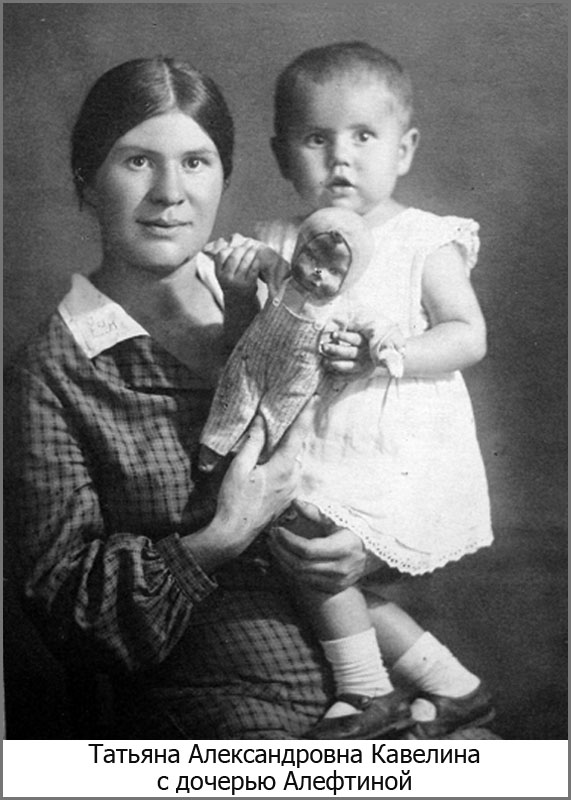
Alexander was killed in December 1942, but Tatiana learned of this later. At that time one of their sons died too… But it was necessary to go on living, working and raising the children. Life was very hard then; they went hungry and ate oilcake. They had to stand in night queues for bread and then fear that the last piece would be taken away on the way. What was there then to feed the children? Tatiana refused for a long time to believe that her husband had been killed, and went on waiting for him for many more years, hoping for a miracle. Until the end of the war she lived together with her husband’s parents in Samarkand, in the Bagishamal district, near the Agricultural Institute. Next door lived the family of an exiled priest, Ioann Alexandrovich Ankirsky. The priest lived with his wife, Anna Alexandrovna, and three children. Another interesting person also lived in the neighbourhood, a Muscovite, Protodeacon Alexei Vladimirovich Schenrock. A native of Moscow, Father Alexei had been brought up in a Lutheran family. He was the son of a well-known historian of literature. While studying at Moscow University he became a member of the religious and philosophical circle organized by the priest Father Boris (Kholchev) at the church of St. Nicholas on Maroseyka. Under the influence of Father Boris he converted from Lutheranism to Orthodoxy. In the early thirties, remaining celibate, Father Alexei accepted the diaconate. He too was exiled to Central Asia from Moscow in the early thirties, and also to Bek-Budi, on the charge of “membership in an Orthodox-monarchist counter-revolutionary organization.” Alexei Vladimirovich was a man of books — extraordinarily erudite, with an encyclopedic mind. He was exceedingly modest and undemanding in everyday life. He had no family of his own, and he helped his sister to raise her children. Terribly short-sighted, he never parted with a book. Passers-by often saw the picture of a strange man walking down the street with his nose in a book, in galoshes tied to his feet with elastic bands.
Alexei Vladimirovich Schenrock combined teaching Latin and German at the University with service in the Church of St. George. In the last years of his life he suffered from severe atherosclerosis and could no longer serve.
Tatiana’s father-in-law, the priest Alexander Nikolaevich Shcherbakov, served until 1930 as rector of the Church of the Meeting of the Lord in the village of Borskoe, Samara Governorate. He was exiled to Central Asia and deprived of the right to serve in church, but he secretly performed all the services at home. The children were strictly forbidden to touch or look behind the little curtain. In the room a special corner was screened off by a curtain, serving as the altar of the home church. In 1945 Alexander’s parents returned to Samara, and after that Tatiana, left alone, began to attend church actively. At first she went with the children to the Cathedral of the Protection or to the church at the railway station. But in time she became a parishioner of the Church of St. George. Originally the building of this church was unsuitable and cramped, but gradually, with the parishioners’ money, they began to build a new building. As for the greatest of feasts, everyone eagerly awaited the completion of the construction and the consecration of the new church building.
For many years Tatiana Alexandrovna worked as an accountant at the Samarkand Tea Factory, but in 1962, in the wave of Khrushchev’s persecutions, she was dismissed from her job for her religious convictions. Some time later she was invited to work as an accountant at GiproVodKhoz. All her life she carried out her work conscientiously and honestly, and she retired when she was over seventy. Tatiana Alexandrovna always said openly to everyone that she believed in God, not hesitating to conceal her convictions.
After retiring she became the accountant of the Church of St. George. According to her daughter’s recollections, Tatiana Alexandrovna never missed a service. On 31 March 1982 Tatiana Alexandrovna was awarded a Patriarchal certificate, with the wording “For diligent labours for the glory of the Holy Church,” signed by His Holiness Patriarch Pimen. At that time she was deputy chairman of the Church Council of the Church of St. George.
In August 1997 she suffered a stroke. Tatiana Alexandrovna lay ill for eight months, and in March 1998 she passed away.
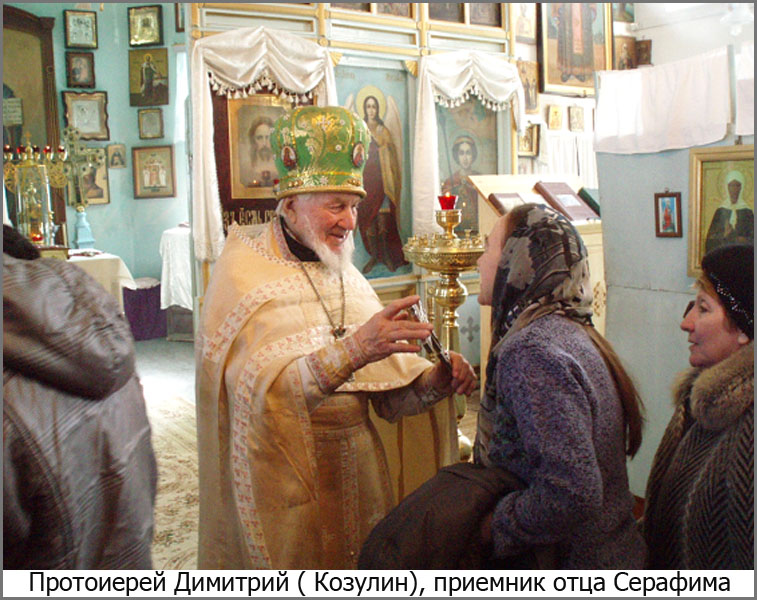
Today the Church of the Holy Great Martyr and Victorious George is served by Archpriest Dimitry (Kozulin), who wears the mitre. In 1961 Batiushka Seraphim married Father Dimitry and Matushka Antonina. In 1968 Father Seraphim blessed him to study at the Trinity-St. Sergius Lavra. On his return from the Lavra, from 1973, he served together with Father Seraphim until his repose, and afterwards himself became rector of the church and has served in it without interruption to this day. Many young men who were at first simply parishioners and then altar servers of Father Dimitry later became clergy. The succession continues, and one of them, Priest Timofey Sirodzhev, serves with the batiushka as second priest. And although we did not find alive those remarkable people of whom we have spoken, yet when coming to the church built by their hands and prayers, praying before the icons painted by Matushka Iunia, and seeing Father Dimitry serving, one feels their invisible presence. And the meaning of the petition is revealed in all its fullness: “Let us pray for all the founders of this holy church…”
In this small collection we have gathered information about only five ascetics, but in fact there were far more of them. About some we know only their names. These are Protodeacon Alexei Schenrock, the nuns Rafaila, Anna (choir director), Sophia, Xenia, Nun Maria (Vlasenkova), the church warden N. N. Reutov, Kozma Boev, Nina Sakmarkina and many others. When we began to gather material on this subject, we did not even know where to begin. There was extremely little information, almost no eyewitnesses were left, and at times it seemed unbelievable that enough recollections and testimonies would be found.
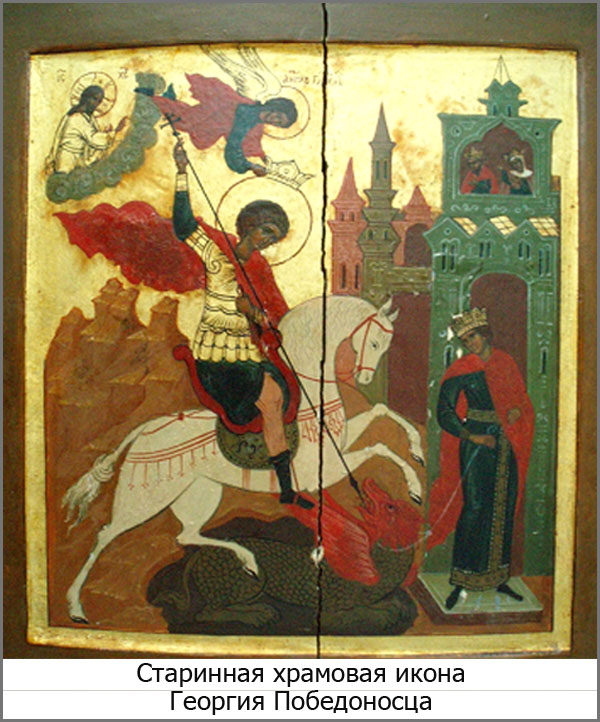
This year it will be 77 years since a small adobe house was acquired in the name of Matushka Iunia. Despite its small size, the church withstood the very difficult years of persecution and prohibitions. And, of course, there is no counting all those people for whom the Church of the Holy Great Martyr and Victorious George was and remains a place of salvation. To this day this church is the most visited in the city. Services are held in it six times a week.
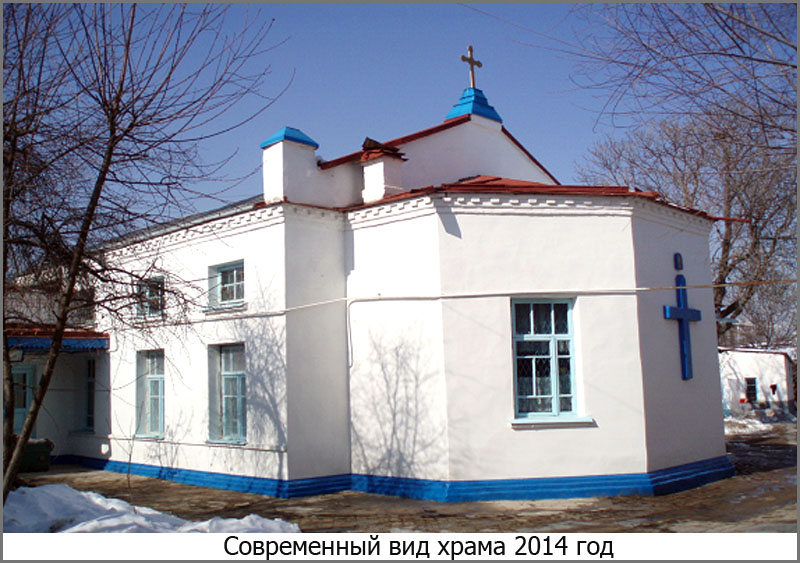
The aim of writing this work is the desire to convey to the parishioners of our church and to all who are interested in the history of Orthodoxy in the Central Asian Diocese living testimonies of life and ministry in the years of the persecution of the Church. All these people can without exaggeration be called ascetics and guardians of the Orthodox faith.
Everything set out here has been gathered from various sources. The greater part is taken from A. P. Artsybushev’s book “Matushka Evdokia” and from the recollections of an eyewitness, the writer Alexander Trofimov, published in the diocesan newspaper “Word of Life” in 1992 under the pseudonym “parishioner”. From the personal archives of Olga Morozova. From Emma Menshikova’s work “A Writer’s Diary,” as well as from articles on the internet and from the recollections of eyewitnesses who are alive today: Batiushka Dimitry (Kozulin), Matushka Antonina, the doctor V. I. Eryomina-Bazarova (who treated Father Seraphim), L. S. Zhuchkova (former choir director), and parishioners of the church.
Sunday School at the Church of the Holy Great Martyr George the Victorious in Samarkand. 2014. Compiled by: A. M. Galak, E. V. Larina and K. V. Krivosheeva.
Additions: From the recollections of Vladimir Zykin, “Pascha in Bystritsa.” “My first memories of divine services go back to 1948, when I attended a night service for the first time. At that time the hieromonk Seraphim Sutorikhin served in our church. Father Seraphim was a special batiushka, of a kind that is now rare. He celebrated the service not formally but with great spiritual uplift; his blue eyes shone, full of tears. He had a good bass voice, loved choral singing, taught the singers himself, and when possible came out of the altar to the kliros and sang together with the choir. In the service he never refused anything, was a sociable, erudite man, and could talk on any subject with the people who came to him. The deacon in the church was my godfather Alexander. On Great Friday at 2 o’clock in the afternoon Vespers was served with the carrying out of the Shroud. During the singing of the troparion ‘The Noble Joseph,’ Fr. Seraphim carried the Shroud out of the altar; I and another boy walked in front with candles in small candlesticks; we had no sticharia on, since none in our size could be found in the church. Everyone went to the middle of the church, where the Shroud was set on the place prepared for it. After Fr. Seraphim read the canon and the sermon, during the singing of ‘Come, let us bless Joseph ever-memorable,’ all the worshippers began to come up and venerate the Shroud. Pascha that year was celebrated on 2 May, the snow had melted, it was dry. The Paschal night was dark, there was something mysterious in it, as though nature itself were awaiting the Great Event. Coloured lanterns were lit on the second tier of the bell tower. There were about 20 villages in the district, and people came from more distant places, since there were few churches, so our church was full of worshippers. Before the Shroud the Acts of the Holy Apostles were read. During the service I stood in the altar. After the Midnight Office, with the Royal Doors closed and the curtain drawn, Fr. Seraphim sang in a quiet voice the stichera ‘Thy Resurrection, O Christ our Saviour’; at the second, louder singing the curtain was opened. The third time the singing became louder still, when the Royal Doors were opened, everyone sang, and a procession of the cross went around the church. At the end of the procession the beginning of Matins was served in the narthex, and for the first time that year the troparion of Pascha resounded.
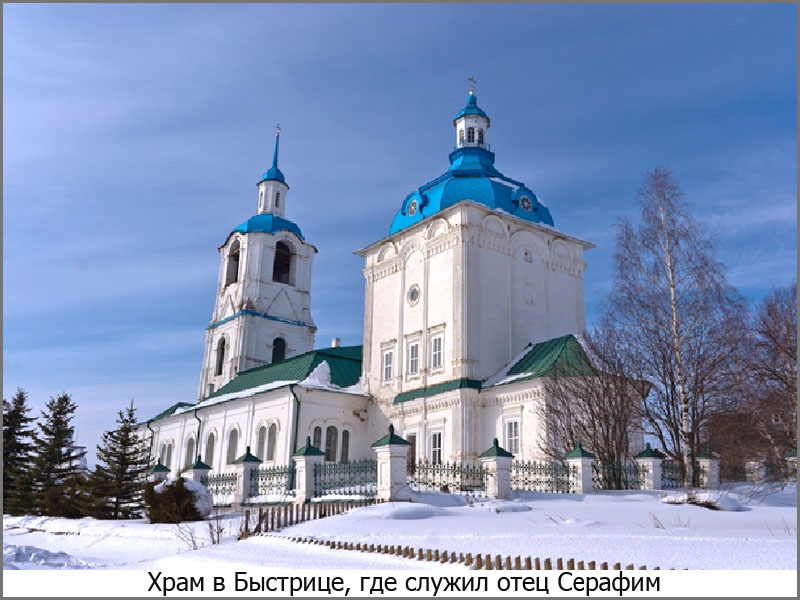
The doors were open, and on entering the church Fr. Seraphim joyfully proclaimed: ‘Christ is risen!’ The spiritual joy in which the batiushka dwelt was multiplied many times that night. He carried the joy of Christ’s Resurrection constantly throughout his whole life. On Paschal night he generously gave this joy to all. When he greeted them, ‘Christ is risen!’, all the worshippers, with faith in what had happened, answered their dear pastor: ‘Indeed He is risen!’ At every ode of the Paschal Canon the whole church was censed and the vestments were changed to a different colour, the sets having been prepared in the altar. At that time the old brocade vestments were still preserved; the clergy changed them quickly and came out after the litany for the next censing of the church. Two censers were used; while one was in use, the other was being prepared. At that time there was no factory-made charcoal, and they used their own, which did not always burn well. The incense was also made by themselves from spruce resin with some additives. Father Seraphim walked quickly around the church and performed the censing; because of the size of the church it took a long time. The choir sang the canon slowly so that each of its odes would end together with the censing. At the end of the canon Fr. Seraphim and those present in the altar sang the touching exapostilarion ‘Having fallen asleep in the flesh as one dead, O King and Lord,’ after which the Paschal stichera soon followed, and the whole church sang them. In the altar Father Seraphim joyfully exchanged the Paschal kiss with everyone. At the end of Matins he read the Catechetical Homily of St. John Chrysostom. He read it loudly, with tender feeling, calling everyone to come to the feast of faith, those who had fasted from the first hour and those who had come at the eleventh hour, doubting nothing, fearing nothing. At the Liturgy Fr. Seraphim read the Gospel of John in Greek and Latin, and Deacon Alexander read it in Slavonic, which for a village church at that time was a rare occurrence. The Paschal service ended at about 5 o’clock in the morning. At the end of October Fr. Seraphim left us. At the invitation of Bishop Gury Egorov, his old acquaintance, he went to the Tashkent Diocese, and the place of his service became the Church of George the Victorious in the city of Samarkand.”
THE PASCHA OF THE SOUL.
Archimandrite Seraphim (Sutorikhin), 1966.
Spiritual reflections.
The Venerable Abba Hyperechius counsels: “Let your mind always be in the Kingdom of Heaven, and you will soon inherit it.” My thought is directed to the same end. A joyful state of life, this inner paradise, this Pascha of the soul will become natural to me too when my soul is established in communion with God. This grace-filled joy the Lord Himself promises in His farewell discourse to His disciples, and in their person to all of us: “I will see you again,” says the Lord, “and your heart will rejoice, and your joy no one will take from you.”
The Apostle Paul calls everyone to this joy when he says: “Rejoice in the Lord always. Again I will say, rejoice!” (Phil. 4:4). Thus everything that contributes to our communion with God, to this true joy of ours — tender prayer, contemplation of God, partaking of the Body and Blood of Christ, patience, doing good to all with Christ’s silence, even to our ill-wishers, and the like — truly leads us into this inner paradise, into this Kingdom of Heaven even here on earth…
This state of soul commanded to us, this inner, inalienable paradise, that is, communion with God and the ways that lead to Him — I seek!
For this grace I hunger and thirst with longing, until the Lord transfers me to the unending life beyond the grave.
To my sorrow, this beginning of the Kingdom of God is still poor in me; the facts of my ignorance and inconstancy often speak of this, my soul grieves over it, for I know that the Kingdom of Heaven passes with us into eternity in the degree of development attained, while in me it is not yet developed or stable.
I grieve. But remembering the words of my Saviour: “The one who comes to Me I will by no means cast out,” and again: “I desire not the death of the sinner, but that he turn and live,” I take heart in my labour and hope in the mercy of God, which grants me to grow stronger on my way to Him. I know how lovingly He condescends to the repentant and encourages them with the embrace of His Love, how He rewards those who labour, how He assures us that for this He came to earth, suffered, died and rose again — to save sinners and to be one with us, as He Himself prayed to the Heavenly Father in His prayer before the Cross: “That they all may be one, as You, Father, are in Me, and I in You; that they also may be one in Us” (John 17:21).
The holy souls, after the end of life on earth, have indeed already entered into this joy of inseparable union with the Lord, and we by God’s grace seek and expect the same.
And then our communion with God will be eternal, unceasing and even increasing — then God will be all in all for endless ages.
We shall never cease to advance in virtue, neither in this age nor in the future holy one, always receiving new light of understanding. And the angels, intelligent beings, do not remain without advancement, but always receive glory upon glory and understanding upon understanding. So let neither all the anxieties of the world nor its vain joys occupy me. “The transgressors have told me idle tales, but not like Thy law, O Lord” (Ps. 118:85).
Let no empty occupations and no sorrow from the enemy trouble me: I AM WITH MY LORD! and I labour for the Lord, and endure for the Lord’s sake, and rejoice in my very being for Him! — though I am a sinner, I strive to be better, remembering the words of the Apostle: “He who is joined to the Lord is one spirit with Him” (1 Cor. 6:17). And still more the words of my Saviour: “He who eats My flesh and drinks My blood abides in Me, and I in him” (John 6:56).
I, timid as I am, boldly become convinced that I am to some degree in that communion with God which I seek, and with the help of God’s grace I shall pass into a greater measure.
The hard-working ascetics, who keep communion with God by the sweat of their brow, bear witness that as the body is close to the soul, so the Lord is close to us. This they have grasped by experience, by means of the prayer they perform unceasingly. O Sweetest Jesus! Grant me too, out of Thy grace and mercy, the grace of this prayer, and with it let me feel this Thy nearness to me, so that I may no longer endure the oppressive loneliness of an orphan!
“O my soul! Let us pursue virtue earnestly and unceasingly, for zeal corrects and makes up for what is lacking, and God becomes its helper. The Lord is near to those who endure for His sake. And the soul that seeks Him will find Him” (Venerable Theodore the Studite).
I say this not because I have already attained or been perfected, but I press on, that I may lay hold of that for which Christ Jesus has also laid hold of me (Phil. 3:12). I speak and write of this tirelessly, for I have been taught by the holy fathers that words are the path to deeds, good words to good deeds, and bad to bad. And I know well that this is so, that speaking of the better always disposes toward the better, and that one must speak of the good even to one who does not do good, so that, ashamed of his words, he may begin to do it too. O Lord, do not abhor my filth, but come and dwell in me![37]
“A Path to the One Thing Needful”
What prompts me to write these lines? A feeling of loneliness. It arises, first, from my living communion with the Lord being interrupted; and second, from the living word of men of grace having ceased.
In the flesh I was born of Adam, but the higher life, the life of the spirit, I received from Christ.
Consequently I must live by the spirit as predominantly as Christ is greater than Adam, and the spirit higher than the flesh. And this life of the spirit is often crowded out by the intrusion of earthly notions, feelings and interests; it even happens that they gain the upper hand, and then the demands of the spirit are pressed down and put in a subordinate position. And imperceptibly to myself I sink into vanity and negligence, and then… emptiness is felt in the soul, a sense of being abandoned by grace. As a man with such infirmities, I need outside help, support from my brethren in Christ, but here too — loneliness.
According to the word of our Saviour, “many go by the broad way, and few find the narrow way that leads to life” (Matt. 7:13–14).
We all suffer from the time a common helplessness, and we ourselves aggravate it by shutting ourselves off from one another. Some dream of being saved somehow, in self-satisfaction; others, shut in, grow accustomed to the thought that there is no one to seek or expect help from, and thus everyone lives for himself.
This sad estrangement could be explained further by a general fear of trusting one another, because inconstancy of people reigns all around; but one cannot fail to see also a general earthbound state of souls, which shut themselves in because each contrives to get by more comfortably and without extra care for another.
To our great sorrow, there is among us also an ailment far more terrible than those just mentioned — the spiritual unseriousness that has seized many. An ailment that paralyzes in the very germ the good impulses of the zealot of piety.
Usually they say: “Do not undertake any ascetic labours. Live as people live, do not stand out. God is merciful, we shall all be saved”… And instead of supporting the zealot’s good disposition, by this their supposedly mature prudence they cool in him all his good impulses toward the appointed prayers, fasts and other rules of Christian life. If the zealot, out of his love for spiritual exercises, does not heed their stock views but labours as best he can, then these supposedly mature people often reward him with all kinds of mockery and demeaning names — hypocrite, Pharisee, a man in spiritual delusion, and the like.
They express their notions of spiritual life in an earthly way, yet try to express them authoritatively, although from the Gospel we know perfectly well that the Kingdom of Heaven “suffers violence, and the violent take it by force” (Matt. 11:12).
In the lives of the saints one often notices that the words of Holy Scripture acted powerfully on people and helped them to change their former life. Perhaps something similar will happen to me. Somehow imperceptibly the words of the Saviour drew my attention: “Abide in Me, and I in you… If anyone does not abide in Me, he is cast out” (John 15:4, 6). These gracious and at the same time terrible words of the Saviour led me to serious reflection. Indeed, if not one jot or one tittle of the Law of God will pass away without being fulfilled, can this warning of the Saviour fail to be fulfilled — that whoever does not abide in the Lord in this life, in mind and heart, will in eternity be cast out from Him? Yet we prove so unwise that we do not tremble at these words, do not try and do not even want to see how necessary it is for us to acquire here the state of communion with God, and how terrible and ruinous it is for us, not having acquired it, to be cast out from the Lord forever there!?
Having understood in this way, as if by chance, from the thought that overshadowed me, this clear spiritual law, which extends from here into all eternity but is now veiled from us by earthly vanity, I place it first: I try to reflect on it, to grieve over it, and to defend myself with it, as with a weapon, against everything hostile around me.
Divine love awaits our sincere communion, our undivided love; it awaits from us also praise for all its benefactions, for every hour of life, whatever it may bring that is incomprehensible or unpleasant in our view, for the burning of these our feelings is destined to become our only occupation throughout our whole eternity.
“The Lord has left for Himself in the world those who work for Him and care for His children, and has chosen for Himself such as would serve before Him” (Venerable Isaac the Syrian). And so, see how precious and necessary is the state of unceasing communion with God, especially for monastics. And how easily and pleasantly one breathes when overshadowed by this grace! Just as consoling, precious and life-giving are meetings with a sincerely spiritual, open person. And yet we are rarely, very rarely, granted such mercies of God. Evidently such is our lot — that we should not rely much on outside help, but, guarding ourselves against loneliness, open up our own path to the Lord, having for this the examples of the holy fathers, and strive toward the Lord ourselves with the strength and abilities we have received and receive from the Lord. May His holy will be done in this too!
“If you stop your advance, your mind will utterly die, becoming deadened by immobility toward the good” (St. Theophylact the Great). [38]
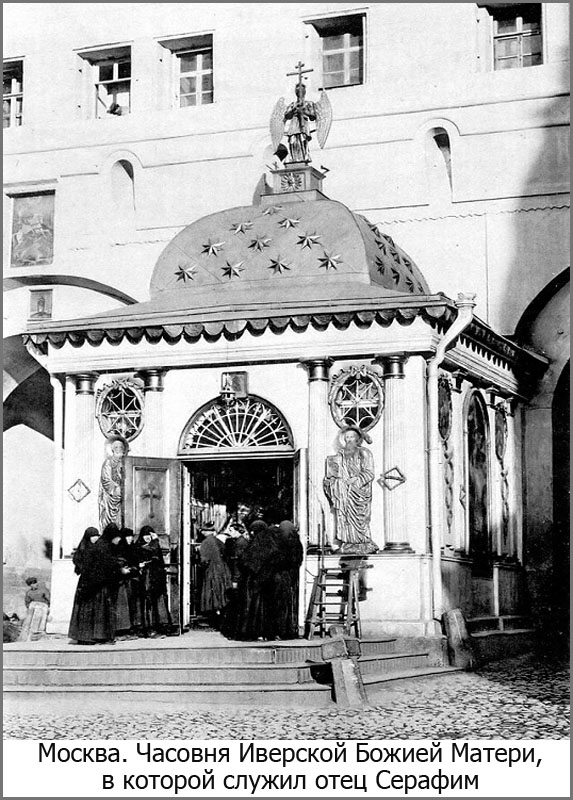
List of priests who served in the Church of the Holy Great Martyr George the Victorious:
1868–1879. First rector — Archpriest Nikolai Georgievich Vysotsky.
1881–1894. Rector — Archpriest Dimitry Nikolaevich Voznesensky. Deacon — Anton Ilyich Pedin.
1893–1897. Dean of the military churches of Samarkand Region — Priest Alexei Nikiforovich Nadezhdin. Buried by the altar wall of the Church of St. George.
August 1900–April 1901. Dean of the military churches of Samarkand Region — Archpriest Vladimir Mikhailovich Nevostruev.
1901–1904. Dean of the military churches of Samarkand Region — rector Dimitry Nikolaevich Voznesensky.
1904–1905. Dean of the military churches of Samarkand Region — Archpriest Pavel Alexandrovich Bartenev. During the First World War, while a priest, he was wounded and died of his wounds.
1905. Archpriest Alexander Konstantinovich Tikhomirov.
1902–1910. Deacon — Elpidifor Kirillovich Sobolev.
August 1905–March 1914. Dean of the military churches of Samarkand Region — Archpriest Vladimir Mikhailovich Nevostruev.
1910–1914. Deacon — Alexander Alexandrovich Borshchov.
1923–1925. Dean, Archpriest Evgeny Marchevsky. Under him the church was closed in 1925.
1926. Priest Philip Kalchenko.
1927–1929. Archpriest Dimitry Alexeevich Terpigorev. Was exiled to Central Asia. In 1937 he was shot in Kazakhstan.
1928. Priest Feodor Karabanov.
1928. Priest Gordy Shturbabin.
1929. Archpriest Mikhail Maslyuk.
1930 (?). Priest Nikolai Kersky.
1932. Rector — Hegumen Avksenty Bunin.
1936. Archpriest Valentin Polikarpov.
1939. Priest Trofim Dashok.
1942–1958. Rector — Archpriest Pyotr Knyazhinsky. Buried in Samarkand.
1948–1962. Rector — Archimandrite Seraphim (Sutorikhin). Was left without a post.
1949. Deacon Grigory Tikhonovich Shapovalov. Buried in Samarkand.
1955. Deacon Viktor Petrovich Knyazhinsky.
1958–1963. Protodeacon Alexei Vladimirovich Schenrock. Buried in Samarkand.
1962. Second priest — Kondraty Malakhov.
1964–1966. Rector — Priest Alexander Mogomedovich Kerimov.
1965–1979. Rector — Archimandrite Seraphim (Sutorikhin). Buried in Samarkand
1965. Second priest — Hegumen Nifont Andrusevich.
1967. Second priest — Hieromonk Pyotr Maslov.
1973. Second priest, and from 1979 rector — Archpriest Dimitry Kozulin.
[1] Internet site: DREVO, the Open Orthodox Encyclopedia. Benemansky A. K.
[2] Information taken from the personal archive of Archimandrite Seraphim Sutorikhin.
[3] Book by A. P. Artsybushev, “Matushka Evdokia,” 1997.
[4] Emma Menshikova, “Diaries.”
[5] Information taken from the report of the rector of the St. George Prayer House in Samarkand to Bishop Hermogenes of Tashkent and Central Asia. 1954. Archive of the Church of St. George.
[6] This story was recorded by A. Trofimov from the words of Nina Sakmarkina, a worker at the Church of St. George, who in turn had heard it from Archimandrite Seraphim.
[7] Personal file of Archimandrite Seraphim. Archive of the Tashkent Diocesan Administration. Inv. personal files 1. Item 370. Sheet 27.
[8] Ibid. Sheets 27, 28.
[9] Autobiography of Archimandrite Seraphim. Author’s personal archive.
[10] Personal file of Archimandrite Seraphim. Archive of the Tashkent Diocesan Administration. Inv. personal files 1. Item 370. Sheets 27, 28.
[11] This story was told to A. Trofimov by Archimandrite Seraphim himself.
[12] Personal file of Archimandrite Seraphim. Archive of the Tashkent Diocesan Administration. Inv. personal files 1. Item 370. Sheets 27, 28.
[13] A. Trofimov. Manuscript.
[14] Personal file of Archimandrite Seraphim. Archive of the Tashkent Diocesan Administration. Inv. personal files 1. Item 370. Sheet 11.
[15] Personal file of Archimandrite Seraphim. Archive of the Tashkent Diocesan Administration. Inv. personal files 1. Item 370. Sheets 27, 28.
[16] Personal file of Archimandrite Seraphim. Archive of the Tashkent Diocesan Administration. Inv. personal files 1. Item 370. Sheets 27, 28.
[17] Personal file of Archimandrite Seraphim. Archive of the Tashkent Diocesan Administration. Inv. personal files 1. Item 370. Sheet 13.
[18] Personal file of Archimandrite Seraphim. Archive of the Tashkent Diocesan Administration. Inv. personal files 1. Item 370. Sheet 11.
[19] Personal file of Archimandrite Seraphim. Archive of the Tashkent Diocesan Administration. Inv. personal files 1. Item 370. Sheets 1, 2, 3.
[20] Personal file of Archimandrite Seraphim. Archive of the Tashkent Diocesan Administration. Inv. personal files 1. Item 370. Sheets 4, 5.
[21] Personal file of Archimandrite Seraphim. Archive of the Tashkent Diocesan Administration. Inv. personal files 1. Item 370. Sheet 14.
[22] Personal file of Archimandrite Seraphim. Archive of the Tashkent Diocesan Administration. Inv. personal files 1. Item 370. Sheet 15.
[23] Personal file of Archimandrite Seraphim. Archive of the Tashkent Diocesan Administration. Inv. personal files 1. Item 370. Sheet 12.
[24] Personal file of Archimandrite Seraphim. Archive of the Tashkent Diocesan Administration. Inv. personal files 1. Item 370. Sheet 38.
[25] Personal file of Archimandrite Seraphim. Archive of the Tashkent Diocesan Administration. Inv. personal files 1. Item 370. Sheets 30–36.
[26] Personal file of Archimandrite Seraphim. Archive of the Tashkent Diocesan Administration. Inv. personal files 1. Item 370. Sheet 38.
[27] Personal file of Archimandrite Seraphim. Archive of the Tashkent Diocesan Administration. Inv. personal files 1. Item 370. Sheets 41–44.
[28] Personal file of Archimandrite Seraphim. Archive of the Tashkent Diocesan Administration. Inv. personal files 1. Item 370. Sheet 48.
[29] Personal file of Archimandrite Seraphim. Archive of the Tashkent Diocesan Administration. Inv. personal files 1. Item 370. Sheet 49.
[30] Personal file of Archimandrite Seraphim. Archive of the Tashkent Diocesan Administration. Inv. personal files 1. Item 370. Sheet 88.
[31] Personal file of Archimandrite Seraphim. Archive of the Tashkent Diocesan Administration. Inv. personal files 1. Item 370. Sheet 63.
[32] Personal file of Archimandrite Seraphim. Archive of the Tashkent Diocesan Administration. Inv. personal files 1. Item 370. Sheets 60, 61.
[33] Personal file of Archimandrite Seraphim. Archive of the Tashkent Diocesan Administration. Inv. personal files 1. Item 370. Sheet 63.
[34] Personal file of Archimandrite Seraphim. Archive of the Tashkent Diocesan Administration. Inv. personal files 1. Item 370. Sheet 67.
[35] A. Trofimov. Manuscript.
[36] Diocesan newspaper “Word of Life,” 1992. “Diary of a Parishioner.” A. Trofimov.
[37] Diocesan newspaper “Word of Life,” 14 April 1996.
[38] Diocesan newspaper “Word of Life,” August 1992.
Page being edited:
Views (4216)