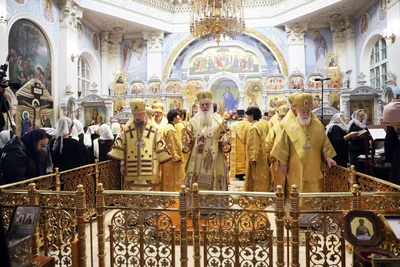
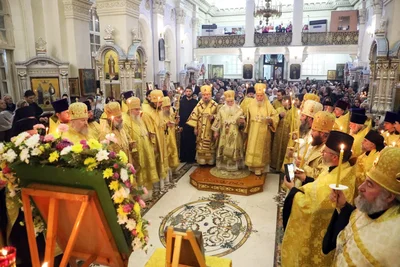
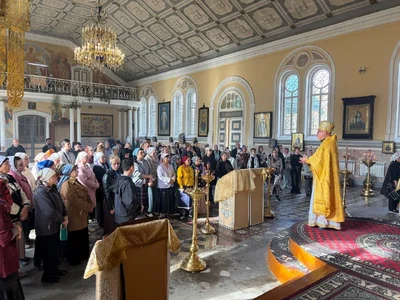
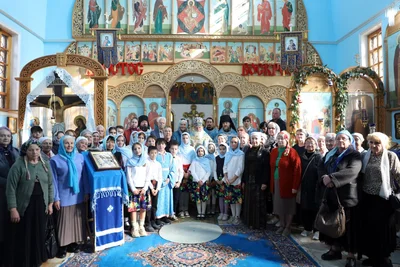
On the evening of 16 December 2015, before the All-Night Vigil, the head of the Central Asian Metropolitan District, Metropolitan Vikenty of Tashkent and Uzbekistan, brought an icon of the Holy Great Martyr Barbara with a particle of her holy relics to the Holy Dormition Cathedral in Tashkent.
The Holy Great Martyr Barbara lived and suffered under the Emperor Maximian (305-311). Her father, the pagan Dioscorus, was a rich and noble man in the city of Heliopolis in Phoenicia. Widowed early, he concentrated all the strength of his affection on his only daughter.
Seeing Barbara's extraordinary beauty, Dioscorus decided to bring her up hidden from the eyes of strangers. For this purpose he built a tower where, apart from Barbara, only her pagan teachers lived. From the tower there opened a view of God's world above and below. By day one could look at the wooded mountains, the swift-flowing rivers and the plains covered with a bright carpet of flowers; by night the harmonious and majestic choir of the heavenly lights offered a spectacle of inexpressible beauty.
Soon the girl began to ask herself about the Cause and Creator of so harmonious and beautiful a world. Gradually she became convinced that the soulless idols, made by human hands, which her father and teachers worshipped, could not have arranged the surrounding world so wisely and magnificently. The desire to know the true God so captured Barbara's soul that she resolved to devote her life to it and to spend it in virginity.
Meanwhile the fame of her beauty spread through the city, and many sought her hand, but despite her father's gentle persuasion she refused marriage. Barbara warned her father that his insistence could end tragically and separate them forever. Dioscorus decided that his daughter's character had been changed by her secluded life. He allowed her to leave the tower and gave her complete freedom in choosing her friends and acquaintances. In the city the girl met young confessors of the faith of Christ, and they revealed to her the teaching about the Creator of the world, about the Trinity and about the Divine Logos. Some time later, by God's Providence, a priest came to Heliopolis from Alexandria in the guise of a merchant. He administered to Barbara the Sacrament of Baptism.
At that time a luxurious bathhouse was being built at Dioscorus's house. On the owner's orders the workmen were preparing to make two windows in it on the south side. But Barbara, taking advantage of her father's absence, persuaded them to make a third window, in the image of the Light of the Trinity. Above the entrance to the bath Barbara traced a cross, which became firmly imprinted in the stone. On the stone steps of the bathhouse the print of her foot remained, from which a spring gushed forth that later showed great healing power; Symeon Metaphrastes, describing the sufferings of the holy martyr, compares it to the life-giving power of the waters of the Jordan and the pool of Siloam.
When Dioscorus returned and expressed displeasure at the change to the building plan, his daughter told him of the Triune God whom she had come to know, of the saving power of the Son of God and of the futility of worshipping idols. Dioscorus flew into a rage, drew his sword and wanted to strike her. The girl fled from her father, and he rushed after her in pursuit. A mountain blocked their way, but it parted and hid the saint in a cleft. On the other side of the cleft there was a way up. St. Barbara managed to hide in a cave on the opposite slope of the mountain. After a long and fruitless search for his daughter, Dioscorus saw two shepherds on the mountain. One of them pointed out the cave where the saint was hiding. Dioscorus beat his daughter cruelly, then put her under guard and starved her for a long time. Finally he handed her over to the governor of the city, Martian. St. Barbara was cruelly tortured: she was scourged with ox sinews, and her wounds were rubbed with a hair shirt. At night in prison, as the holy virgin prayed fervently to her Heavenly Bridegroom, the Saviour Himself appeared to her and healed her wounds. Then the saint was subjected to new and even crueller tortures.
Among the crowd standing near the place where the martyr was tortured was a Christian woman of Heliopolis, Juliana. Her heart was filled with compassion for the voluntary martyrdom of the beautiful and noble girl. Juliana also wished to suffer for Christ. She began to denounce the torturers loudly. She was seized. The holy martyrs were tortured for a very long time: their bodies were torn with hooks, their breasts were cut off, and they were led naked through the city amid mockery and beatings. Through the prayers of St. Barbara the Lord sent an Angel, who covered the nakedness of the holy martyrs with a radiant garment. The steadfast confessors of the faith of Christ, Saints Barbara and Juliana, were beheaded. St. Barbara was executed by Dioscorus himself. God's retribution was not slow to overtake both tormentors, Martian and Dioscorus: they were burned by lightning.
In the 6th century the relics of the holy Great Martyr were transferred to Constantinople. In the 12th century the daughter of the Byzantine Emperor Alexios Komnenos (1081-1118), Princess Barbara, on marrying the Russian Prince Mikhail Izyaslavich, brought them to Kyiv. They rest to this day in St. Volodymyr's Cathedral in Kyiv.