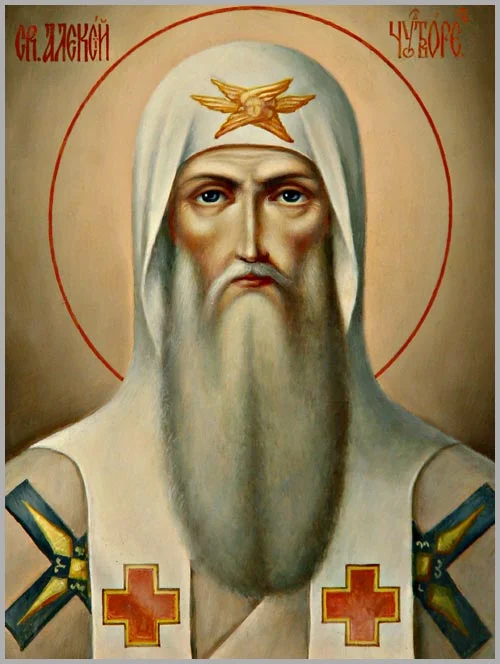
St. Alexius came from a boyar family of the Principality of Chernigov and was named Eleutherius in the world. He was born in 1300 (according to other sources in 1292, 1293 or 1304) and from an early age was sent to learn to read and write. "God chose him from his youth as a shepherd for the sheep and a great teacher," and early revealed to the future hierarch his high calling. In his twelfth year Eleutherius had set out nets to catch birds, dozed off without noticing it and suddenly clearly heard a voice: "Alexius! Why do you labour in vain? You shall catch men." From then on the boy became thoughtful and quiet, gave up childish games and began more eagerly to read the divine books. His inclination towards soul-profiting reading and prayer grew with every year, and soon his most ardent desire became to enter a monastery in order to devote himself entirely to God.
And in 1320 he entered the Monastery of the Theophany in Moscow and was tonsured then with the name Alexius, in his 20th year. Alexius spent twenty years in the Theophany Monastery, wearing himself out with fasting and vigil, prayers and tears, studying Holy Scripture, perfecting himself and rising in the spiritual life. His mentor and guide was the elder Gerontius, experienced in the spiritual life. Stephen, the brother of Venerable Sergius, who entered the Theophany monastery, was from 1337 his spiritual brother: they sang together on the kliros and loved one another spiritually. Metropolitan Theognostus loved Stephen, Gerontius and Alexius and from time to time called them to him for spiritual conversations. Later the Metropolitan made Stephen hegumen of the monastery, while Alexius, whose virtues and great gifts he valued, he drew close to himself, entrusting him with the administration of the Church's judicial affairs. Working so closely with the Greek hierarch, Alexius needed to know the Greek language, both spoken and written. In handling judicial affairs he came to know people and their weaknesses intimately and acquired extensive and precise knowledge of church law. For twelve years he performed the office of judge, with the title of the Metropolitan's vicar.
At the end of 1352 (1350) Metropolitan Theognostus consecrated Alexius Bishop of Vladimir. The Metropolitan and Grand Prince John Ioannovich decided, at a joint council, that blessed Alexius should be Theognostus's successor on the metropolitan see. Word of this choice was sent at once to Constantinople with the request "not to appoint anyone else as Metropolitan of Russia but the venerable Alexius, who for many years has been vicar and is of a most virtuous life."
Having become Metropolitan in 1354, St. Alexius set about church affairs with tireless zeal. At that time the Russian Church was torn by great disorders and disputes, in particular because of the claims of Roman, Metropolitan of Lithuania and Volhynia, who demanded for himself the revenues of the Bishop of Tver. The hierarch knew that although a separate metropolitan had been requested in the time of Metropolitan Theognostus, this had not lasted long, nor had it been in the form Roman wanted.
And to put an end to the unrest and anxieties, the humble hierarch set out in 1356 for Constantinople; Roman also came there. Patriarch Callistus confirmed Roman as Metropolitan of Lithuania and Volhynia, and granted Alexius the standing of Archbishop of Kyiv and Great Russia, with the title of "all-honourable Metropolitan and Exarch." On the way back a terrible storm arose at sea: the waves rolled like mountains, and at every moment the ship seemed about to vanish into the abyss. All who were with the Metropolitan despaired of being saved. The hierarch prayed, prayed fervently, vowing to build a church in the name of the saint of the day on which the ship reached the shore. The Lord heard the hierarch's prayer. Calm came, and the ship reached the shore on 16 August. Thus the hierarch remained bound by a vow to the All-Merciful Saviour.
In Moscow the long-awaited hierarch was received with transports of joy. And he turned zealously to the affairs of the metropolia. Several dioceses had been left without archpastors, who had died of the plague. He consecrated bishops for Rostov, Smolensk and Ryazan. At the same time he deposed Bishop Athanasius of Sarai for acting in another's diocese and consecrated John for Sarai. Caring for his flock in every way, he established coenobitic monasteries (on the model of the Trinity Monastery founded by Venerable Sergius). St. Alexius laboured much to calm unrest and internecine strife, and established relations with the khans of the Horde.
The fame of Metropolitan Alexius's holy life reached the capital of the Tatar khan. Taidula, the wife of Khan Jani Beg, fell gravely ill and went blind. No treatment could restore her sight, and she resolved to turn to St. Alexius, of whom she had heard as a holy man. An embassy from the khan came to Moscow with a letter to the Grand Prince. "We have heard," wrote the khan, "that you have a servant of God who, if he asks God for anything, God hears him. Let him come to us, and if my queen is healed by his prayers, you will have peace with me; but if you do not let him come, I will go and lay waste your land." The humble hierarch was troubled when the Grand Prince handed him the khan's letter and asked him to fulfil his will. Love for his homeland and the holy Church did not allow him to refuse to fulfil the will of the formidable khan; but how could a humble man take such a great task upon himself? "The request and the task exceed the measure of my strength," the hierarch said to the prince, "but I trust in Him Who gave sight to the blind man; He will not disdain the prayer of faith." The hierarch began to prepare for the journey. In the cathedral church, with all the clergy, he served a moleben before the icon of the Mother of God and then before the shrine of St. Peter. During the very prayer, before the eyes of all, a candle at the tomb of Peter the Wonderworker suddenly lit by itself. Consoled, Alexius divided the miraculous candle into pieces, distributed them as a blessing to those present and, making a small candle from what remained, took it together with holy water to serve a new moleben in the Horde. He set out from Moscow on 18 August 1357. He went to the Horde with firm faith; and Taidula's faith was strengthened by a vision. While blessed Alexius was on the way, Taidula saw in a dream a man clothed in hierarchal vestments coming to her, and with him others clad in vestments. She ordered garments to be made like those she had seen. The awaited guest was received with honour in the Horde. The hierarch served a moleben over the sick woman with the wondrous candle, sprinkled her with holy water, and Taidula began to see. The grateful khan gave the hierarch a ring as a mark of honour, which can be seen to this day in the patriarchal sacristy. Having worked a miracle of faith among the people of darkness, the hierarch returned home, and Taidula afterwards interceded much on behalf of Rus'.
Holy zeal for the good of his homeland compelled St. Alexius to undertake the same journey once more. Khan Jani Beg was treacherously murdered by his son Berdi Beg, who also killed 12 of his brothers. An envoy of the new khan came to Moscow, demanding gifts from the Russian princes and summoning them to the Horde in person. The hierarch was implored to go to the Horde again to soften Berdi Beg's cruelty. The danger was obvious. "But the good shepherd gives his life for the sheep," the hierarch said to himself, and set off down the Volga to the Golden Horde. In the Horde he had to endure much oppression and sorrow. But with God's help he managed to win the favour of Berdi Beg. And the grateful Taidula could not forget her healer: through her mediation favour was obtained for the Russian state and Church: St. Alexius received from Berdi Beg a yarlyk (charter) and protection for the Russian clergy.
When Grand Prince John died (1359), the guardianship of the young Prince Dmitry (the future Donskoy) fell on the shoulders of the hierarch. For several years he was the civil and spiritual leader of Rus'. By his intelligence and wide learning, his perseverance and firmness of character, his devout and strict life, St. Alexius won universal respect. Zealously caring for the piety of all his flock and teaching it to fulfil its Christian duties, the hierarch was a teacher and peacemaker of the princes who quarrelled among themselves over their domains. Through the labours of the hierarch the power of the Grand Prince of Moscow grew and strengthened. He raised up Moscow as the centre of Orthodoxy and of the unity of Rus'.
Meanwhile the hierarch was occupied with building monasteries. In 1361 he founded a coenobitic convent in the name of his Guardian Angel, Alexius. In the same year he founded, on the bank of the Yauza River, the votive monastery dedicated to the Image of the Saviour Not Made by Hands. Turning to Venerable Sergius, the hierarch said: "I wish you to give me one of your disciples." And the venerable one lovingly gave his disciple Andronicus as superior of the new monastery. In 1362 the hierarch founded the Vladychny Monastery, 3 versts from Serpukhov. Its first hegumen was his disciple Varlaam, venerated to this day for his devout life. After that the hierarch fulfilled his earlier intention of restoring two ancient monasteries: the Annunciation Monastery in Nizhny Novgorod and the Monastery of Sts. Constantine and Helen in Vladimir. In both he introduced the coenobitic rule. In 1365, in the Kremlin itself, a monastery was founded in honour of the miracle of the Archangel Michael, on land given by Queen Taidula. It was a grateful memorial of the miracle worked on the queen on the day of the feast of the miracle at Colossae (6/19 September). The hierarch built and adorned the Church of the Archangel Michael with all generosity. He provided for the upkeep of the monastery, where he established a full coenobitic life. "In the Chudov Monastery," wrote Venerable Joseph of Volokolamsk, "blessed Metropolitan Alexius settled honourable elders, asking some of St. Sergius and taking others from other monasteries under his authority; these monks lived as monks, a spiritual life, so that many came to them, old and young, and received benefit." The most reliable instructor here was the hierarch himself. He loved this monastery and from time to time laboured here in fasting and prayer. "The Monastery of the Miracle of Michael I commend to you, my son, Grand Prince Dmitry Ivanovich," wrote the hierarch. It was also he who advised the Grand Prince to build a stone Kremlin, safe from fires and reliable for defence against the enemy.
From 1367 St. Alexius had to bear many sorrows and labours over the affairs of the princes of Tver. Together with Venerable Sergius he brought peace to Tver, and Prince Mikhail, after five years of enmity, was forced to submit to Grand Prince Dmitry. The treaty was concluded through the mediation of St. Alexius. In it we read: "By the blessing of our father, the Metropolitan of all Rus', the Prince of Tver swears for himself and his heirs to recognise the Grand Prince of Moscow as his elder brother, never to seek the patrimony of Vladimir and never to accept it from the khan."
The Metropolitan often visited his friend in the wilderness, Venerable Sergius, and consulted with him on everything concerning church affairs. The wise counsels of the humble elder and his holy, angel-like life gave the hierarch the idea of preparing in Sergius a worthy successor to himself on the primatial see. Feeling his strength failing with age, he wished to follow the example of his predecessor, Metropolitan Theognostus, who while still alive had, together with the Grand Prince, asked the Patriarch to appoint no successor other than him, that is, Alexius.
And so he summoned Venerable Sergius to Moscow from his beloved solitude. On foot the elder hegumen goes to his friend the Metropolitan. The hierarch met his guest from the wilderness with love. In the course of their conversation he suddenly ordered a golden "paramand" cross adorned with precious stones to be brought. With his own hands he placed the golden cross on Sergius, "as if as a sign of betrothal to the episcopal rank," and said: "I would wish, while I am still alive, to find a man who after me could shepherd the flock of Christ. I know for certain that everyone, from the Grand Prince down to the least person, will wish to have you as their shepherd. Now, in good time, you will be honoured with the rank of bishop, and after my departure you will receive my throne as well."
So unexpected a proposal from the elderly hierarch deeply troubled the humble soul of Sergius. With great self-abasement, even with sorrow, he began to decline the honour offered him, despite the hierarch's long persuasion. Then the discerning hierarch saw that if he insisted any further, he would force Venerable Sergius to withdraw into some unknown wilderness, and fearing that the lamp which illumined his flock with its quiet light and warmed it with grace-filled warmth might be hidden altogether, he changed the subject. Comforting the elder with words of fatherly love, he let him go in peace back to his monastery.
St. Alexius reached a ripe old age, 78 years, having occupied the metropolitan see for 24 years. During his ministry he consecrated more than 20 archpastors of the Russian Church.
Precious monuments of his pastoral teaching are the Gospel, a circular epistle to his flock and an epistle to the Christians of the Nizhny Novgorod region. The Gospel of St. Alexius, written in his own hand, is kept in the Chudov Monastery. It was written while the hierarch was in Constantinople and therefore at a time when he could have at hand the best copies of the Greek Gospel. In his circular instruction the hierarch, having spoken of his duty to teach the flock and of the disposition with which the flock should receive instruction, says to all: "Come to the priest, your spiritual father, with repentance and tears; reject all evil deeds and do not return to them. True repentance consists in hating one's former sins. Leaving all your affairs, gather without sloth for the prayer of the Church. Do not say: we will sing the service at home. As a house without fire cannot be warmed by smoke alone, so is such prayer without the prayer of the Church. The Church is called heaven on earth. In it the Lamb, the Son and Word of God, is sacrificed for the cleansing of the sins of the whole world; in it the Gospel of the Kingdom of God and the writings of the holy apostles are proclaimed; in it is the throne of God's glory, invisibly overshadowed by the Cherubim; in it, by the hands of priests, the Divine Body and Blood are received and imparted to the faithful for the salvation and cleansing of soul and body. Therefore, when you enter the church, tremble in soul and body: it is no ordinary house that you enter. Do not dare, children, to anger God with your talking in church. Have the sign of Christ in your souls. And the sign for the sheep of God's flock is communion of the Body and Blood of Christ. You, children, as sheep of the rational flock, do not let a single fast pass without renewing this sign upon yourselves: partake of the Body and Blood of Christ."
In his epistle to the flock of Nizhny Novgorod he teaches the fear of God. To pastors he says: "Do not fear the faces of the powerful; forbid them to wrong the lesser ones. Let there be peace, love and truth among Christians, not only in word and on the tongue, but in a pure heart and an upright soul. I write this not only for hegumens and priests, but also for princes and boyars, for men and women, and for all Orthodox Christians. Have, children, care, submission and obedience towards your spiritual fathers, for they teach you what is profitable and saving for the soul." The holy Church glorifies the hierarch as "nourisher of widows and father of orphans, most excellent helper of those in sorrow, consolation of those who weep, shepherd and guide of all who stray," "beauty of the Church," "great wonderworker," "luminary of all the Russian metropolia," "golden-radiant star of Russia."
The hierarch of God ended his earthly course on 12 February 1378. He bequeathed that his body be laid in the Chudov Monastery and indicated the place of burial, "behind the altar" of his church, not wishing, out of humility, to be buried inside the church. But the pious Grand Prince Dmitry Ioannovich Donskoy (1363–1389), who deeply revered the great hierarch, ordered the body of Metropolitan Alexius to be laid in the church, near the altar. His healing relics were uncovered 50 years after his repose.
20 May (Old Style) / 2 June: The Finding and Translation of the Venerable Relics
Since the first church built in the Chudov Monastery by St. Alexius himself in the name of the holy Archangel Michael, in memory of his miracle at Chonae, was made of wood, it happened that its roof, decayed with time, collapsed during the celebration of the Divine Liturgy, yet by God's providence all who were in the church at that moment remained unharmed. Then the Grand Prince of Moscow, Vasily Vasilyevich the Dark (1425–1462), ordered a stone church to be built. And when trenches for the foundation of the new church were being dug inside the former wooden church, the relics of the great St. Alexius were found incorrupt, and even the vestments on him undecayed. This was on 20 May 1431. From that time the memory of the hierarch began to be venerated. In the new church, consecrated like the former one in the name of the Archangel of God Michael, a side chapel was built in honour of the Annunciation of the Most Holy Theotokos, in which the much-healing relics of St. Alexius were laid.
In 1484, under the superior of the Chudov Monastery, Archimandrite Gennadius (from 12 December 1484 Archbishop of Novgorod; commemorated 4/17 December), the construction of a new refectory with a church dedicated to St. Alexius began in the monastery. In 1485 his holy relics were translated into the new refectory church and placed by the south wall, where they remained for two centuries. On 12 February 1535, the hierarch's feast day, his relics were placed in a new silver shrine.
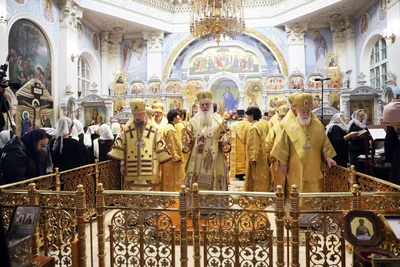
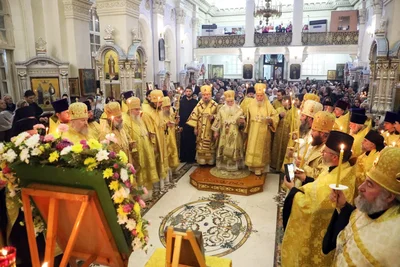
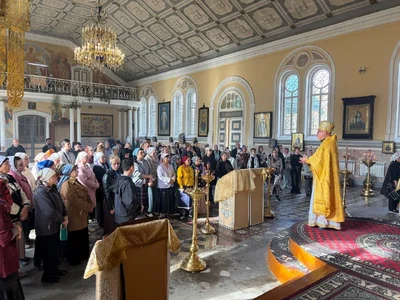
On 20 May 1686, under Patriarch Joachim of All Russia († 1690), the relics of the hierarch were solemnly translated from the refectory church, by then dilapidated, to the arch between the newly built church of the Annunciation of the Most Holy Theotokos and the church of St. Alexius, where they rested openly. Today the holy relics rest in the Patriarchal Cathedral of the Theophany in Moscow.
Since the uncovering of the relics, healings and miracles of every kind have flowed abundantly from the saint of God.