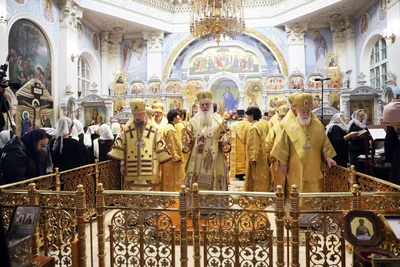
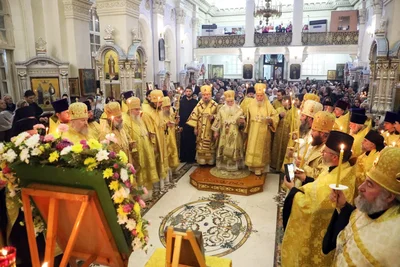
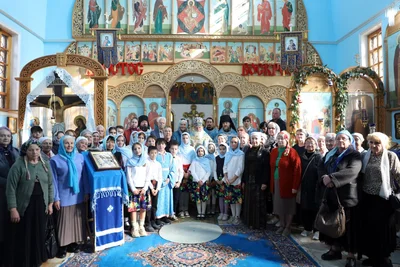
On the 22nd Sunday after Pentecost, 5 November 2017, when the Holy Church prayerfully commemorates the holy Apostle James, the Brother of the Lord, the head of the Central Asian Metropolitan District, Metropolitan Vikenty of Tashkent and Uzbekistan, celebrated the Divine Liturgy at the Dormition Cathedral in Tashkent. The All-Night Vigil was served the evening before.
Concelebrating with His Eminence were: Mitred Archpriest Mikhail Kotlyarov, Hieromonk Daniil (Gubaidulin), Protodeacon Alexander Nesin, Deacon Mikhail Mezhovikov, Deacon Rustik Kovalev and Deacon Vasily Shivaldov.
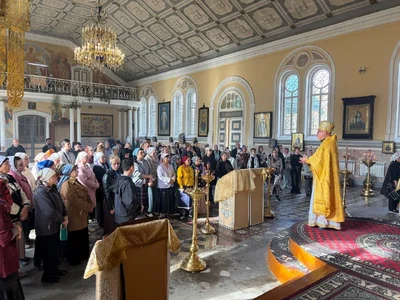
At the end of the Liturgy the magnification to the holy Apostle James was sung, and then Metropolitan Vikenty addressed the flock with his archpastoral word, explaining the meaning of the Gospel parable read at the service. That day the following parable was read:
"There was a certain rich man who was clothed in purple and fine linen and fared sumptuously every day. But there was a certain beggar named Lazarus, full of sores, who was laid at his gate, desiring to be fed with the crumbs which fell from the rich man's table. Moreover the dogs came and licked his sores. So it was that the beggar died, and was carried by the angels to Abraham's bosom. The rich man also died and was buried. And being in torments in Hades, he lifted up his eyes and saw Abraham afar off, and Lazarus in his bosom. Then he cried and said, 'Father Abraham, have mercy on me, and send Lazarus that he may dip the tip of his finger in water and cool my tongue; for I am tormented in this flame.' But Abraham said, 'Son, remember that in your lifetime you received your good things, and likewise Lazarus evil things; but now he is comforted and you are tormented. And besides all this, between us and you there is a great gulf fixed, so that those who want to pass from here to you cannot, nor can those from there pass to us.' Then he said, 'I beg you therefore, father, that you would send him to my father's house, for I have five brothers, that he may testify to them, lest they also come to this place of torment.' Abraham said to him, 'They have Moses and the prophets; let them hear them.' And he said, 'No, father Abraham; but if one goes to them from the dead, they will repent.' But he said to him, 'If they do not hear Moses and the prophets, neither will they be persuaded though one rise from the dead'" (Luke 16:19–31).
"There are people who are successful and rich, who use their wealth for their own enjoyment, pleasure and joy; but there are also people in need, deprived of the most necessary bodily and material goods, who endure all this with humility," His Eminence noted in his sermon. "We have seen in today's Gospel narrative that death made both equal, the rich man and Lazarus. The body went into the earth, and the soul went into eternity. Through this parable the Lord reveals to us the mystery of eternal life: that besides earthly life there is eternal life. But, sadly, not everyone is able to enter that eternal life of joy, because there is also an eternal life of suffering and torment, prepared for those who behaved wrongly in this earthly life and spent it wrongly.
From today's parable we can also learn that bodily and spiritual poverty is, to a certain degree, a path to attaining eternity. The beggar Lazarus, feeding on the crumbs that fell from the rich man's table, bore everything patiently; he was not troubled, he did not murmur, he did not condemn the rich man, he patiently endured his lot. And for this the Lord rewarded him with great joy and consolation: the enjoyment of the Kingdom of God and of eternity. But if a poor man who has nothing murmurs and condemns everyone and everything, then this poverty brings him no benefit, neither earthly nor eternal, nor in the Kingdom of Heaven.
In the same parable we also see the rich man, who used his wealth only for his own pleasure and paid no attention to those in need. And so we ask the question: 'Is wealth an obstacle to the Kingdom of Heaven?' This question can be answered with an example from our own life, when we see many rich people who have attained the Kingdom of God and holiness. We know the Righteous Job the Long-Suffering and the holy Royal Passion-bearers. They had material wealth, but above all they were rich in soul. They did a great deal of good, built many churches and monasteries, founded various houses to help those in need, and so on.
Therefore we can say that neither wealth nor poverty is an obstacle to the Kingdom of God. On the other hand, both wealth and poverty can become an obstacle to the Kingdom of God when a person understands his poverty wrongly or treats his wealth wrongly."