“…In the Sacrament of Baptism, dear brothers and sisters, we receive the grace of God, the grace of Christ, and the Church places us on the first step of our spiritual growth. We must grow spiritually, rise higher, and go up these steps of spiritual growth and perfection to the measure of the stature of the fullness of Christ…” Metropolitan Vikenty of Tashkent and Uzbekistan
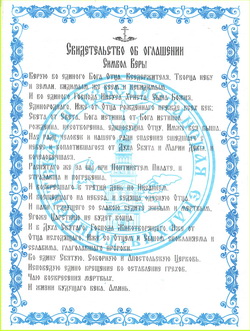
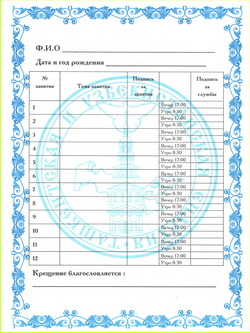
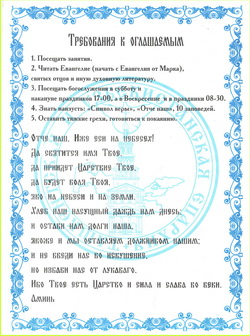
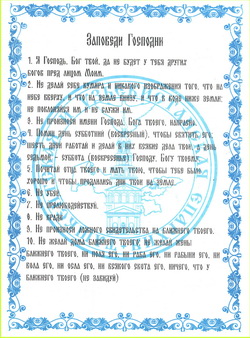
Outline of 12 Catechetical Talks for Those Preparing for the Sacrament of Baptism
The practice of the Holy Dormition Cathedral in Tashkent
Contents of the lessons
- Introduction. What is baptism, and why is preparation for it necessary? How do the Sacraments of the Church differ from magical acts? Why should one not approach the Sacraments of the Church without preparation? Myths about baptism.
- God. The attributes of God. God the Trinity. What is a dogma? The theology of the icon of the Most Holy Trinity by St. Andrei Rublev. The Son of God. Who is Jesus Christ? A brief retelling of the Gospel: the Nativity of the Lord (the dogma of the virginal conception of the Most Holy Mother of God), the Savior’s emergence to preach, the death on the Cross, the Resurrection, the Ascension, the descent of the Holy Spirit. Why is the Lord Jesus Christ called the Savior? What do we need to be saved from?
- The creation of the world. Adam and Eve. The purpose of man and woman. The story of the Fall. The consequences of the Fall. What is sin? Why does man fall ill? Happiness. To live with God is great happiness; to live without God is misfortune. Fulfilling the will of God leads to happiness. Examples of people who found happiness (blessedness) and of people who lost happiness.
- The commandments of God. Commandments 1–4. Sins against the commandments.
- The commandments of God. Commandments 5–10. Sins against the commandments
- The Sacraments of the Church. What is a Sacrament? Synergy — “co-working”. Baptism, Chrismation (with an explanation of the rite), Repentance.
- The Sacraments of the Church. Communion. Marriage. Priesthood. Holy Unction.
- What is prayer? What kinds of prayer are there? The “Our Father” — an interpretation. The Creed.
- The life of the age to come. The inevitability of death. What preparation for death means. Hell and Paradise. Examples of descriptions of the afterlife: C. S. Lewis, “The Great Divorce”; Archpriest A. Torik, “Dimon”.
- A practical session. Getting to know the church, its structure and its objects.
- Feedback. Answers to existing questions, doubts and uncertainties.
- Examination. A review of the topics covered. The catechumen must know by heart the prayers “Our Father” and the Creed, read the Gospel of Mark, and recite the commandments of God from memory. During the course of study the catechumen attends Sunday and festal services (at the Liturgy the unbaptized pray only until the Liturgy of the Faithful) and takes part in repentance (a confessional conversation), but without the prayer of absolution from the priest.

Introductory lesson.
Good day.
We are beginning our lessons before Baptism. We call them “catechesis” — preparation for the conscious reception of the Sacrament of Baptism. What does it mean to receive it rightly? And what does Baptism mean? Before we begin to examine this, I would like to ask you why you have come here. What do you want to receive from Baptism? What will change after baptism?
The Sacrament of baptism consists of two moments: preparation (catechesis) and baptism itself. To prepare for the Sacrament, it is necessary to realize the full importance of this decision. Immersion in water in itself does not bring us closer to God if we have no faith; that is, before baptism we must acquire faith, we must repent and have the desire to change our life by 180 degrees. One must never think that baptism is needed only to gain success, good luck, health or other earthly goods. Baptism is not merely a request for something, but also our giving our hearts to God. The highest purpose of Baptism is the possibility of a person’s meeting with God and union with Him, for the salvation of our souls. Most often we regard God as the Giver of various goods. We come to Him and ask for health, money, success in study and work — earthly goods. To ask is, of course, not a sin, but most often God plays the role of a goldfish or a magic wand for us. Yet if we think about it, God is a living Person, more alive than all the living. And when we ask God for something, we must not forget that He awaits our attention. We can take an example from our everyday relations with those close to us. Often we do not want to communicate with the person himself, yet we constantly ask him for something; so children sometimes ask their parents for money, forgetting that the parents need their company and gratitude. And in effect it turns out that the person is a matter of indifference to us. Archpriest Georgy Chistyakov gives a good example: he says that people often turn to God as to an electrician or a plumber, only in case of extreme need, and then, having paid with candles or something else, we see God to the door. We do not want Him, like an electrician or a plumber, to remain with us in our life! But the Lord wants these relations to be not merely those of consumers but mutual. He wants us to give something back with gratitude and joy. This is needed not by God, for God is the All-Blessed and All-Sufficient Being; by and large, He does not need our candles or prayers — He needs our hearts, and to give one’s heart to God is very hard and difficult, since God does not wish to share our heart with sins and attachments. In the Old Testament God says: “I am the Lord your God, a jealous God” (Exodus 20:5)”. I understand these words to mean that the Lord is jealous for us with regard to every sin, sinful attachments, vices and passions, as a husband is jealous over his wife and does not wish to share her with anyone. What is in the heart of modern man? One third is taken up by work, one third goes to sleep, and if only the other third went to the family — but no, it goes to entertainment. How much time do we give to our children, wife, husband? I am not even asking how much time we give to God. To free up time, humanity has invented many different devices: the multicooker, washing machine, dishwasher, vacuum cleaner, mobile phones, computers, cars — and what is the result? We have started to lack time catastrophically; the pace of life has accelerated so much that we cannot keep up with it. The paradox of our age is that the more devices for freeing up time we use, the less time we have left for life! For example, mobile phones have ceased to be a means of communication for us — they are mostly a means of entertainment — a mass of different applications! That is, all our free time goes on entertainment — social networks, television programs, films, news… There are news blocks on practically every television channel. It is important for people to know what is happening in the world. But why? Who remembers the news of a week ago? If we cannot recall what happened a week ago, it means that this information was not needed by us — it is merely information-entertainment or gossip.
When you ask a person why he does not go to church, the answer is: no time! This is the most common answer. But when you ask, “Do you have televisions at home?” everyone answers, “Yes.” There is a television in every room and even in the kitchen. How much time do we spend watching television? Everyone is different, of course, but usually a person watches television on average from 1 to 3 hours a day. It turns out that one day a week we devote to the television. And how much time do we give to God? According to the rule of the Church, every day in the morning after sleep and in the evening before sleep one must read the prayers, which takes about 15–20 minutes each time. Is that much or little? It is little, but even that is good if it is fulfilled.
And what is baptism? Baptism is a Sacrament that unites us with God and brings us into the Church of Christ, but on one condition: that the person will change his life, will confess, receive Communion, pray and live by the commandments of God. The Sacrament of baptism by itself does not save a person. In our time a situation has arisen in which there are many baptized Orthodox but few enlightened ones — those who know what they believe and take part in the Sacraments of the Church. A person lights candles, kisses icons, orders molebens, takes holy water and thinks that he has been in the Church. In fact he has only been in a temple, in a building for prayer. But to be in the Church, one must regularly partake of the Body and Blood of our Lord Jesus Christ, because the Church is the Body of Christ, a community of people united by one faith and by the Sacraments. Everything that exists in the Church — any prayers, Sacraments, rites — is interaction, cooperation, working together with God. God does not want to do anything without the participation of man. The goal of our life is the salvation of the soul, and God does not save a person without his participation. Where did this wrong attitude to baptism come from, when people who are unprepared, or perhaps even entirely unbelieving, are baptized and feel that they have already done their duty before God?
In pre-revolutionary Russia there was no need to prepare a person for baptism, because the majority of the population, especially the peasantry, knew their faith in practice; they absorbed faith and piety, as the saying goes, with their mother’s milk. A person received his first literacy in the Church from church books, then entered the parish school, where alongside arithmetic he studied the Law of God, then moved on to the theological school, and after the theological school, if he had the ability and means, he went to the seminary or university. That is, throughout his whole life a person constantly received knowledge about God. After the revolution the situation changed radically: the Church was separated from the state, teaching the Law of God in schools and colleges was forbidden, and the words “God”, “Church” and “priest” were removed from all textbooks. A special role in destroying the imperial educational system was played by Nadezhda Konstantinovna Krupskaya, Lenin’s wife, who with her “brilliant” gift and persistent desire to “put an end to obscurantism” managed to remove everything bright from education and to set it on the principles of dead atheism. Religious education was done away with! In the period that followed, people were baptized half-secretly, teaching people was forbidden, and so baptisms went like this: one came to church, paid a little money — and was baptized. In this period the attitude to the Sacrament of baptism and to the Church was formed, at best, as to a household services bureau: the client pays for the service, and the ministers carry out his order. The person left baptized but unenlightened. One can understand the situation in the Soviet years: there were persecutions. And the very fact that a person came to be baptized and was not afraid already spoke of his faith. But in the nineties and the two-thousands there were no longer persecutions. And the majority of those who were baptized by the rules of Soviet times, without preparation, remained static; that is, nothing changed in them. It was precisely in those years, especially in the nineties, that terrible crimes were committed. And who committed these crimes? Baptized people. And in the penal colonies and prisons the majority of people are baptized. But why do they commit crimes? Because they were baptized only formally. They needed only the rite. Only in order to obtain luck, good fortune, success and so on. There were people who lit candles in church before committing a crime. Now there are no persecutions; we must take advantage of the situation, go to church more, confess, receive Communion. In Soviet times priests and believing people looked at the ruined churches and monasteries and somewhere deep in their souls dreamed of our time, when it would be possible to build churches freely, to baptize, to teach, and to enlighten the people. They could not even believe that such a miracle might happen decades later!
The Sacrament of Baptism is performed under two conditions: 1. the will of God; 2. the will of man. And if one of these conditions is not fulfilled, the Sacrament may not take place. One must not approach the Sacrament formally, and one must not take from the Sacrament only one part.
In ancient times Baptism was divided into several parts, and preparation for baptism lasted about three years.
1. Catechesis. It is precisely the stage of catechesis that we are going through now. At this stage the person went to church, read the Gospel and studied the faith. And the result of all this was Baptism; if a person does not labor, what he has received may not be to his benefit. This is probably what happened in the nineties, when people were not prepared for Baptism. Outwardly the person was baptized, but inwardly, it seems, not. Apparently it was not accomplished. In the Sacrament there must be a change in the person. A person must change qualitatively, but for this effort must be made. One must think about one’s life, about one’s sins, and one must learn something about one’s faith.
Let us take this example. You come to a king for rich gifts, but you were not prepared: you have neither sacks nor boxes for the presents. The king wants to pour gold out for you, but you have no sack, not even a little bag; he wants to pour out rubies for you, but you have no little box. And so you leave with nothing.
- The second part of Baptism is the ritual side of Baptism, when prayers are read over the catechumen and he is immersed in water. From this moment the old life ends and a new life begins. In Baptism a person is born to spiritual life. The birth takes place for the Church.
- The third part of Baptism is what theologians call reception, that is, observation of the baptized person. They watched whether the Sacrament had truly been accomplished, whether a change had taken place in the person and in his life. The Church — that is, the people of God — could declare to the baptized person that his baptism had not been accomplished.
If anyone thinks that the Sacrament of Baptism is a magic wand that with one wave can set a person’s life in order, this is a profound delusion. For this one must labor. Trust in God, but do not slacken yourself. Potatoes in the garden will not dig themselves up, even if one fervently begs God for it. To dig up potatoes one must work, and if this labor is done with prayer, then, lo and behold, the weather is good and everything somehow goes easily and quickly. This is cooperation with God. In the Church there are no magical actions, that is, no sacred rites that would work by themselves without the will and faith of the person. Magic, in the modern understanding, means curses, the evil eye, love spells and so on, when a person or his fate is changed by means of incantations and spells, sometimes against the person’s will. For example, a love spell, with the help of some otherworldly forces, makes one person love another. By force! But how will he love? He will love wrongly! Such love is called a lustful passion. In the Church everything is different. Do you want to be baptized? You must do it voluntarily! That is precisely why, for example, one cannot baptize a person who is in an unconscious state (in intensive care or in a coma). He must somehow express his wish or voluntary consent, for example nod or blink an eye…
Why do we baptize children without their will? Do we have the right to do so? Why do we not ask the children’s permission?
Do we have the right to swaddle our children? Do our children want to study? One could think up many more questions whose answer is obvious. In general, if we constantly ask a child what he wants and act only according to his whim, we will spoil him, because human nature tends to follow the path of least resistance (we will speak of this later). A child wants only to watch cartoons, eat ice cream, and play with toys and on the computer. Some parents raised their children on the American model of upbringing (no prohibitions, and consulting the child) and in the end got terribly spoiled children who subsequently raised their parents.
We baptize children according to the faith of their parents and godparents. Until a certain age, children are not able to use their will; more precisely, it is not yet developed in them. The will of a child develops as he is constantly accustomed to goodness, and a free, good will develops. Until children come of age, many decisions are made for them by their parents or elders. For example, from an early age a child is first sent to kindergarten, then to school… he is not asked whether he wants this or not; nor is a child asked whether he wants to have his teeth treated. From the earliest age there is an opportunity to sow a good seed in the child’s soul and to lay a spiritual foundation: to baptize him, to give him Communion regularly, to read prayers and the Gospel with him. Must all this really be done only at a conscious age?
The same applies to Sunday schools and to the study of the “Law of God” in ordinary schools. We do not impose faith on them; we hand on to them our inheritance. And when a child comes of age, he has a choice: he knows what good and evil are. The same cannot be said of children who were deprived of the opportunity to learn what good is.
We once had an opportunity to give lessons in goodness, without a religious component, to first-graders in a general-education school, in which they study what honor, courage, goodness, forgiveness and love are through fairy tales. We agreed with the headmaster and explained ourselves to the class teacher, but the parents of these children refused this subject, saying that their children would sort things out for themselves when they grew up. Why, then, do so many children become alcoholics, drug addicts, and debauchees? Why did they not sort out their choice?
Teenagers are often brought to priests in order to be somehow re-educated: thieves, alcoholics, drug addicts. And what are priests supposed to do with such a teenager? Where were the parents before? Psychologists say that a child’s upbringing takes place up to the age of three from birth; that is, after the age of three one can only correct his behavior. That is why we baptize and raise children in the Orthodox faith from infancy. As Venerable Ephraim the Syrian says: “Blessed is he who raises his children in a God-pleasing way.”
It happens that life maims a person so badly that, at retirement age or even in old age, he turns to God for help and comes to the Church tormented, crippled, battered by life. But even in such a state the Lord receives a person if he repents and asks for help; the Lord turns away from no one. Yet it would be better for a person not to go through all the sins and falls, but from childhood to direct his striving toward Him!

The Attributes of God.
Our talk today will be about God.
It is very difficult for a person to speak about God, because He cannot be seen with physical eyes, touched, or studied fully from books. One cannot, having received some definite knowledge about God, say: “I know God!” God is not an object! He is a PERSON! THE PERFECT PERSON! More alive than all the living! The One Who has being in Himself. “I AM WHO I AM!” God said in the Old Testament; that is, the One Who Himself is Life!
It is not God who is the object that we study; rather it is we, on whom He looks and toward whom He directs His action. From this standpoint we cannot reason about God. But this does not mean that God cannot be spoken of at all; if one could not speak of Him, religion would disappear. God reveals Himself to us as we are able to perceive Him. God treats us as we treat our own children: when we agree to play with our children at their childish games, we are willing to stoop to their level so that the children will understand us, and we will play by their rules just to teach them something good. In the same way the Lord condescends to a level accessible to man and communicates with him. God communicates with us by our rules; if you will, God plays our games by our rules.
We have revelation, that is, certain knowledge that God Himself has revealed to us about Himself. By this revelation we can say at least something about God, how He manifests Himself in this world. On this basis we have the right to speak about Who God is.
God has attributes, or qualities, which He manifests in relation to the world.
- God is Spirit. He has no body. It can be hard for a person to understand that God has no hands, feet, ears or eyes, and so that it might be easier for man to grasp divine truths, in the Old Testament God revealed Himself as a Being like a man, having parts of the body. In general it is hard for a person to understand what spirit is; it seems to us that without matter there can be no existence. Let us take an example: a person is walking toward us, and from afar we can determine his state of spirit, although we do not see the spirit itself; a person may be even in his facial expression and gestures, yet by some incomprehensible signs we determine his spirit. We can determine what the spirit of a room is, the spirit of a book. (St. Ignatius Brianchaninov speaks of this.) Why does a person feel at ease in church — and not only a person who is possessed? This is not only because of the presence of icons and candles; there is a certain “prayed-in” quality of the place, a special state of spirit in such places, and a person feels God’s special presence in that place. Consequently, spirit is a certain reality. Since God created man in His image and likeness, man has, besides body and soul, a spirit, by which we can know God and be united with Him. “Like is known by like.”
- God is eternal. Everything in our earthly world is temporary: stones, mountains, the Earth, the Sun, the Universe — even scientists say that all bodies in the Universe have their term. The Apostle Peter says: “But the heavens and the earth which are now preserved by the same word, are reserved for fire until the day of judgment and perdition of ungodly men” (2 Pet. 3:7). Only God always was, is and will be; He is the Creator of time. There was never a moment when God did not exist. This can be hard to grasp. Man too possesses a divine attribute: he never dies as a person. Yes, we die in body, but the spirit of man remains alive forever.
- God is omniscient. This means that God knows everything about everyone and everything. There is not a single thing inaccessible to His mind and wisdom, since He is the creator of everything that exists. He knows what has been and knows beforehand what will happen to man and to the world; there is not a single trifle that would escape His gaze and providence. “But the very hairs of your head are all numbered” (Matt. 10:30). In connection with this there are several difficult questions: does man have freedom given God’s omniscience? Does man still have any role in this life? Or is man simply a programmed machine? It must be said that God’s omniscience does not affect man’s freedom of choice. The Lord does not predetermine every aspect of life. Man is free to choose for himself between good and evil. But by His nature the Lord must know the final result of human activity, because God is outside time; He sees the beginning and the end of all actions. One can picture it like this: the circle is the Universe, or our visible world, and God is at the same time outside this circle, outside time, and inside this circle, in time; therefore for Him nothing is unknown.
God is almighty. We can see God’s omnipotence by looking at nature, at the world that the Lord created. Indeed, how many processes take place in a single moment on Earth and in space. How wisely the Lord created man and the animal world. If any one process on Earth were missing, we would perish! In the rite of baptism there are wonderful words: “Master, Lord our God, … Who hast set the head on the heights, and planted in it many senses that hinder not one another.” In translation it sounds like this: “Master, Lord our God, Thou … hast made the head firm at the top, gathering in it many senses that do not impede one another.” We do not even think how intricately the human organism, soul and feelings are arranged. How many chemical processes go on in the body, and a person does not even notice all this! People love trips into nature and enjoy picturesque places, yet all this was created by our Lord. Elder Paisios of the Holy Mountain says that the divine right hand planted plants and trees quite simply, and a person rests in nature, which cannot be said in full measure of the works of human hands. People cannot even repair the damage they have caused to the Earth. Let scientists try to mend the holes in the atmosphere that rockets have made.
The animal world, too, amazes with its wisdom. Bees together form a remarkable organization; they build their honeycombs in the shape of hexagons, without rulers or protractors, so that the honey does not leak out. Woodpeckers make 8,000–12,000 strikes a day at a rate of 20–25 strikes a second (almost twice as fast as a machine gun), and have a tongue of about 13 centimeters that passes through an opening the size of an ant, and moreover the tongue grows from the right nostril, winding around the brain. The skull, neck and beak of a woodpecker are a unique engineering system for drilling; man has so far been unable to invent anything like it!God is Love and Goodness. Everything that the Lord creates and does proceeds from His good divine nature. God does everything out of love for man and for creation, even if it seems to us that something terrible and sorrowful is happening to people, since divine love must be understood not from the point of view of comfort but from the point of view of pedagogy and the salvation of the soul. God wishes to save the immortal human soul and not the perishable body, and therefore, in order to influence the human soul in some way, the Lord causes “inconvenience”. People, when they run into troubles, grief and temptations, usually begin to ask: “What has God punished me for? I am not the most sinful person, am I? I am a good person?” It is perhaps from this very question that spiritual life will begin to be born, if of course the person makes an effort. So it is with disobedient children who, having been punished by their parents, begin to ask the same question: “What was I punished for?” Real parents, of course, love their children and wish them no harm, but a child’s mischief sometimes forces parental love to use severe punishment. One must not think that love is only kisses, hugs, flowers, chocolates…; sometimes it is stern rebuke with corporal punishment. If a child is not punished from an early age, he will not understand what may be done and what may not. In the Old Testament there is the story of the forefather and priest Eli, who was himself a righteous man but did not give due attention to the upbringing of his children; perhaps he was too soft, and his children, also priests, Hophni and Phinehas, committed terrible sins, and for this the father and the whole people were punished by God. The Philistines, a pagan people, destroyed 30,000 Israelites and the sons of Eli. That is how “soft love” leads to terrible consequences!
Dogma.
Now we must speak about the dogmas of our faith.
Dogmas are God-revealed truths containing the teaching about God and His Economy, which the Church defines and confesses as immutable truths.
These dogmas are revealed to us by the Lord Himself. A dogma is a truth that cannot be proved and that the Lord Himself has revealed to us. A dogma is the foundation of the Church, on which the whole teaching of the faith has been built for two thousand years. The Church of Christ with its dogmas is unshakable. Nikita Sergeyevich Khrushchev once promised that in 1980 he would show the last priest on television and made every effort to do so, but nothing came of it, because, as the Savior Himself promised: “I will build My Church, and the gates of Hades shall not prevail against it” (Matt. 16:18). After the 1990s the Orthodox Church began to grow stronger, and where is Nikita Sergeyevich now?
Dogmas are the axioms of our faith. Let us recall the school subject of geometry: an axiom is a theorem that requires no proof. Some think that an axiom is an obvious statement, that it requires no proof because it is clear to everyone anyway. Parallel lines do not intersect. What is obvious here? Who in his life has ever seen parallel lines? Rails are not parallel lines, since they are curved and, moreover, not infinite, as the definition requires. We have never seen parallel lines in our life and most likely never will; we do not know what infinity is. In fact an axiom is what we accept on faith.
Man is made in such a way that everything in his life rests on faith: wherever a person goes, whatever he does, he must first believe in the success of his undertaking, in a positive outcome of his work. The point is that the axioms of the various sciences are revised, since new axioms are found that satisfy the modern outlook and new scientific discoveries. The same cannot be said of dogmas. As Christianity received its dogmas, so it continues to rely on them in modern life and will continue to do so until the end of the world. A person or a group of people who deny the Christian dogmas cannot remain in the Church, and therefore fall away from salvation, since these dogmas were given by God Himself; they are revelation.
Indeed, if one approaches the understanding of dogmas objectively, one can understand that it was impossible to invent them; they are not a fruit of human imagination — they are the revelation of God Himself about Himself!
The Dogma of the Most Holy Trinity.
God is One in essence, but threefold in Persons: the Father, the Son and the Holy Spirit, the Trinity consubstantial and indivisible.
1) God is triune, and the triunity consists in that in God there are Three Persons (hypostases): the Father, the Son, the Holy Spirit.
2) Each Person of the Most Holy Trinity is God, but They are not three Gods; They are one divine Being.
3) The three Persons differ in their personal, or hypostatic properties.
The Gospel of Matthew ends with Christ’s parting words: “Go therefore and make disciples of all the nations, baptizing them in the name of the Father and of the Son and of the Holy Spirit!”
Many sectarians say that the teaching on the Holy Trinity is an invention. But one can invent only that which a person has at some time encountered.
That God is a Trinity we learn from divine revelation, that is, from what God Himself has revealed to us about Himself.
The dogma of the Most Holy Trinity cannot be comprehended to the end; it is a mysterious dogma, incomprehensible at the level of reason. The mystery of the Most Holy Trinity is grasped, and only in part, in the experience of spiritual life. This comprehension is always bound up with ascetic struggle. Faith in the Trinity distinguishes Christianity from all other monotheistic religions: Judaism and Islam.
In order to bring the teaching on the Most Holy Trinity somehow closer to human perception, the holy fathers used various kinds of analogies borrowed from the created world. For example, the sun and the light and warmth that proceed from it. A source of water, the spring that comes from it, and, finally, the stream or river. St. Basil the Great considered the rainbow the most perfect of the analogies, because “one and the same light is both continuous in itself and many-colored.” God the Father begets the Son before all ages, the Son of God is eternally begotten of the Father, and the Holy Spirit proceeds from the Father before all ages. Thus the Father has unbegottenness, the Son has begottenness, and the Spirit has procession.
In the Orthodox world there is a single (canonically correct) icon of the Holy Trinity — the icon by Venerable Andrei Rublev in the form of three angels.
The meaning of the icon is that it must help a person to pray, so that the person may somehow understand or imagine to Whom he is praying.
Before Andrei Rublev’s icon there were other similar icons, but they were called “the Hospitality of Abraham”, since they depicted Abraham and Sarah, that is, the portrayal of the historical event when the Lord came to Abraham in the form of three wanderers. Andrei Rublev’s icon also bears the name “The Pre-Eternal Council”, when, outside time, before the creation of the world, the Holy Trinity decides to create our world.
Andrei Rublev conveys wonderfully the unity of the Most Holy Trinity: the contours of the garments of the three wanderers form a circle, and a circle, as is known, is a symbol of eternity; the identical faces point to the equal dignity of the Persons of the Most Holy Trinity! All the angels look at one another — and in this lies unity! The angels sit at a table on which stands a cup with the head of a sacrificial animal. This says that from the beginning God foresaw the outcome of human freedom — the Fall and the sacrificial redemption by Christ — and that later the Son would have to come into the world and offer Himself as a sacrifice for human sins. And this is why in Andrei Rublev’s icon the central figure is precisely Christ.
Above God the Father a house is depicted — this means that the Father cares for the Economy (the divine plan for the salvation of mankind), for the fate of the world and of each person individually. Above Christ is a tree, since Christ was crucified on a tree. Above the Spirit is the image of a mountain — it symbolizes the necessity of the ascent of the human spirit in order to attain unity with the Holy Spirit.
The icon also contains a hidden meaning that is not noticed at once. The contours of the Father and the Holy Spirit form a cup in which Christ Himself sits. In the Garden of Gethsemane the Lord prayed: “Let this cup pass from Me” (Matt. 26:39) — the cup of suffering. And now He Himself is found in the cup… In our time the icon of the Mother of God “The Inexhaustible Cup” has come to be especially venerated; before this image people pray for deliverance from the sin of drunkenness. And on this icon too the Christ Child is depicted in a cup — a symbol of the Eucharist, or Communion. Such is the deep meaning embedded in this icon, which was painted in the 15th century by Venerable Andrei Rublev.
The Teaching on Christ the Savior.
God created man as a free being, able to abuse his freedom and turn his back on his Creator. In His love for man, God decided from eternity to choose an extraordinary means of saving fallen man, through His Only-Begotten Son. A prophecy of this was given to our first parents immediately after the Fall, in the words about the seed of the woman that would crush the head of the serpent (Gen. 3:15). For many centuries God prepared people to receive the Redeemer, sending prophets and appearing in revelation. And when the time came, the Lord did not delay, but came to earth in human form and became one of us. Having become incarnate, the Lord accomplishes the work of the Redemption of the human race from condemnation to eternal death, thereby giving people the possibility of being children of God and heirs of His Kingdom.
No religion has so lofty an idea as the Incarnation of God (the coming of God the Creator in the flesh). In Islam there is God and His prophet (Muhammad). Buddhism has no concept of a personal God at all, and its whole meaning lies in attaining nirvana — dissolving into some energy, having been freed from the endless cycles of samsara (rebirths). In pagan religions demigods descended to earth, but they were not creators of everything that exists; they were demigods.
God, Who created the whole world, the Creator and Provider, Himself comes down to earth to save people! There never has been and never will be anything like it! This is precisely the “newness” of the Gospel. There will never be anything newer than the New Testament! There is nothing newer than that God came into the world, suffered for us and rose again!
Christ is the God-man. Every Christian is obliged to know and understand this! Moreover, Christ’s God-manhood must not be understood as it is described, for example, in Roman or Greek mythology… let us say, Heracles is a demigod–half-man. Christ is true God and true man in all His fullness. In Him alone is all the fullness of the Godhead and at the same time the whole human nature.
Some sectarian doctrines distort the God-manhood of Christ. They claim that He was merely an unusual man endowed with special divine gifts, or, if one may call them so, abilities. There is no truth in such a teaching. It is a false teaching! Why? Let us figure it out!
We call Christ the Savior! Why? Because He saves all of us from sins, the devil and death. Let us imagine such a situation:
In your apartment block lives a certain Alexander Ivanovich… a good man, he does not drink or smoke, he is calm and kindly… in short, an ideal man! Terrorists seize him, take him out into the yard and shoot him before your eyes. Can one say that he is the savior of your building? Doubtful, is it not? Even if he had shielded all the people living in the building with his own chest, even if he had asked to be killed instead of all the residents of the building, still one could not say that he had become the savior of the whole city, of all the people living in it, of those who have lived and are living on earth!!! Because he is a simple man! A simple man cannot become a savior! Even if he were a prophet of God! In the Old Testament one can see many cases when messengers of God were executed, and in the New Testament there are many martyrs who suffered for their faith! And we cannot call them saviors, because they were simple people! Only God can become the Savior! Only the God-man, Jesus Christ, can save us from our sins — not a man named Jesus. This is why teachings that distort the dogmas are not saving, and are false.
It is well known that Christ was born in a stable, in conditions of extreme poverty. In deep humility, through the Holy Virgin, God came down to earth, uniting Himself unconfusedly, unchangeably, inseparably and indivisibly with human nature.
In the humble cave a great event took place: for people sunk in terrible sins of murder, violence and debauchery, the light of salvation suddenly shone. Heavenly Love itself came to people to save them from eternal death. But people, then as now, are often insensible to the divine call and unworthy of His love.
Why was Christ not born into a royal family? If the Gospel had been written by simple people, they would have written that God was born into a royal family, married and so on (as it was in the description of the life of Krishna, who had 16,108 wives!).
And note who met Christ — shepherds! The leaders of the Jewish people, who should have been the first to greet their Messiah with joy, could not have imagined that Christ would come in such humility and abasement. They expected a messiah-king who would subjugate all the oppressors of the Jewish people. In his conversation with Pilate, Christ answers him: “My kingdom is not of this world!” (John 18:36). That is why it was not to them but to simple Bethlehem shepherds, people with a simple, kind heart, that the Lord revealed the glad tidings of the birth of Christ the Savior.
Besides the shepherds, wise men from distant eastern countries knew of the birth of the Messiah. The Lord reveals Himself to those who seek the truth and strive toward it. Seeing an unusual star in the sky, the wise men decided that the star that had appeared proclaimed to the world the birth of a great King, with Whom a new epoch would begin in the history of mankind — the epoch of the transfiguration of the world. The poverty of the hut did not trouble the Magi; they firmly trusted the star, which did not deceive them. Coming to the divine Child, they “fell down and worshiped Him. And when they had opened their treasures, they presented gifts to Him: gold, frankincense, and myrrh.” Gold — as to a King, frankincense — as to God, and myrrh — as to a Man who must die. In studying the Gospel we find this peculiarity: the shepherds came at once to the newborn Savior in the little cave, while the Magi came two years later, to a house. These are two ways to God: the first is the direct way to God in simplicity of heart, to receive the Savior by faith; the second is the long way of the mind in search of the meaning of life. At present it is the intelligentsia that goes by this second way: by trial and error, through various scientific discoveries, sects, eastern cults, occultism and psychics, a person has to make his way to the Truth. Not many reach the goal, and so they remain in their delusion.
Christ, living on earth, preached, worked miracles and raised the dead! The raising of the dead is one of the greatest miracles worked by the God-man on earth! Let us turn our attention to the raising of Lazarus! A man lay dead in the tomb for four days! For the hot climate of Palestine this is a very long time; the body had begun to decay: “he already stinks,” they told Christ. But for the Lord and Creator of the laws of the world there is no barrier and no irreversible process… it was one of the great miracles — the raising of Lazarus after four days. This miracle made a stunning impression on those present, so that many of them believed in Christ.
How does Christ’s earthly life end? Did He become an earthly King? He was crucified! Moreover, five days before His crucifixion people cried to Him “Hosanna…!!! Blessed is He who comes in the name of the Lord!”, meeting Him as a King, and then the same people cried “Crucify, crucify Him!” By his sinful nature man is capable of answering good with evil!
After the Savior was condemned to death, all His disciples ran away in fear. And He Himself was led to execution, perhaps the most terrible execution in the history of mankind! Crucifixion in the East was considered the most terrible and most shameful death, and the gravest crimes were punished by it. The man carried the cross on which he would afterwards be crucified to the place of execution. On the way he was beaten severely. On reaching the place, the man was laid on the cross and nailed to it at the most painful places: the wrists and the feet. The arms were stretched out as far as possible, and a small support was placed under the feet so that he could stand. Then the cross was raised and set in a pit, which was then filled in. On the cross a person could die over several days — at night from cold, by day from heat… and all this time he suffered from savage, unbearable pain. Above the head a “charter” was nailed — a scroll on which his crime was described. People on the cross suffered so much that even the executioners themselves could not look at their torments; they took with them a narcotic drink, vinegar mixed with myrrh, and gave it to the dying to ease their suffering. They dipped a sponge in the narcotic drink, put it on a spear and held it out to the crucified.
To this day, excavations turn up the bodies of people crucified on the cross. Their bones were crushed at the places where they were nailed to the cross, which shows that these people on the cross also suffered from enormous physical pain.
The cross-section of nails at that time was somewhat different from today’s. It was not round but four-sided: it resembles the playing-card suit of diamonds. In general this suit symbolizes the nails with which Christ was nailed. “Clubs” is a stylized cross on which Christ was crucified, spades denotes the spear that was thrust into Christ’s side, “hearts” denotes the sponge in which the vinegar was dipped. Therefore all these symbols are sacred for a Christian, and when a person uses them in a game, it is blasphemy.
By His death on the cross the Lord saved us all, offering Himself as a sacrifice; now, after this, God does not require bloody sacrifices from us, as was the case in the Old Testament. Christ shed His blood and does not desire vengeance; He does not want destruction, but on the contrary brings salvation to all.
To understand thoroughly why we call Christ the Savior, and to learn what He saves us from, we must make a digression into the history of the creation of the world and of man.

Talk 3
The Creation of the World
We can learn about the creation of our visible world from the first book of the Bible — Genesis. It must be said that the account of the creation of the world was revealed to the prophet Moses, and he wrote it down for posterity. The point is that prophecies concern not only what will be but also what has been. “Bereshit bara Elohim” — this is how the first words of the Bible, “In the beginning God created,” sound in ancient Hebrew. Moreover, “bereshit” means not merely “at the beginning”, as, say, at the beginning of a year or of an epoch, but is a unique word meaning “in the beginning,” when there was not yet time: in eternity the Lord creates our world. The verb “bara” means to create “out of nothing”, that is, our world was created out of emptiness, and the verb is in the singular. “Elohim” can literally be translated as “Gods”, but the Bible is a book that preaches faith in one God; how can there be a plural here in relation to God? This is a hint at God the Trinity (a noun in the plural and a verb in the singular). Since it was too early to reveal the teaching on the Trinity to Old Testament man, the Lord thus told people His teaching in an implicit way.
In the beginning God created the heaven and the earth (Gen. 1:1). The heaven in this verse means not our visible firmament but the heavenly host — the world of angels. Before the creation of our visible world the invisible world of angels was created, but a catastrophe took place there: the chief angel, Lucifer, became proud, opposed the will of God and became the devil — the adversary of God; with him a considerable part of the angels fell away, and they turned into demons.
And the earth was without form and void, and darkness was upon the deep, and the Spirit of God moved upon the water. (Gen. 1:2)
Our universe was still without form, unordered, and since there was not yet light, darkness covered all the space. The Spirit of God “moved” — in modern Russian this sounds as if God were traveling through this space at enormous speed, but from the omnipresence of God it follows that God has no need to travel through space — He is everywhere. The verb “merahefet”, “moved”, in ancient Hebrew is used when a bird is brooding eggs and hovering; in this sense the Lord enveloped our world with His warmth, care and love, so that wonderful changes take place within, just as in an egg wonderful changes take place under the influence of warmth! In the yolk and the white, by means of warmth, life is conceived. So here too, out of water, that is, out of unstable, amorphous material, through the action of divine warmth the visible world begins to be conceived, and out of unrecognizable outlines something resembling the modern world gradually begins to appear.
And God said, Let there be light: and there was light (Gen. 1:3). On the first day of the life of our world the Lord creates light. It should be noted that there were as yet no sources of light, only a luminosity of space.
And God saw the light, that it was good: and God divided the light from the darkness. And God called the light Day, and the darkness He called Night. And the evening and the morning were the first day. (Gen. 1:4–5). At a certain moment the light ceased to shine; thus the Lord marked off the periods, because in ancient Hebrew “yom”, day, is a certain span of time, not necessarily 24 hours, all the more so as there was no sun yet.
And God said, Let there be a firmament in the midst of the waters, and let it divide the waters from the waters. And God made the firmament, and divided the waters which were under the firmament from the waters which were above the firmament: and it was so. And God called the firmament Heaven. And the evening and the morning were the second day. (Gen. 1:6–8).
The result of the creation of the second day is the “firmament” — that is the Slavonic word, and in ancient Hebrew it is “raqia”, which means space, a tent; that is, this primordial matter, which in Genesis is called “water”, now breaks up into parts, out of which our universe is later outlined under the action of certain processes. It should also be noted that there are as yet no heavenly luminaries.
And God said, Let the waters under the heaven be gathered together unto one place, and let the dry land appear: and it was so. And God called the dry land Earth; and the gathering together of the waters called He Seas: and God saw that it was good. And God said, Let the earth bring forth grass, the herb yielding seed, and the fruit tree yielding fruit after his kind, whose seed is in itself, upon the earth: and it was so. And the earth brought forth grass, and herb yielding seed after his kind, and the tree yielding fruit, whose seed was in itself, after his kind: and God saw that it was good. And the evening and the morning were the third day. (Gen. 1:9–13).
The result of the third creative day was dry land, seas (rivers, lakes), grass and trees. The first life appears, still primitive, but able to reproduce by itself, after its kind, plants and trees through seed.
And God said, Let there be lights in the firmament of the heaven to divide the day from the night; and let them be for signs, and for seasons, and for days, and years: and let them be for lights in the firmament of the heaven to give light upon the earth: and it was so. And God made two great lights; the greater light to rule the day, and the lesser light to rule the night: He made the stars also. And God set them in the firmament of the heaven to give light upon the earth, and to rule over the day and over the night, and to divide the light from the darkness: and God saw that it was good. And the evening and the morning were the fourth day. (Gen. 1:14–19).
Only on the fourth day does the Lord create the heavenly luminaries. One can say that our solar, or daily, time appears. The prophet Moses deliberately, by God’s inspiration, does not give proper names to the constellations and does not mention “the Moon” or “the Sun”, so that no one would think of deifying the heavenly bodies, cast horoscopes, or set up pagan shrines in honor of idols. Here only hints are given at the stars, the Moon and the Sun known to all.
And God said, Let the waters bring forth abundantly the moving creature that hath life, and fowl that may fly above the earth in the open firmament of heaven. And God created great whales, and every living creature that moveth, which the waters brought forth abundantly, after their kind, and every winged fowl after his kind: and God saw that it was good. And God blessed them, saying, Be fruitful, and multiply, and fill the waters in the seas, and let fowl multiply in the earth. And the evening and the morning were the fifth day. (Gen. 1:20–23).
On the fifth day the first animals appear: fish, reptiles and birds. The verb “bara” is used for the second time; that is, the high organization of living beings compels Divine Providence to create out of nothing. The word for reptiles in ancient Hebrew sounds like “sherets”, literally “much-bringing-forth”, which explains the high fertility of this kind of creature. The Lord blesses the first animals: “Be fruitful and multiply.” In Russian these two verbs are synonyms and can be interchanged, which cannot be said of the sound of them in ancient Hebrew: “peru u-revu”. “Peru” means be fruitful, and “revu” means take care of your offspring. To be fruitful and multiply is not such a difficult function, but to feed and raise them to their feet is a feat!
And God said, Let the earth bring forth the living creature after his kind, cattle, and creeping thing, and beast of the earth after his kind: and it was so. And God made the beast of the earth after his kind, and cattle after their kind, and every thing that creepeth upon the earth after his kind: and God saw that it was good.(Gen. 1:24–25)
By God’s law all creation produces only its own kind. This law is violated by modern technologies that cross various vegetables with animal genes, which cannot have a positive effect on the health of people who consume such produce.
And God said, Let Us make man in Our image, after Our likeness: and let them have dominion over the fish of the sea, and over the fowl of the air, and over the cattle, and over all the earth, and over every creeping thing that creepeth upon the earth. So God created man in His own image, in the image of God created He him; male and female created He them. And God blessed them, and God said unto them, Be fruitful, and multiply, and replenish the earth, and subdue it: and have dominion over the fish of the sea, and over the fowl of the air, and over every living thing that moveth upon the earth. (Gen. 1:26–27)
The Lord holds a council about the creation of man in His image and likeness. With whom does the Lord God take counsel? A council among the Persons of the Most Holy Trinity. From the point of view of linguistics there is no great difference between the word “image” and “likeness”, but from the theological point of view there is. The word “image” means those gifts with which the Lord has generously endowed man — reason, will, conscience, feelings, love and so on, while “likeness” is that toward which man must strive, improve and develop in order to unfold in himself these gifts, or talents, of God. In the end man must become like God, be made like Him, as our saints did, and for this we call them “venerable” (prepodobny, literally “most like”).
The creation of man and woman is one of the main themes of the book of Genesis. Something about the creation of man and woman is also said in the second chapter of Genesis: “And the Lord God said, It is not good that the man should be alone; I will make him an help meet for him. And out of the ground the Lord God formed every beast of the field, and every fowl of the air; and brought them unto Adam to see what he would call them: and whatsoever Adam called every living creature, that was the name thereof. And Adam gave names to all cattle, and to the fowl of the air, and to every beast of the field; but for Adam there was not found an help meet for him. And the Lord God caused a deep sleep to fall upon Adam, and he slept: and He took one of his ribs, and closed up the flesh instead thereof; and the rib, which the Lord God had taken from man, made He a woman, and brought her unto the man. And Adam said, This is now bone of my bones, and flesh of my flesh: she shall be called Woman, because she was taken out of Man. Therefore shall a man leave his father and his mother, and shall cleave unto his wife: and they shall be one flesh.” (Gen. 2:18–24) To everything He created the Lord gave an assessment — “good” — and only at the creation of man did the Lord say that it is not good for man to be alone. Man could not find a worthy helper, interlocutor, friend who would understand him. The salvation of man is easier to accomplish together with someone. Therefore the Lord brings an ecstatic sleep upon man and takes out a rib, and from this rib woman is created. In Hebrew “Ish” is man, husband, and “Isha” is woman. Thus in many languages there are echoes of the biblical origin of woman from man: in Russian on – ona, in English he–she… This act explains the constant attraction of the opposite sexes to each other. To be a full human being means to be united with the opposite sex. But on the other hand there are great differences between man and woman, and not only physiological ones. From the earliest age boys and girls develop differently. This is connected with the fact that women and men are to solve different tasks. To women, as keepers of the domestic hearth, the Lord granted heightened feelings, intuition, and the ability to overcome pain and hard trials. Especially in our time it seems that women are much stronger in overcoming all kinds of sorrows, illnesses and losses. Women have a lower pain threshold of sensitivity (“Moral Foundations of Family Life”, p. 29); this is apparently connected with the fact that a woman has to bear children. In men the pain threshold is higher. In connection with this there is a poem on the Internet:
With face exhausted, gray and haggard,
On the white, rumpled sheet,
Like a victim of raging cholera,
He lies with knees drawn to the wall,
Groaning long, as in childbirth,
The thermometer trembling in his hands,
All the sorrow of the Jewish people
Is frozen in his narrowed pupils,
Down his resolute chin
Runs foaming saliva,
He whispers piteously and timidly:
“How will you manage now alone with the children???”
The talk in the flat has died down,
The night light barely burns,
It is dark… all the curtains are drawn…
The husband has a temperature of thirty-seven and two.
(© Source: http://www.vampodarok.com/stihi.php?stih=1186)
In women the corpus callosum, which provides the connection between the hemispheres, is 30% thicker, which makes women perceive information not only analytically but also emotionally (“Moral Foundations of Family Life”, p. 27). Suppose young men and young women are sitting in a lecture hall at a lecture. Most of the young men perceive the lecture through a logical system, working mainly with the left hemisphere of the brain; this cannot be said of the girls: when they listen, both hemispheres of the brain work, and for them the main thing is not the meaning of what is said but the intonation, facial expression and gestures. Women are excellent at reading a person’s mood from breathing, gestures, facial expression and the intonation of speech. Thanks to the good connection between the hemispheres of the brain, a woman, like a multifunctional machine, can cook porridge, talk on the telephone, watch television and rock a baby at the same time. Many men cannot do this. A man is adapted for only one task, but having concentrated all his strength, he will perform that task “excellently”. A close relative of mine, the head of a family, when he first decided to take up cooking, ran into what in his opinion was an insurmountable problem. Reading a cookbook, because it said “cut the potatoes into cubes” (?!) and did not specify the size of those very cubes, he abandoned the idea of surprising his family with culinary delights.
It has been observed that for men as providers the main value lies in career and work, while for women as keepers of the domestic hearth it lies in the family, and it is precisely these occupations that, as it seems to them, can bring happiness.
In men and women the sexual center is located in different places. In men it is connected with the optic nerve, and in women with the auditory system. Hence the proverb: men love with their eyes, and women with their ears. Therefore women who dress seductively should understand that by their revealing outfits they tempt men. We must help men to suppress their instincts. But unfortunately women cannot or do not want to understand this.
Family quarrels and misunderstandings come from a failure to understand that man and woman are different halves of one whole and that only by uniting can one become perfect. Reason alone is not enough to rear and raise children properly, but neither can a strong family be built on feelings alone; so if husband and wife complement each other, they become a universal and unique organism.
And the Lord God formed man of the dust of the ground, and breathed into his nostrils the breath of life; and man became a living soul. (Gen. 2:7)
It is interesting that man is created from the earth, not from, say, a ray of the sun or a meteorite, but from the simplest material, which we trample every day. Yet at the same time the Lord breathed His breath into man; that is, the Lord left a particle of Himself in man. Like is known by like, and therefore man is always drawn to everything earthly — to plant potatoes, carrots, cabbage; to eat well, to sleep, to build a house, to bear children, to keep pets. Some love the earth so much that they are willing to dig in it day and night without days off. On the other hand, the human spirit longs for God — this is expressed in the search for the meaning of life, the seeking of truth, justice, perfection. If a person does not find God in his life, he tries to replace Him with some entertainments or sinful vices — drug addiction, drunkenness, computer games, shopaholism, gambling, watching television and the Internet, and other pursuits. The spirit of man will yearn for God until it finds Him.
And on the seventh day God ended His work which He had made; and He rested on the seventh day from all His work which He had made. And God blessed the seventh day, and sanctified it: because that in it He had rested from all His work which God created and made. (Gen. 2:2, 3)
On the seventh day the Lord ceased to create anything new, and therefore He gave the commandment to sanctify the seventh day and dedicate it to God. The word “rested” does not mean that God stopped working; the Lord labors and cares for man constantly. Because if even one process on Earth were stopped, destruction would come upon all living things.
The Fall of Man.
The Bible says that man in paradise was a perfect creation. All the animals of the earth were named by man. “Now the serpent was more cunning than any beast of the field which the Lord God had made” (Gen. 3:1). Why was the serpent more cunning? Because it was Satan in the form of a serpent. In Russian folk epics, for example “The Tale of Peter and Fevronia of Murom”, and in the life of the holy Great Martyr George the Victorious, the devil is meant by the image of a serpent. In Chinese philosophy the dragon also symbolizes, though not cunning but wisdom. So this serpent began to tempt Eve with the words: “Did God indeed say, ‘You shall not eat of every tree of the garden’?” (Gen. 3:1) This question itself was needed only to draw Eve into a dialogue. We have already said that women perceive dialogue more with feelings — they are easier to draw into conversation, all the more so when it is a scandalous one. There is a provocation in the question itself — “of every tree” is a brazen lie, which a person will not put up with; he will protest, argue, try to prove otherwise. In Internet communities there are a great many people engaged in trolling (from the English “fishing with a lure”), who likewise use provocation and lies, thereby stirring up emotions and scandals, which is just what these “trolls” want. As we see, this is the most ancient method, tried by the devil, to set people at odds with each other and with God. People who engage in quarrels, squabbles, gossip, lies and slander are doing the devil’s work. Eve took the bait that the serpent skillfully cast. She began to converse with the serpent. The rule of the ascetics says that one must not converse with evil thoughts; one must turn away from them as early as possible. Answering the serpent, Eve reproduces God’s commandment inaccurately and gets confused: “We may eat the fruit of the trees of the garden; but of the fruit of the tree which is in the midst of the garden, God has said, ‘You shall not eat it, nor shall you touch it, lest you die’” (Gen. 3:2–3). To this the serpent replies: “You will not surely die. For God knows that in the day you eat of it your eyes will be opened, and you will be like God, knowing good and evil.” The serpent tempts Eve with doubt and distrust. And the serpent also offers man to become a god without God, to take up magic. A magical act is the performance of some mechanical ritual after which a person begins to possess supernatural power and knowledge and can influence the fate of people, and so on. The female nature is especially susceptible to temptations of this kind; women love to peek into the future, if only with one little eye, and are fond of dream books and all kinds of fortune-telling. Despite the fact that this is a great sin.
In the tree of the knowledge of good and evil itself there was no essence of evil — it was only a test for man’s will. Through abstinence and trust in God, man was to strengthen his free will in the will of God.
After Eve ate the forbidden fruit, her falling away from God’s goodness was accomplished, and she decided to feed it to her husband as well. It often happens that a person is afraid to be in opposition alone, and tempts someone else — it is not so frightening to drown together! A drowning person drags down those who are near him. After the people sinned, the era of sin began. Then the eyes of both of them were opened, and they knew that they were naked; and they sewed fig leaves together and made themselves coverings. (Gen. 3:7) Before eating the forbidden fruit the glory of God covered them, and they looked at each other chastely, as boys and girls of 2–3 years look at each other, but after the Fall they look with impure eyes, for which primitive clothing was needed. What is more, falling away from God’s grace leads to a person’s losing wisdom. And they heard the sound of the Lord God walking in the garden in the cool of the day, and Adam and his wife hid themselves from the presence of the Lord God among the trees of the garden (Gen. 3:8). When God’s grace departs from man, he loses his mind — Adam and Eve hide from the All-Knowing God; it seems to them that God will not see them there. Then the Lord God called to Adam and said to him, Where are you? (Gen. 3:9) Of course God knows where Adam is; this is God’s first call to repentance. It happens that parents come home after strictly ordering the children not to touch the sweets and see that candy wrappers are scattered everywhere, while from under the table come uneven breathing and whispering. And the father says loudly: “Where are the children? What has happened to them?” He expects the children to come out from under the table of their own accord and ask forgiveness. But, as usually happens, children do not take hints. Have you eaten from the tree of which I commanded you that you should not eat? (Gen. 3:11) Adam too does not understand hints, and so the Lord asks him directly about his transgression. And what do we see? Adam said, The woman whom You gave to be with me, she gave me of the tree, and I ate. (Gen. 3:12) This is the most ordinary answer of a sinful man! In his answer he accused not only Eve, his wife, but also God Himself, Who turned out to be to blame for giving him such a wife. This topic is very close to us priests, and it shows itself especially in the Sacrament of confession, when people try to shift their guilt onto someone else: wife, children, bosses, the state, the rulers. To see oneself as a sinner is a feat, though a small one. “Yes, I drink,” some say, “but my wife is hopeless, and so I relieve stress; yes, I swear, but my subordinates will not obey otherwise; yes, I judge my boss, but he is cruel and pays us little; I do not honor my parents, because they are decrepit old dotards.” To see one’s own sins can be harder than unloading a railway car of coal.
Communion with God begins with the simple prayer “Lord, have mercy”. You all know it. It is the shortest prayer. It is better to begin with a small but sincere prayer, and not as the Pharisee in the Gospel prayed. He said: “God, I thank You that I am not like other men — extortioners, unjust, adulterers…” (Luke 18:11) He thought that he was better than they and surpassed them in the spiritual sense as well. But Christianity says that first of all a person needs repentance, that is, to see his sins. All spiritual life begins with repentance. Until there is repentance, there will be no connection between God and man. We must grasp this. Since Adam and Eve, after their sin, had no repentance, the Lord removes them from the blessed life. Before that we know that they lived in Paradise. In Paradise man had everything, both material and spiritual. Man lacked nothing.
In our life it often happens that spoiled children who lacked nothing from childhood, on growing up, want to taste “the bitterness of life”. Such children want to know another life, and in most cases it all ends in drug addiction and drunkenness. There is a saying: “One cannot understand sweetness without having known bitterness.” But how can we know what state we are in? Is it good for us or bad? Very simply! Look around. See how others live. We often complain about our life. How badly we live. We have a chronic lack of money, of health and of other goods. Our neighbors always have more, our friends have it better, and we lack. But if we look a little further than we usually look. Go to a penal colony and see how people live in prisons, what they have. No health? Walk around the hospitals. Priests often, in the course of their ministry, have to visit hospitals and intensive care units. They come out of there with completely different feelings, with an understanding of how happy they are to be able to move, walk, run and jump.
Adam and Eve wanted to learn by experience what sin is. Some may ask: “How can the Lord judge them for sin if they did not know sin?” The point is that in Hebrew the word “to know” or “knowledge” carries a very deep meaning (“da’at” in Hebrew means mutual interpenetration), that is, to be completely permeated. The same verb was used when, after the Fall, Adam “knew” his wife: not merely recognized her, but knew her by experience. Adam knew what sin was, but he had no experience of it. It is like a child whose mother tells him that the kettle is hot. He knows he must not touch it, but he has no experience yet. The forbidden fruit is sweet, but it leaves an unpleasant aftertaste, a bitterness. And so, after the Fall, the Lord removes Adam and Eve to another place, a place of repentance and amendment. This is our Earth. The Bible says that the Lord drove them out of Paradise. This is said for the man of the Old Testament: God is angry, God drove them out. But in reality it is impossible for an unrepentant person to be near God. Man himself ran away from Paradise. Even in our own time we can see such cases: when a criminal is caught and filmed for the news, he tries to cover his face and hide from the camera; he does not want the whole world to see him. Sin weighs upon a person. In the same way, after committing sin a person cannot stand before God, cannot remain unrepentant. Such is the property of sin. Sin does not want to be discovered. Conversely, when a person does everything according to conscience, he has no reason to hide.
And so, after the Fall, man wanted to run away. And the Lord, in His mercy, creates other conditions for man. Of course these conditions are harsh, but it is precisely in these conditions that man is given the opportunity to repent. Criminals, too, are placed in special conditions, so that a person may suffer a little and grieve. His opportunities and his freedom are restricted. And in this state a person can repent and amend his life. Such are the conditions the Lord creates for man on Earth. Since man is the king of the world, of the earth and of the beasts, it was not man alone who changed with the Fall, but practically the whole Universe. The earth fell together with man; it changed. To make anything grow on the earth, enormous labor is required. And most importantly, man himself changed. He became mortal, diseases overcome him. Sin entered man, and this sin is passed on from generation to generation.
How is original sin expressed? Imagine that your child is in ideal conditions. You bring him up as the purest, brightest being. You shield the child from everything bad, but as he grows up, bad qualities begin to appear in him. For example, greed, or the child stops obeying, or becomes rude or starts stealing. One asks, where does this come from? The answer is very simple: it is original sin. Christianity teaches that from the very beginning man is infected with sin. Up to a certain age this is not felt, but later it shows itself. Mankind is born afflicted by sin from Adam himself. Some religions hold that man is a “tabula rasa,” a blank sheet of paper: whatever you write on it will be there. Nothing of the kind. However hard we try, sin always shows itself from an early age. A struggle against sin is necessary. A child must not be taught anything bad: doing wrong is no great skill! On the contrary, we must by every means put into the child as much good and truth as possible, and instill the best qualities. Some parents say: “Why take a child to church by force from childhood, why give him Communion? When he grows up, he will work it out himself.” Yet for some reason in such a situation children very quickly come to understand drugs, alcoholic drinks and so on. One should tell these parents that then one should not take the child to school by force either, but rather ask whether he wants to go to school or not, and when he grows up he will work it out himself. If we ask children what they want to do, we will hear: first, ice cream; second, cake, cartoons, computer games… And what about school, music, drawing, the various clubs? A good deed always comes with some compulsion; only sinning is easy and requires no effort. That is why from childhood it is essential to bring a child up in goodness, to take him to church, give him Communion, take him to school and to clubs.
So, when the place of repentance had been determined, prophetic words of punishment were spoken to Adam and Eve (in Church Slavonic the word for punishment means “instruction”). Adam was told that he would labor by the sweat of his brow to obtain bread, and Eve was told that the Lord set her husband as head over her and that she would bear children in pain. Even modern medicine cannot free a woman from the pain she endures in childbirth. But not only Adam and Eve received their punishment, but also the serpent who tempted Eve. A prophecy was pronounced for him: “And I will put enmity between you and the woman, and between your seed and her Seed; He shall bruise your head, and you shall bruise His heel” (Gen. 3:15). Whose seed of the woman is meant? The holy Fathers of the Church see in this Seed of the woman Christ, since He was born immaculately of the Mother of God. It follows that the devil will trouble mankind in every way and will raise his hand against Christ Himself and kill Him, yet he will in no way expect that Christ God will rise from the dead.
And so from the very first time sin began to weigh man down and even to rule over him. People were waiting for a Savior. Perhaps, on some unconscious level, they understood that Someone must come to save them from their sins.

Talk 4
Sin. Evil.
What is sin? On the one hand the question seems quite obvious, since we commit it every day. But when you say: “Show me sin, I do not see it,” laughter begins… What is sin? Is there evil in the world? Yes, there is. But can evil be seen? Is there an evil substance or object?
People usually say that there is: drugs. Indeed, drug addiction has reached such proportions that some countries have stopped fighting this plague and simply opened shops selling so-called “soft drugs,” supposedly because the state should control a profitable business and monitor its turnover. But on the other hand, today not a single serious operation is performed without narcotics. We do not at all appreciate what a blessing this is. People endured monstrous pain before the appearance of anesthesia!
Alcohol is also a useful remedy, first of all as an antiseptic. If you wipe your hands with spirit, gargle with it or make compresses, it is a very necessary remedy. It is another matter when a person begins to “disinfect” his stomach! Or to look for the ever-elusive measure. Usually a person says that one can drink a little vodka, one only has to know one’s limit. He looks for this limit for a year, two years, ten years, until he reaches the state of an alcoholic and keeps insisting: “I am not an alcoholic, I can stop at any moment, I just like drinking for now…” It should be noted that health differs from person to person, so a man who has drunk alcohol for a long time may say, “You see, I have been drinking vodka for so many years and nothing happens to me,” while his son or friend dies after a short period of indulging in alcohol.
Cigarettes are an invention of the human mind. The Lord created the wonderful tobacco plant, and knowing its useful property, He gave us a remedy against moths and against the harmful insects that devour farmland. It is enough to plant tobacco near the garden beds, and insects will be afraid even of its smell; or to put tobacco in a wardrobe with clothes, and the moth will consider your clothes unfit to eat and to live in. But a man with a rich imagination thought up first drying the tobacco, setting it alight and inhaling the acrid smoke. How could this enter the head of a rational person! Why not then try stuffing this tobacco into one’s ears; perhaps that would also have some effect.
Money. Some listeners are very critical of money, considering it the greatest evil. When you tell them, “I will rid you of evil: bring me all your savings,” they laugh and will not give up even a small part of their hard-earned money. Yet with their money one could buy food, visit a home for the disabled, an orphanage or hospitals, and bring great joy to the sick and abandoned, doing a great good, a good deed. Therefore money is not evil but a great blessing in skillful hands. A modern person cannot survive even one day without money: he buys food and clothing, uses water and electricity, and pays money for all of it.
Weapons are also, on the one hand, evil, but on the other hand weapons are also a deterrent to those who do not want to live by the law. For he [the ruler] is God’s minister to you for good. But if you do evil, be afraid; for he does not bear the sword in vain; for he is God’s minister, an avenger to execute wrath on him who practices evil. (Rom. 13:4). The borders of every state are guarded by soldiers with weapons, not by people with gingerbread! Soldiers with weapons are the guarantee of our safety and peace.
The most interesting thing is that good has a tangible manifestation in the world: a fragrant flower, a laughing child, a green forest, meadows, the fruit of trees, the sun. Everything we encounter in our life is a blessing! Evil, on the contrary, cannot be touched; it is not material. When the Lord created our world, He gave His assessment: “very good” (Gen. 1:31). Evil, on the contrary, has no nature of its own, because God did not create it; it appears when something good is distorted and spoiled.
Evil or sin can be compared to a wound.
Happiness.
Every person desires happiness and strives for it. Everyone wants to find it. What then is happiness? From people’s answers one can make a list of what happiness is for them:
- Family, children;
- Work, career;
- Health;
- Peace in the whole world;
- Friends, acquaintances;
- Comfort;
- Peace of soul, a clear conscience.
Family and Children.
Family and children are a great blessing! Especially when you come home after work and are surrounded by your beloved children and wife. A person feels a lift of the spirit. As one elder says, children are filled with grace. When a person is in a bad mood, he can embrace a child, and all his negativity is lifted as if by hand. True, there are also quarrels, scandals and other troubles in a family. Someone will think that rather than live like this, it is better to live alone. Can a lonely person be happy? Yes, he can. Some monks lead a hermit’s life in caves, say, on the Holy Mountain of Athos, and they live quite well and rejoice.
Work and career are of great importance to a person, especially to men. After the Fall in Paradise, Adam heard from God the words: “In the sweat of your face you shall eat bread” (Gen. 3:19). A man feels well, his conscience encourages him, when he gives all his strength to work and service, brings his earnings home and supports his family; in this case he feels himself the head of the family. But sooner or later a person ends his career, in old age, or by a turn of circumstances he may be dismissed. One can meet people who do not work because of their health. Does happiness end when a career ends? Of course not! There are many happy pensioners and people with limited health who know how to rejoice, and joy, as a rule, is a sign of happiness.
Health.
How wonderful it is to have health! The ability to walk, jump, run, see, hear: is this not health? How do you know that you are healthy? What is health? We usually answer this question quickly and almost without thinking: “Health is when nothing hurts…” or I hear something else of the kind. It turns out that every morning I begin by scanning my body for diseases: the head, kidneys, liver, legs, arms, lungs, pancreas and so on. Usually health is unnoticeable and an almost incomprehensible state. How do I know that I am not ill? Only in illness can a person roughly understand that health is a gift of God. But even a sick person can draw benefit from his illness. The point is that the Lord, in His mercy, heals our souls through the illnesses of the body. We must humble ourselves and accept illness as medicine for our sins. Then a person can find happiness even in his illness. Priests often encounter terminally ill people. I, as a priest, also converse with gravely ill people, cancer patients. Here is one case. I was invited to a man with cancer, but his relatives were hiding the diagnosis from him. Arriving at his home, I saw that the patient was constantly bustling about: he was preparing tackle for a future fishing trip, watching television for days on end, and said that he was a little unwell and that as soon as he recovered he would go fishing. He did not think about Confession and Communion, since he considered himself almost healthy. I had to talk with the relatives about revealing the true state of the patient’s health, so that he could truly prepare for the Sacraments and a possible passage into eternity. The patient’s wife received my proposal with apprehension, as she did not know what his reaction would be. When the patient learned his diagnosis, he wept and lost heart, and there were fits of despair; in the end he called me and, in a calm atmosphere, confessed, received Holy Unction and Communion. His television was no longer on, and he forgot about fishing. I gave him a prayer rope for saying the Jesus Prayer. Peace and serenity could be read on his face. I came to him once more for Communion, and then he died peacefully, as a Christian. The patient’s wife said that he had refused painkillers and prayed all the time. Thus even in the most terrible torment one can find peace of soul. We know of the disabled man Nick Vujicic, who travels all over the world preaching about happiness. Nick was born without arms and legs, and he preaches to all healthy people that everyone without exception can be happy.
Peace in the Whole World.
A time of peace is a great blessing: no one is shooting at us, there is no need to hide in a bomb shelter. Do we often think about this? Unfortunately, in peacetime spiritual life fades, interest in divine services is lost, and indifference to the Sacraments appears. In Australia in 2014 a terrorist took hostages in a café, and the residents of Sydney, who had never known wars or terrorist attacks, began taking selfies against the background of the ill-fated café. What is this? It is the fruit of a peaceful, prosperous life. People who were far from major military action and from terrorist attacks have forgotten how to sympathize. It would seem simple to sympathize with those whose lives are threatened, but no. People who have passed through the trial of war become more humane and understand the value of peaceful life. War lifts the spirit of fighters, awakens heroism and steadfastness at the front, kindles hearts with faith and hope, increases productivity in the rear, and reveals the unity of the people. Soldiers who have been on the front line often experience such a spiritual uplift as they would never have experienced in a peaceful and prosperous life, because they were fulfilling a sacred duty: giving their lives for their family and Motherland. War and persecution bring forth new ascetics, martyrs and brave warriors.
Friends and Acquaintances.
Of course, for the most part people are herd creatures. We cannot live in solitude without society. It is good to have reliable friends, but it is very hard when friends betray. Prosperous people have many friends, but if they fall into trouble, the friends quickly vanish. There are quite a few people in the world who live on their own. They are well alone and are not interested in public life. How can we say that these people are unhappy? They feel quite well. There are hermit monks who live in mountain gorges; no one sees them and they see no one, yet they do not become unhappy because of it; on the contrary, their faces express joy and happiness.
Comfort.
A person surrounds himself with many things that create convenience and comfort: computers, furniture, telephones, tablets, washing machines and dishwashers, televisions and other things. All these devices bring positive emotions, but a person often becomes a slave to things, dependent on them. On the one hand, all these things were created to save precious time and to make our children well developed, but the result is precisely the opposite. Scientists noticed long ago that with the invention of the calculator children stopped learning the multiplication table, with the appearance of television they stopped reading books, and with the appearance of the computer they stopped striving for knowledge. With the appearance of all kinds of gadgets people have begun to degrade, or, to put it more simply, to grow dull. One becomes afraid for the future of all mankind. Internet addiction has become an integral part of our life. Remembering my own childhood, one cannot help sympathizing with the “tablet” generation. In my childhood all the children were happy, because we made a little happiness for ourselves by building ships, whittling swords and tommy guns, and making bows and crossbows. Active games such as hide-and-seek, tag, hopscotch, football, lapta and others did not create the illusion of play, but the child truly felt the importance and responsibility of his participation. From childhood a child understood that he himself could organize a little happiness for himself, without a large financial investment, and more often without any at all. Today, by buying a child tablets and mobile phones, we program him to think that happiness is bought, that it cannot be achieved by oneself, that it can only be bought. A three-year-old toddler poking at the screen of an expensive iPad arouses the delight and amazement of parents and relatives: look what a developed child we have, he plays on the computer himself. Poor little one! His own parents are “hooking” him on computer games, which in the future will bring him so much grief! By buying the child yet another gadget, we kill his aspiration and destroy his dreams. A child must have a dream, even if not as lofty as the parents would like, but it is his dream; and a dream should not be fulfilled instantly: one must go toward a dream for a long time and persistently, overcoming all obstacles; only then can it bring satisfaction. How is a child to learn to achieve his goal? How is a child to learn to develop his abilities? A person cannot live without a goal and a dream. In the Nazi concentration camps experiments were conducted on people: one day a group of prisoners carried stones from one place to another, and the next day carried them back from that place. And so day after day they performed the same action. All the prisoners perished not so much from physical exertion as from meaningless work. A person cannot do thoughtless work like a donkey; he needs meaning in everything. A child who was “buried” in tablets and phones in childhood will in the future face great problems in the form of loss of the meaning of life and, as a consequence, drug addiction, gambling addiction, drunkenness and depression. In prosperous countries children have already begun to suffer from an adult illness. What is the reason? One of the main causes of depression is the loss of the meaning of life. During the Great Patriotic War there was no depression; people had no time for depression. The main goal was victory, so people paid no attention to their own problems, ailments and hardships. At the front they went into attack, in the rear they worked three shifts. Depression is a disease of prosperous countries; it appears following a surfeit of earthly goods. In prosperous countries epidemics of depression break out, beginning from the age of five, while these epidemics have not reached Africa, since there people still fight for a piece of bread, for a place under the sun. It happens that people recall their hard times as the happiest moments of their lives: a soldier remembers combat, mothers remember sleepless nights by the bed of an infant, students remember exams. Boris Grebenshchikov sang: “I have seen the generals; they drink and eat our death. Their children go mad because they have nothing left to want. And the earth lies in rust. Churches were mixed with ashes, and if we want to have somewhere to return to, it is time to return home.” A wonderful illustration of this problem. So it turns out that a child has his whole life ahead of him, yet his gaze is extinguished, he is depressed, there is no joy. Today any young family can afford to buy a car or an apartment by taking out a bank loan. One asks, does a young man have the right to take an executive-class car before he has even begun to earn money properly? One can take it, but it will soon all become tiresome. The point is that at first a person saves money for many years, and then buys an expensive item with his own money, and it brings him great joy. If one does everything the other way round, the joy passes quickly, while the loan will go on pressing like a heavy burden for many years, and God forbid he loses his job or becomes temporarily incapacitated: that is a real disaster. As soon as a person has taken out a loan, depression quietly knocks at the door of his home. There are disheartening forecasts for the future about the spread of depression across the whole world; it will be illness number one.
All these characteristics of happiness are conditional; they cannot claim to disclose the concept of happiness completely. To speak frankly, happiness is a non-material category. One can experience all the pleasures of the world and not find happiness. The point is that man is a being of spirit, soul and body: even if we satisfy our flesh and soul, but the spirit hungers, man will suffer torment. Let us imagine that a person has satisfied his flesh with exquisite food and excellent drinks, slept well, watched all the television programs, gone to the cinema, played on the computer, drunk wine, and for the soul gone to a concert and listened to his favorite music, yet still something is lacking. What else is needed for happiness? God! The most important thing that man lacks on this earth is God. Languor of spirit, despondency: this is what the holy Fathers call the state in which the spirit finds no nourishment. It is a very terrible state; it can be worse than a grave illness, because it leads to suicide. To feed one’s spirit with earthly pleasures is the same as quenching one’s thirst in intense heat with warm sweet syrup. A person will not find rest until he finds God. It happens that a person is tormented, his spirit languishes, he tries to satisfy it with earthly delights and nothing comes of it, until he enters a church to pray, then repents of his sins, and later receives Communion: this is Who I needed! Christ Himself enters the person, and he understands that he needs hardly anyone or anything else. Today almost the whole industry is engaged in entertainment, in delivering man from the spirit of despondency, but precisely the opposite happens: the spirit suffers even more from entertainment.
Peace of Soul, a Clear Conscience.
A person can receive peace of soul and a clear conscience in full measure only from God and in God. Man cannot be at peace in soul without the grace of God, without the Sacraments of the Church. All our life, consciously or unconsciously, we seek God: this is the goal of our life. If a person has not met God, then whatever position he may hold, he will be dissatisfied. Thus a rich man needs to become still richer, a man who holds power needs still more power; all this comes from the fact that the person has not met Perfection. The attempt to earn a lot of money or to take all power into one’s hands is an attempt to make up for one’s own deficiency. As soon as a person meets Christ, Who holds everything in His power, Who is immeasurably rich, the person understands that he has met the One Who will give him everything. When a seeking person prepares properly and receives Communion, he understands that this is the only thing worth living for, this is what I sought all my life and could never find! Therefore the one thing a person needs most in life is Christ.

Talk 5
The Commandments of God.
Commandments 1–4
We begin a large topic: the commandments of God. The Ten Commandments are not simply a system of prohibitions that God gave out of whim or to show His power. No. God gives man a norm of behavior so that it may be well with him, so that man may not lose happiness. The commandments of God are not even a criminal code, in which every crime carries a punishment; they are best compared to the rules of the road. Keep the rules, and this will help you avoid an accident in which you could be maimed or even killed.
In the Gospel, when asked which commandment is the greatest, Jesus Christ said: “‘You shall love the Lord your God with all your heart, with all your soul, and with all your mind.’ This is the first and great commandment. And the second is like it: ‘You shall love your neighbor as yourself.’ On these two commandments hang all the Law and the Prophets” (Matt. 22:37–40).
It turns out that the Ten Commandments are an expansion of the two main commandments: love God and love your neighbor. The first four commandments regulate man’s relationship to God, and the remaining six, man’s relationship to man.
The first commandment, given on Sinai, reads: “I am the Lord thy God: thou shalt have no other gods before Me” (in Church Slavonic: “Az esm’ Gospod’ Bog tvoy: da ne budet tebe bozi inii, razve Mene”).
This first commandment is the foundation of all ten commandments of Sinai. It says that there is only one God, living and true, Whom we must worship and Whom we must love with all our heart and all our soul.
Can we, Orthodox Christians, have “other gods”? Yes, it is possible. Our Lord Jesus Christ Himself said: “For where your treasure is, there your heart will be also” (Matt. 6:21). This means that any treasure can become our idol, which we begin to worship and love. For every treasure to which our heart has attached itself comes between God and us and becomes an idol for us.
If the first commandment speaks of the one living God and of worshipping Him alone, then the second commandment speaks of how God is to be worshipped.
“Thou shalt not make unto thyself an idol, nor any likeness of anything that is in heaven above, or that is in the earth beneath, or that is in the water under the earth: thou shalt not bow down to them, nor serve them” (Ex. 20:4–5).
To help us understand the words of the commandment correctly, let us recall the words of St. Paul the Apostle, spoken in Athens: “Therefore, since we are the offspring of God, we ought not to think that the Divine Nature is like gold or silver or stone, something shaped by art and man’s devising” (Acts 17:29).
The second commandment forbids idolatry, and all believers are called to worship God in spirit and in truth (see John 4:21–24).
Idolatry consists in people worshipping, instead of God, nature or things made by man himself.
Besides crude idolatry there is also subtle idolatry: covetousness, gluttony or love of delicacies, overeating and drunkenness, pride, vainglory, hypocrisy.
The question arises involuntarily: does the second commandment not forbid having any sacred images at all?
Here is the answer we find in the Orthodox Catechism of Metropolitan Philaret:
“Not at all. This is clearly seen from the fact that the same Moses, through whom God gave the commandment forbidding idols, at the same time received from God the command to set up in the Tabernacle… golden sacred images of the Cherubim, and that in the inner part of the temple toward which the people turned to worship God” (see Ex. 25:17–22).
The veneration of holy icons, the cross, and sacred images in general is not idolatry, because the respect shown to them refers to the one whom they remind us of…
The third commandment: “Thou shalt not take the name of the Lord thy God in vain.” That is, do not utter the name of the Lord your God in vain, for the Lord will not leave unpunished the one who utters His name in vain (Ex. 20:7).
It can be said boldly of this commandment that it is broken in our life more than all the other commandments of God.
What does it mean to utter the name of the Lord in vain? It means to utter it over every trifle, in petty, insignificant circumstances, to utter it at every step… Which of us is not guilty of this sin?…
The so-called swearing by God is also a vain utterance of God’s name. We know how widespread among people is such swearing, that is, calling God as a witness on necessary and unnecessary occasions. And how often God is called as a witness to an obvious lie, to obvious untruth… We know that even the Apostle Peter committed this sin (see Matt. 26:74)…
There must be no place for swearing among Christians, for it is a clear violation of the commandment of God!
Let us always remember that if we are guilty of breaking one commandment, we are guilty of breaking the law of God, the will of God in general (see James 2:10), for the will of God is indivisible.
The fourth commandment reads:
“Remember the Sabbath day, to keep it holy: six days thou shalt labor, and do (in them) all thy work; but the seventh day is the Sabbath of the Lord thy God.” (see Ex. 20:8–11).
To understand the fourth commandment, given by God on Sinai, we must know that the word “Sabbath” is not a Russian word but comes from the Hebrew word “shabbat,” which means rest. So in Hebrew the fourth commandment reads precisely: “Remember the day of rest… six days you shall labor and do all your work; but the seventh day, the day of rest, is the Sabbath of the Lord your God.”
Why, then, did the Church of Christ in the New Testament begin to hallow the first day of the week, that is, Sunday, as the day of rest? Because the Resurrection of the Lord took place on the first day of the week (see Luke 24:1–3). And this day, Sunday, became the day of rest for all faithful children of God of the New Testament from the time of the birth of the Church of Christ on earth (see John 20:19–24; Acts 20:7–12; 1 Cor. 16:1–2; Rev. 1:10).
Following the example of the holy Apostles and the early Christians, we too honor and hallow the first day of the week, that is, Sunday, in memory of the Resurrection of Jesus Christ, which gave us justification and freedom from the slavery of sin.
What does it mean to remember and hallow the day of rest? On the day of rest we should not do tasks that can be done at another time. But this does not mean that we should not do tasks without which it is impossible or difficult to manage on the day of rest. Which tasks these are, without which one cannot manage on the day of rest, each person must decide for himself.
The New Testament does not list the works that may be done and those that may not be done on the day of rest, as we see, for example, in the Old Testament with regard to the Sabbath. However, Church tradition tells us clearly what can and should be done on the day of rest.
First of all, we must be “in the Spirit” on the day of rest, as the Apostle John was in the Spirit on the Lord’s day on the island of Patmos.
To be in the Spirit on the day of rest means to focus attention on our inner, spiritual man. It means to give our soul good spiritual food. This food is given in our holy churches, so attending services on the day of rest is the best means of showing care for our inner man.
If we have not been able to be in church on a Sunday or feast day, let us give our soul spiritual food at home, by reading the Word of God and spiritual literature.
But the day of rest does not mean a day of inactivity. To hallow the day of rest means to fill it with holy works (see Luke 13:10–16; John 5:5–16), works of love and mercy. Many sick people, confined to bed, await a visit and consolation. Let us go to them with a feeling of love and compassion and with words of comfort and encouragement. And this will be the best observance of our days of rest.
In considering the first four commandments we see that they speak of our relationship to God. Beginning with the fifth commandment, God speaks to us of our relationship to people.

Talk 6
Commandments 5–10
The fifth commandment:
“Honor thy father and thy mother, that it may be well with thee, and that thou mayest live long on the earth.” That is, honor your father and your mother, that your days may be long upon the land which the Lord your God is giving you (Ex. 20:12).
“Honor your father and your mother”… To honor parents means to love them, to be grateful to them, to show care and concern for them, to help them in everything and to share with them all their sorrows and joys.
Whoever does not honor his father or his mother in the broadest sense of the word cannot be a good Christian.
The promise of God connected with the fifth commandment may surprise us… The long life which God links with the keeping of the fifth commandment will become clear to us if we remember that in the people of Israel the breaking of this commandment was punished by death. In the Book of Exodus 21:17 we read: “And he who curses his father or his mother shall surely be put to death.” Solomon speaks very vividly in his Proverbs about the result of breaking the fifth commandment: “Whoever curses his father or his mother, his lamp will be put out in deep darkness” (Prov. 20:20).
To understand better the meaning of the fifth commandment on honoring parents, we must note that the concept of father and mother cannot be limited only to the father and mother from whom we were born… It must include every person who is older than we in physical or spiritual age, who is above us in knowledge or experience, who holds a position of authority in the Church or among the people. Only then shall we understand the supreme importance of the fifth commandment both for the believing people and for all mankind.
The sixth commandment reads: “Thou shalt not kill!” (Ex. 20:13).
The word “kill” is well understood by all of us. But we must penetrate its meaning still deeper. To kill means to deprive a living being of the most precious thing it possesses, that is, life. Between birth and death life manifests itself in the most complex phenomena: in the processes taking place in the body, and in man also in the soul. When He created man, God breathed into him “the breath of life,” after which man became “a living soul” (Gen. 2:7). When creating plants and animals, God did not endow them with His “breath.” This shows that man received from God many divine properties that plants and animals do not possess. And the sixth commandment was given by God to protect life as the highest good that man possesses.
The Word of God says that murder is not only depriving oneself or another person of life, but also the destruction of life that leads to premature death.
What destroys human life? Alcohol slowly but surely leads the alcoholic to an early grave. Smoking slowly but surely poisons a person with the powerful poison of nicotine. Both the alcoholic and the smoker definitely break the sixth commandment, which says: “Thou shalt not kill!” Excess in food and drink definitely destroys the digestive organs and disturbs the work of the heart, thereby shortening a person’s life. May the Lord preserve us from gluttony, which is slow suicide.
Neglect of medicine can also bring human life to premature death… But the opposite is also true: abuse of medicines can likewise lead to a shortening of life.
But what is especially striking is that the Word of God equates hatred with murder. Thus in the first catholic epistle of St. John the Theologian we read: “Whoever hates his brother is a murderer” (3:15).
Hatred is a feeling of strong enmity that is inseparably linked with the wish for the worst for the one whom we hate. And if we analyze the feeling of hatred still deeper, we shall see that hatred carries within itself the wish for the death of the one we hate. This wish for the death of the one we hate may be deeply hidden in our heart, but it accompanies every feeling of hatred, whether we want it or not. That is why everyone who hates his neighbor is a potential murderer, that is, a hidden murderer who has not shown himself in deed but wishes the destruction and disappearance of the person he hates.
The Word of God speaks of one weapon that also carries death within it and is also able to kill. This is man’s tongue. St. James the Apostle writes:
“No man can tame the tongue. It is an unruly evil, full of deadly poison” (3:8). What serious words about the deadliness of our tongue! They say that a person can be killed with the tongue, that is, with a word… Such sins of our tongue as slander and calumny are able truly to wound the heart of our neighbor deeply and mortally.
And calumny is especially deadly. It truly destroys the slandered person: it destroys his dignity, his authority. Calumny can make the purest angel the filthiest creature in the eyes of those around… Let the words of the sixth commandment, “Thou shalt not kill!”, warn us also with regard to our tongue.
The seventh commandment reads: “Thou shalt not commit adultery” (Ex. 20:14).
This great commandment is quite clear to all mankind, and only one thing is necessary: that there be in the heart an ardent desire always to keep it.
Our Lord Jesus Christ in His Sermon on the Mount broadened the seventh commandment of the Old Testament. He tells us that besides physical adultery there is also spiritual adultery, adultery in the heart, adultery in thoughts… And in His eyes our impure thoughts are as sinful as impure deeds.
The seventh commandment, “Thou shalt not commit adultery,” calls us to absolute chastity, to chastity not only of the flesh but also of the spirit, to chastity of heart and thoughts. And such chastity will be ours if we abide in Christ unceasingly, and He in us.
The eighth commandment reads: “Thou shalt not steal.” (Ex. 20:15).
Much plunder and many thefts, seemingly harmless, are committed on our planet, and how necessary to mankind is the commandment of God: “Thou shalt not steal.” For most people this commandment is forgotten or consciously broken. We are often not troubled by the appropriation of some trifle. One mother severely punished her little son for taking a neighbor’s spool of thread. The neighbor said to her: “Surely one cannot punish a boy so for a spool, as if he had taken gold.” The mother answered: “Today he took a spool, and tomorrow he will take gold.” Of course, human law will not punish a spool of thread as strictly as gold. But God’s law is strict also with regard to so-called trifles, for petty thefts are a sure road to great thefts, and above all they are, like great thefts, a violation of the eighth commandment.
The ninth commandment reads: “Thou shalt not bear false witness against thy neighbor” (Ex. 20:16).
Some interpreters of the Word of God limit the ninth commandment to testimony in courts. The institution of witnesses in court exists in all countries of the world, and evasion of testimony is punished by the laws of each country. Unfortunately, there are witnesses who appear in court with lies.
Since false witness in court is punished by law, not all witnesses dare to bear false testimony there. False witnesses carry their false testimony to where no punishment threatens them. Thus the ninth commandment is much broader in scope: it embraces the whole life of man…
We all know that in every person there are two sides: good and bad. Every person has pluses and minuses, good, positive qualities and bad, negative traits. If we depict a person only from his bad side, if we emphasize only his bad qualities, we definitely bear false witness against him, that is, we portray him untruthfully. We know the property of flies: to seek out wounds and sores on a person’s body and to settle precisely on them. Just so act those who speak only ill of people. They say that Tsar Peter the First would interrupt anyone who spoke to him only ill of someone with these words: “Do not tell me only about this man’s bad sides; surely he has good qualities too, so tell me about them also.”
But the false witness never speaks of a person’s good qualities; he carries with him only black paints. Spreading unverified and unkind rumors about a person is false witness against him. The effect of this kind of false witness is extremely strong. It is like a fire that has broken out and spreads with lightning speed, seizing ever new objects.
Exaggerating the shortcomings of our neighbors is also false witness… And exaggeration of the shortcomings and mistakes of our neighbors can turn into reproach. How many believers are guilty of this sin!
But the most terrible false witness against a neighbor is calumny.
Calumny is the uttering of a deliberate untruth in order to discredit a person. Calumny is ascribing to a pure and innocent person some impurity, some invented sin. Calumny is throwing mud at a person who has not deserved it.
The most terrible thing about the sin of false witness against our neighbor is that a word once spoken can never be taken back. Never! One can regret what was said, one can weep and sob… One can repent before God and ask forgiveness of the person we have blackened with our false witness, but what we said about him is said forever and irrevocably.
Counterfeit money in circulation can gradually be caught and destroyed. But how can one catch calumny once released, and how can one heal the souls poisoned by it? How great this sin is in the eyes of God can be seen from the Book of Revelation, where it is said that the lot of “all liars… shall be in the lake which burns with fire and brimstone” (21:8).
The tenth commandment reads: “Thou shalt not covet thy neighbor’s wife, thou shalt not covet thy neighbor’s house, nor his field, nor his manservant, nor his maidservant, nor his ox, nor his donkey, nor any cattle of his, nor anything that is thy neighbor’s.” That is, do not covet your neighbor’s house; do not covet your neighbor’s wife, nor his manservant, nor his maidservant, nor his ox, nor his donkey, nor anything that is your neighbor’s (Ex. 20:17).
The tenth commandment, given by God on Sinai, is directed against a very widespread vice, covetousness. Covetousness is greed, the desire to have more than is needed: to have beyond what is necessary… The covetous man himself will never call covetousness a sin. He thinks rather that it is a virtue, a special wisdom, care and foresight regarding his future.
The sin of covetousness made Judas Iscariot first a thief and later the betrayer of his Teacher Christ, because thirty pieces of silver proved dearer to him than the Savior of the world. And what did these pieces of silver give Judas? Nothing but terrible pangs of conscience, to be rid of which he threw them at the feet of Christ’s enemies, and himself went and hanged himself.
Let us listen to what the Apostle Paul writes to Timothy about covetousness and love of money: “For the love of money is a root of all kinds of evil, for which some have strayed from the faith in their greediness, and pierced themselves through with many sorrows. But you, O man of God, flee these things and pursue righteousness, godliness, faith, love, patience, gentleness” (1 Tim. 6:10–11). In these words the Apostle Paul sets heavenly treasures against earthly ones.
Covetousness and love of money are indeed the root of all evils. The most united families have been broken up in dividing the inheritance left after the death of parents, and disputes over inheritance have led and still lead to enmity between brothers and sisters. Covetousness has given rise, and still gives rise, to thousands of marriages of convenience, which give those who enter them nothing but tears.
It was precisely covetousness and love of money that were the cause of all thefts and plunder, that is, of the breaking of the eighth commandment, “Thou shalt not steal.”
Covetousness gave rise in human history to most of the bloodiest wars. And this same sin was the cause of the enslavement of black Africans, whose horrors of slavery are so well told in the book “Uncle Tom’s Cabin.”
St. Paul the Apostle calls covetousness “idolatry” (Col. 3:5). And indeed, mammon easily turns into an idol, into “another god,” and chains to itself the heart of the covetous man.
Modesty in everything, in clothing, in food, in our daily life, is the way to overcome covetousness, the thirst for gain, greed, in a word, to overcome seeking more than we need. The Apostle Paul writes well about this in 1 Tim. 6:6–9: “Now godliness with contentment is great gain. For we brought nothing into this world, and it is certain we can carry nothing out. And having food and clothing, with these we shall be content. But those who desire to be rich fall into temptation and a snare, and into many foolish and harmful lusts which drown men in destruction and perdition.”
Let us recall Christ’s parable of a covetous man: “The ground of a certain rich man yielded plentifully. And he thought within himself, saying, ‘What shall I do, since I have no room to store my crops?’ So he said, ‘I will do this: I will pull down my barns and build greater, and there I will store all my crops and my goods. And I will say to my soul, “Soul, you have many goods laid up for many years; take your ease; eat, drink, and be merry.”’ But God said to him, ‘Fool! This night your soul will be required of you; then whose will those things be which you have provided?’ So is he who lays up treasure for himself, and is not rich toward God” (Luke 12:16–21).

Talk 7
A Sacrament is a sacred action through which the grace of the Holy Spirit, or the saving power of God, is imparted to a person in a hidden, invisible way.
The Holy Orthodox Church has seven Sacraments: Baptism, Chrismation, Repentance, Communion, Marriage, Priesthood and Holy Unction.
The Sacrament of Baptism: The Door into the Church of Christ
Every day great Sacraments are celebrated in the Church: sacred actions in which the grace of God is imparted to man. Our Lord Jesus Christ Himself lovingly instituted the Sacraments so that, having recourse to them throughout our life, we might be able to live righteously.
Baptism is the first Sacrament with which the Church meets those who come to God. The Sacrament of Baptism is the door through which one enters the life of the Church. Entry into the Church, the salvation of one’s soul and communion with Eternal Life are accomplished through the Sacraments.
A conversation about why a person receives Baptism must begin with the account of the time when God created the whole world and people, setting them to rule in the new world.
God created people, just like the angels, so that they would love God and one another and enjoy the great joy of life in God’s love. The life of people in Paradise was filled with joy and blessedness. Their conscience was at peace, their heart was pure, their mind was bright. God created people free, because without freedom there can be no love. People had the right to choose: to love Him or not to love Him. And love is shown in the joyful fulfillment of the wishes of the one you love.
God began to teach people love. For this He gave them an easy commandment: not to eat of the fruit of the tree of the knowledge of good and evil.
The devil envied the paradisal bliss of the first people and resolved to deprive them of life in Paradise. People yielded to the devil’s temptation, broke the commandment, or the will of God, sinned, and fell into sin. Thus the Fall of man took place.
This first sin of Adam and Eve, or the Fall of man, is called original sin, since it was this sin that became the beginning of all subsequent sins in people.
The disorder of human nature caused by original sin is clearly expressed in the words of the Apostle Paul: For the good that I will to do, I do not do; but the evil I will not to do, that I practice. Now if I do what I will not to do, it is no longer I who do it, but sin that dwells in me (Rom. 7:19–20).
The most terrible consequence of original sin is not temporary earthly suffering and not even physical death, but separation from God. Before Christ no man could be united with God even after death.
The abyss between God and man was impassable.
Christ comes to save man, to heal him of original sin and to unite him with God again.
When Jesus Christ was born, a unique Person appeared in our world: the God-man. In Him the divine and human qualities are combined in an astonishing way. Here He lies in the arms of the Mother of God. As man He occupies a certain definite space; as God He is omnipresent. As man He was born in time; as God He is eternal. As man He is still weak and in everything dependent on His Mother; as God He is almighty. As man He still needs to grow and learn; as God He is already all-knowing.
Born of the Holy Virgin, He was nourished at His mother’s breast and grew gradually. He experienced weariness and the need for sleep and rest, He experienced hunger and thirst and all the hardships that we too experience. In the end He was betrayed by one of His disciples, Judas, to a shameful death, to crucifixion on the cross. Christ went to this death voluntarily, in order to deliver us from the death that our forefather Adam brought upon himself by his own will. He suffered on the cross to free us from suffering; He died to free us from death. On the third day He rose again, becoming the firstfruits of those who have fallen asleep (1 Cor. 15:20), for as He rose, so it is appointed for us to rise on the day of our resurrection.
This is very important for us: for if He is there as man, then we, human beings, can be there also. He has paved for us the road to the Kingdom of Heaven, to life with God.
Our Lord Jesus Christ founded the Church on earth to sanctify sinful people and to reunite them with God. The Church is the totality of all Orthodox Christians, living and departed, united with one another by faith, the love of Christ, the hierarchy and the holy Sacraments.
After the victory of the Lord Jesus Christ over sin and death, the possibility of spiritual life and of struggle against sin opens for man. Spiritual life is an ascetic feat, in response to which God again dwells in man by His grace.
The consequences of original sin in man are destroyed through the Sacrament of Baptism, the second, spiritual birth.
What is the Sacrament of Baptism? It is the Sacrament in which a person who believes in Christ, through threefold immersion in water with the invocation of the name of the Most Holy Trinity, is washed from original sin and from the sins committed before Baptism, is reborn by the grace of the Holy Spirit into a new spiritual life, and becomes a member of the Church.
The aim of Baptism must be one: union with God, the receiving of His grace.
The fruit of a person’s Baptism must be that he ceases to live for himself and begins to live for Christ and for others, finding in this the fullness of life.
Baptism is a spiritual birth, and like physical birth it can be only one. Baptism is necessary for a person for salvation, for unless one is born of water and the Spirit, he cannot enter the kingdom of God (John 3:5). Christ says clearly in the Gospel: He who believes and is baptized will be saved; but he who does not believe will be condemned (Mark 16:16). The Savior speaks of faith in God.
In Baptism two things take place: death and birth.
What dies here, and what is buried? If an infant is baptized, then in Baptism there dies the original sin which he inherited from his sinning forefathers Adam and Eve; if an adult is baptized, then in Baptism there dies not only original sin but also all his personal sins committed before Baptism. And what is born in the baptized person? A new spiritual life is born.
Necessary Conditions for the Baptism of an Adult and an Infant
Sending the Apostles out to preach, Christ teaches them: Go therefore and make disciples of all the nations, baptizing them in the name of the Father and of the Son and of the Holy Spirit, teaching them to observe all things that I have commanded you; and lo, I am with you always, even to the end of the age (Matt. 28:19–20).
The necessary conditions for receiving the Sacrament of Baptism are repentance and faith. A repentant person is aware of his sins and understands what great mercy God shows him in the Sacrament of Baptism, forgiving all iniquities.
An infant receives Baptism on the faith of his sponsors, the godparents, who undertake to bring up the person being baptized (the godchild) in piety and in the truths of the Orthodox faith. Therefore the sponsors must be baptized and Orthodox believers.
The Rite of the Sacrament of Baptism
The one who wishes to receive Baptism enters the narthex of the church. He stands with head bowed, facing east. The east signifies the part of the world, Paradise and the Kingdom of Heaven. Standing like one condemned, this person seeks and awaits deliverance from the Lord. The priest breathes three times on his face and chest and lays his hand on his head.
The hand of the priest is the hand of the Lord Jesus Christ Himself, a gesture of protection and blessing, because in the future this person is to face a deadly struggle with the powers of darkness.
Then the priest reads three prayers of exorcism against the evil spirits.
The candidate for Baptism, with the sponsor, turns to the west. The west signifies the land of darkness, the kingdom of demons. From now on the person becomes a soldier of Christ, who must withstand this dark kingdom with God’s help. And he makes the baptismal vows, saying: “I renounce Satan, and all his works, and all his pride, and all his service.” He says this three times and, as a sign of revulsion and renunciation, spits toward the west. Spitting is a sign of loathing, a sign of hatred for sin and for Satan as the father of sin. Then, together with the sponsor, he turns to the east and makes a solemn vow, takes an oath: “I unite myself to Christ,” that is, I will do not the will of the demon, not the will of my passions, but only the will of God. Then the sponsor or the candidate reads the Creed, a brief statement of the truths and dogmas of the Christian faith. The priest blesses the water, praying that it may receive the grace and power of the waters of the Jordan. Then he anoints the candidate with oil: the forehead, ears, chest, hands and feet. The symbol here is the following: when the flood ended, Noah released a dove from the ark, and it returned with an olive branch, a testimony that the wrath of God had ended. And in Baptism the anointing with oil signifies the reconciliation of the sinner with God.
The candidate is immersed in the water. The immersion is three times, in honor of God, the Holy Trinity.
According to the teaching of the Church, immersion in water has a deep symbolic meaning. Baptism is a remembrance of the burial and resurrection of Jesus Christ (Rom. 6:4). And the outward sign of this is immersion in water as death and burial with Christ, and coming up out of the water as resurrection with Him. Immersion also means that the person being baptized dies to the sinful life and is buried with Christ in order to live with Him and in Him.
Next comes the clothing in white garments. The white garment is a sign of the restoration of man’s true nature, lost by all mankind through the fall of our forefathers; by it the person is also called to a pure life in Christ.
Together with the white garment a baptismal cross is placed on the newly baptized. “The Cross is the guardian of the whole universe. The Cross is the might of kings and nations. The Cross is the confirmation of the faithful, the Cross is the glory of the Angels and the scourge of demons.”
After coming out of the font, the Sacrament of Chrismation is performed, in which the gifts of the Holy Spirit are given to the believer, strengthening him in the spiritual Christian life. In this Sacrament the gift of the Holy Spirit is given to the person, just as it was given to Christ’s Apostles on the feast of Pentecost. Thus the person is given strength to fulfill the Gospel commandments, strength to struggle with his sins, strength to live according to the will of God. The Lord Jesus Christ Himself spoke of the gracious gifts of the Holy Spirit: He who believes in Me, as the Scripture has said, out of his heart will flow rivers of living water. But this He spoke concerning the Spirit, whom those believing in Him would receive; for the Holy Spirit was not yet given, because Jesus was not yet glorified (John 7:38–39).
In performing the Sacrament, the forehead, eyes, nostrils, ears, mouth, chest, hands and feet are anointed in the form of a cross with holy chrism (fragrant oil consecrated by the Patriarch), with the words: “The seal of the gift of the Holy Spirit. Amen.”
Then the newly baptized walks three times around the font and the small table on which the Cross and the Gospel lie (the circle is a symbol of eternity, so this rite speaks of the eternal communion of the soul with the Triune God). The Gospel is read, which tells of the command of the Lord Jesus Christ to the Apostles to go to all ends of the Universe, to teach and baptize the people.
The last rite is the tonsure of the hair, as a sacrifice and a sign that his only lord and master is God.
The gifts of the Holy Spirit received in the Sacrament of Chrismation become ours only on condition of our personal conscious acceptance of them, appropriation of them, and preservation of their saving action in us.
The Duties of a Christian
“In Baptism a person puts on Christ, being freed from original sin, and Divine Grace comes upon him, but bad hereditary tendencies remain. Can God not wipe these away too by holy Baptism? He can, but He leaves them to the person so that he may struggle, so that he may conquer and in the end receive the victor’s crown.” Elder Paisios of Mount Athos.
Thus Baptism is only the beginning of the path of salvation. It must be remembered that the seed of sin, sinful habits and the attraction to sin, remain in man and are overcome by the efforts of the person himself, by the ASCETIC STRUGGLE of his whole life, for the Kingdom of God, according to the Lord’s words, is taken by effort. By taking part in the Sacraments of the Church (Repentance, Communion), the Christian, according to his faith and need, nurtures the Divine grace received in Baptism. While the grace of God is decisive in the work of our salvation, the efforts of the Christian himself are also of great importance, as an expression of his striving to fulfill the Will of God, his striving toward God and eternal life.
The Will of God is revealed to the Christian in the commandments. The Ten Commandments, which Moses received on Mount Sinai, embrace all aspects of human life.
Holy Scripture: Ex. 20:2–17.
The first four commandments set out our duties toward God; the remaining six, toward our neighbors. Answering the question which commandment in the Law is the greatest, the Lord Jesus Christ said: You shall love the Lord your God with all your heart, with all your soul, and with all your mind. This is the first and great commandment. And the second is like it: You shall love your neighbor as yourself. On these two commandments hang all the Law and the Prophets (Matt. 22:37–40).
We must love God first of all and above all, because He is our Creator, Provider and Savior. In Him we live and move and have our being (Acts 17:28).
Then there must be love for our neighbor, which serves as the expression of our love for God. Whoever does not love his neighbor does not love God. By loving God and our neighbors, we show true love also for ourselves, because true love for oneself consists precisely in fulfilling our duties toward God and our neighbors. It is expressed in care for one’s soul, in cleansing oneself from sins, in subjecting the body to the spirit, in limiting personal needs. We must take care of our health and of the development of our spiritual powers and abilities, so as to show our love for God and our neighbors better.
Later these commandments were supplemented by the Savior in the Sermon on the Mount with the nine Beatitudes, by fulfilling which we can attain Christian perfection, or holiness.
The Ten Commandments were given in Old Testament times to restrain people from evil. The Beatitudes (Matt. 5:3–12) were given to Christians to show them what dispositions of soul they should have in order to draw ever closer to God and to attain holiness, and with it spiritual blessedness.
At Baptism we receive the grace of the Holy Spirit, which is more precious than all worldly treasures. The moment when grace descends and is united with a person is the beginning of the Christian life, the life that the Lord expects from us.
Through this Sacrament the person being baptized is brought into the Church and becomes its member. A person who has become a Christian must be decisively transformed, according to the word of the Lord, Who said: “If you love Me, keep My commandments” (John 14:15), and Who promised such people: “If you keep My commandments, you will abide in My love” (John 15:10).
The Damage of Man’s Nature by Sin. Proneness to Sin. The Need for Cleansing of the Soul and Reconciliation with God.
The first man was created by God in harmony of spirit, soul and body: the spirit was directed toward God, the soul was freely united or subordinated to the spirit, and the body to the soul. The spirit was in constant communion with God, and receiving strength from Him, it sanctified the soul, while the soul supported the body. The will of God was that man should strive freely, that is, with love, toward God, the source of eternal life and blessedness. But by the Fall people destroyed in themselves the harmony, the unity of spirit, soul and body, and disordered their nature. The essence of the Fall was that the forefathers, yielding to temptation, began to look upon the forbidden fruit not as upon a commandment of God but in its supposed relation to themselves, to their sensuality, their heart and their reason. “And when the woman saw that the tree was good for food,” that is, she supposed some special pleasant taste in the forbidden fruit: this is the lust of the flesh. “And that it was pleasant to the eyes,” that is, it seemed the most beautiful of all: the lust of the eyes, or the passion for pleasure. “And a tree desirable to make one wise,” that is, Eve wanted to know higher and divine knowledge: this is the pride of life.
Sin changed people, deprived them of peace of soul, and altered human nature so that people lost communion with God. Therefore sin is compared to a sickness of the soul, as a result of which man constantly falls away from God and thus needs reunion with Him and forgiveness.
Man is constantly aware of his sinfulness, that is, he experiences “pangs of conscience”; however, without the intervention or help of God this inner damage to human nature disordered by sin cannot be restored. For this the coming of God Himself to earth was required, in order to save man from perdition and eternal death.
In the Sacrament of Baptism a person receives forgiveness of all sins committed before baptism and the possibility of a sinless life afterward. But why, then, does he continue to sin even after that? After the fall of the forefathers, human nature became prone to sin. Man was given free will so that he himself, by his own will, might want to return to God, and not under compulsion or out of necessity.
The History of the Institution of the Sacrament of Repentance (Mark 1:4–5; John 20:22–23)
Jesus Christ gave the holy Apostles, and through them all priests, the power to absolve (forgive) sins: Receive the Holy Spirit. If you forgive the sins of any, they are forgiven them; if you retain the sins of any, they are retained (John 20:22–23). John the Baptist had already prepared people to receive the Savior, preaching a baptism of repentance for the remission of sins. And all were baptized by him in the Jordan River, confessing their sins (Mark 1:4–5).
The Sacrament of Repentance was instituted by the Lord Jesus Christ so that a Christian who has sinned after baptism may receive forgiveness of sins and restore the grace received at baptism. Repentance is a Sacrament in which a believer confesses (discloses orally) his sins to God in the presence of a priest and receives through the priest forgiveness of sins from the Lord Jesus Christ Himself.
In the Sacrament of Repentance every penitent visibly receives forgiveness from the priest, and invisibly receives from God the power, or grace, that removes all sins from the human soul.
How the Sacrament Is Performed
Before Confession the priest reads prayers for those who are confessing, and then gives the exhortation (see the Book of Needs): “My child, Christ stands invisibly before you, receiving your confession. Do not be ashamed and do not be afraid, hide nothing from me, but tell everything in which you have sinned, without embarrassment, so as to receive remission (of sins) from our Lord Jesus Christ. Here is His image before us; I am only a witness, to testify before Him to all that you tell me. But if you hide anything from me, you will have a double sin. Understand that you have come to a hospital; do not leave here uncured.”
Then those confessing come to the priest one by one and repent of their sins. When the penitent has finished speaking, the priest bows his head, covers it with the epitrachelion and reads the prayer of absolution: “…reconcile and unite him (the penitent) to Thy Holy Church in Christ Jesus our Lord…” After the prayer of absolution the penitent makes the sign of the cross and kisses the cross and the Gospel on the lectern.
Conditions for Receiving Forgiveness of Sins:
- Reconciliation with all one’s neighbors (to forgive and to ask forgiveness).
- Sincere contrition of heart and sorrow for one’s sins (repentance) and oral confession of them.
- A firm intention to amend one’s life.
- Faith in the Lord Jesus Christ and hope in His mercy.
One must confess all one’s sins, at least the grave ones, committed since the last confession. If even one sin is consciously concealed, deliberately left unspoken, the whole confession is invalid and sacrilegious, and not a single sin is forgiven. But if some sin has been left unsaid through forgetfulness, the confession is valid and all sins are absolved, but the forgotten sin must be confessed at the next confession.
An indispensable condition for receiving forgiveness of sins is heartfelt and complete repentance, accompanied by a firm resolve never to sin again in the future. Repentance is contrition of heart, or sorrow for one’s sins (for all the Lord’s benefits and great love for us we repay with complete ingratitude and sin, and thus deprive ourselves of the life of grace and cast ourselves into slavery to the devil).
Readiness to make good to our neighbor the harm we have caused, and likewise readiness to forgive, even to our enemies, all the offenses done to us, is also a necessary condition of true repentance. The wrong done before God can be corrected in various ways: by bearing without murmuring all the sufferings, illnesses, oppressions and persecutions sent by God; further, by good deeds to propitiate God.
At times, for our correction, the priest may impose a penance. A penance (Greek: “prohibition”) is a means of correction which the priest, as judge and spiritual physician, imposes on the penitent to heal his soul of the sickness of sin and to restore God’s righteousness. Usually this consists of fasting, prayer, almsgiving, visiting holy places, preparation for Communion, and sometimes excommunication from the Eucharist for a set period. A penance imposed by a spiritual father must be fulfilled promptly and exactly. After the term of the penance has been completed, only the priest who imposed it can release the penitent from it (that is, lift it).
Preparation for Confession
Although the Sacrament of Repentance may be performed separately from the other Sacraments, in tradition and in meaning it is nevertheless connected with preparation for the Sacrament of Communion. The vessel of the soul must be cleansed before it receives the great Mysteries of the Body and Blood of Christ. Preparation includes reading penitential canons and prayers, which bring the soul into the proper frame of mind, fasting, and taking part in the divine services. Such preparation over several days is called “govenie” (preparation for Communion).
Examination of conscience: have I forgotten, or concealed in confession, any grave sin? Have I been reconciled with my neighbours before confession, and have I forgiven those who offended me from my heart? For more, see “Experience in Structuring Confession” by Archimandrite John (Krestiankin).
“Every confession should be as if it were the last confession of our life…; … confession must be utterly personal, my own, and not some general one; one must begin by asking oneself: what am I ashamed of in my life? What do I wish to hide from the face of God, and what do I wish to hide from the judgement of my own conscience, what am I afraid of?” (Metropolitan Anthony of Sourozh).
Sins against God
Reading literature or watching programmes that contain blasphemy against God, doubts about the truths and dogmas of the Holy Church, murmuring against God for the trials sent. Did I swear by God’s name in vain? Did I always take part in the church service on Sundays? Did I behave well in church? Did I do heavy work on feast days? Did I keep the fasts? Did I engage in fortune-telling or sorcery?
Sins against one’s neighbour
Towards parents (obedience, respect, prayer for them, or else judging and grieving them), and likewise towards other close people. Attitude to superiors and mentors (obedience or judging). Careless fulfilment of one’s duties. Attitude to those around us (insult, contempt, curses, revenge, leading into sin, causing harm, violence, murder, damage to health, marital infidelity, theft). Damage to another’s property, deceit, slander, judging, groundless suspicion. Envy, insults, mockery of one’s neighbour.
Sins against oneself
Foul language, irritation, curses. Harming one’s own health. Excess in food and drink. Carnal lusts, desires, feelings. Looking at shameless pictures and programmes. Indecent conversations and songs. Laziness in fulfilling one’s duties.
Having recalled all your sins, awaken contrition for them in your heart. For confession it is better to come to church before the service begins, in order to hear the prayers which the priest reads before confession starts. Approaching the priest, make the sign of the cross and begin your confession. Finish with a feeling of repentance, for example: “For these and all my sins, perhaps forgotten, I repent before God, I grieve with all my heart, and I firmly resolve to amend.”
If the priest considers it impossible to absolve the sins of a given penitent immediately, for example because of their unrepentance, the prayer of absolution is not read and the penitent is not admitted to Communion.
Then listen attentively to the priest’s instructions, remember the penance, and with a feeling of humility, repentance and faith listen reverently to the prayer of absolution from sins. After the prayer of absolution, kiss the holy cross and the Gospel on the lectern.
After confession, thank the Lord that in His infinite mercy He has had mercy on you and forgiven your sins.
You may also read Psalm 50: “Have mercy on me, O God…”.
To struggle against sin and overcome it, one must ask God for help.
The fruits of repentance are the amendment of one’s life and compelling oneself to good deeds.

Talk 8
The Sacrament of Communion. The Last Supper. The History of the Institution of the Sacrament of the Eucharist (Matt. 26:26–28; Mark 14:22–24; Luke 22:19–24).
In a talk with the people the Lord Jesus Christ said: …unless you eat the flesh of the Son of Man and drink His blood, you have no life in you. Whoever eats My flesh and drinks My blood has eternal life, and I will raise him up at the last day. For My flesh is food indeed, and My blood is drink indeed. He who eats My flesh and drinks My blood abides in Me, and I in him (John 6:53–56).
With these words the Lord pointed to the absolute necessity for all Christians of taking part in the Sacrament of Communion, or the Eucharist (Greek: thanksgiving). The Sacrament itself was instituted by the Lord at the Last Supper.
Jesus took bread, blessed and broke it, and gave it to the disciples and said, “Take, eat; this is My body.” Then He took the cup, and gave thanks, and gave it to them, saying, “Drink from it, all of you. For this is My blood of the new covenant, which is shed for many for the remission of sins” (Matt. 26:26–28). Thus the Lord Jesus Christ instituted the Sacrament of Communion and commanded His disciples to perform it always: …do this in remembrance of Me (Luke 22:19). In accordance with Christ’s commandment the Sacrament of Communion is constantly performed in the Church of Christ, and will be performed until the end of the age, at the divine service called the Liturgy, during which the bread and wine, by the action of the Holy Spirit, are changed or transubstantiated into the true Body and the true Blood of Christ.
A real meeting of man with God on earth in the Sacrament of Communion. The definition of the Sacrament of Communion (John 6:53–56).
According to the teaching of the Holy Church, a Christian who receives Holy Communion is mystically united with Christ, for in every particle of the broken Lamb the whole Christ is contained. Communion is the Sacrament in which the believer (an Orthodox Christian), under the appearance of bread and wine, receives (partakes of) the very Body and Blood of the Lord Jesus Christ, and through this is mystically united with Christ and becomes a partaker of eternal life.
Understanding the Sacrament of Communion surpasses the capacity of our reason. This Sacrament kindles Christ’s love in us, lifts the heart to God, brings forth virtues in it, holds back the assaults of the dark power upon us, grants strength against temptations, enlivens soul and body, heals them, gives them strength, and nurtures virtues – it restores in us that purity of soul which the first-created Adam had before the Fall.
St. John of Kronstadt, the Righteous, writes about the significance of the Sacrament of Communion in the struggle with strong temptations: “If you feel the heaviness of the struggle and see that you cannot cope with evil alone, run to your spiritual father and ask him to give you the Holy Mysteries. This is a great and all-powerful weapon in the struggle.”
Repentance alone is not enough to preserve the purity of our heart and to strengthen our spirit in piety and virtues. If repentance cleanses us from the defilement of our soul, then the Communion of the Lord’s Body and Blood waters us with grace and bars the return into our soul of the evil spirit driven out by repentance. Therefore, by the custom of the Church, the Sacraments of Repentance (Confession) and Communion follow directly one after the other. At the same time, however necessary Communion of the Body and Blood of Christ may be for us, it cannot take place unless Repentance precedes it.
Archbishop Arseny (Chudovsky) writes: “It is a great thing to receive the Holy Mysteries, and great are the fruits of it: the renewal of the heart by the Holy Spirit, a blessed disposition of the spirit. And as great as this matter is, so careful a preparation does it require of us. Therefore, if you wish to receive the grace of God from Holy Communion, strive in every way to amend your heart.”
How to Prepare Worthily for Holy Communion
The basis of preparation for the Sacrament of Communion is repentance. Awareness of one’s sinfulness reveals personal weaknesses and awakens the desire to become better through union with Christ in His Most Pure Mysteries. Prayer and fasting attune the soul to repentance.
“The Orthodox Prayer Book”: “…preparation for Holy Communion (“govenie”) lasts several days and concerns both bodily and spiritual life. Abstinence is prescribed for the body (bodily purity and restraint in food). On fasting days food of animal origin is excluded (meat, milk, eggs, fish). Bread, vegetables and fruit are eaten in moderation. The mind should not be scattered over the trifles of everyday life or be distracted.
During the days of preparation one should attend the services in church, if circumstances permit, and keep the home rule of prayer more diligently. One must also abstain from marital relations. On the eve of Communion one should be at the evening service and read at home, besides the usual evening rule, the penitential canon, the canon to the Mother of God and the canon to the Guardian Angel. The canon for Communion is also read and, for those who wish, the akathist to Jesus the Sweetest. After midnight one does not eat or drink. In the morning one reads the morning prayers and the whole Rule for Holy Communion, except the canon read on the previous day. Before Communion Confession is necessary – in the evening on the eve, or in the morning before the Liturgy.”
To many the preparation described may seem beyond their strength, and therefore the Church leaves the question of the frequency of Communion and the extent of preparation for it to the priests and spiritual fathers.
St. John of Kronstadt, the Righteous: “Some place all their well-being and standing before God in reading through all the prescribed prayers, paying no attention to the readiness of the heart for God – to their own inner amendment. Many read the rule for Communion in this way. Yet here one must look first of all to the amendment and readiness of the heart to receive the Holy Mysteries. Let us recall that a single word of the publican, spoken from a fervent heart, justified him. God looks not at the multitude of words, but at the disposition of the heart. The chief thing is a living faith of the heart and the warmth of repentance for sins.”
It is very important, before partaking of the Holy Mysteries of Christ, to forgive all who have offended us. In a state of malice or enmity towards anyone one must on no account receive Communion.
How often should one receive Communion? This must be agreed with the priest. Priests give blessings differently. To people who strive to bring their lives into the Church, some modern pastors recommend receiving Communion once or twice a month. Other priests bless even more frequent Communion. Usually people confess and receive Communion during all four multi-day fasts of the church year, on the Twelve Great Feasts, on the great feasts and patronal feasts, and on their name days and birthdays.
One should not miss an opportunity to make use as often as possible of the grace given by partaking of the Holy Mysteries of Christ.
By the custom of the Church, infants after their Baptism may receive Communion very often, practically every day, and without prior confession or fasting. From the age of 5 or 6 it is useful to accustom children to receive Communion on an empty stomach.
On the day of Communion one should come to church by the beginning of the Liturgy, without being late. At the bringing out of the Holy Gifts a prostration is made. One should approach the Chalice gradually, unhurriedly, without pushing. It is better to say the Jesus Prayer at this time. Hold your arms crossed on your chest (the right over the left); do not cross yourself at the Chalice. Having received the Body and Blood of the Lord from the spoon, the communicant must kiss the base of the Holy Chalice and step aside to the table with the “warm water”; drink so that no particle remains in the mouth.
Communion at Home
At home Communion may be received by gravely ill people who cannot come to church and do not expect to recover soon. For this, relatives should invite a priest to the home, explaining to him the circumstances of the illness and the condition of the sick person. One should turn to the nearest church or to a priest one knows.
After Communion in church the prayers of thanksgiving after Holy Communion are read, which one should listen to attentively, or else read them at home from the prayer book.
The day of Communion is a special day for the Christian soul, when it is united with Christ in a special, mystical way. As the whole house is tidied and put in order for the reception of the most important guests and all ordinary affairs are set aside, so the day of Communion should be spent like the great feasts, devoting it, as far as possible, to solitude, prayer, concentration and spiritual reading.
The Venerable St. Nilus of Sora, after partaking of the Holy Mysteries, was accustomed to spend some time in deep silence and inward concentration, and advised others to do the same: “one must allow the Holy Mysteries, in quiet and silence, to act in a saving and healing way upon the soul that is sick with sins.”
The Sacrament of Marriage
Marriage is a sacrament in which, with the bridegroom and bride freely promising before the Priest and the Church their mutual conjugal fidelity, their marital union is blessed, in the image of the spiritual union of Christ with the Church, and the grace of pure oneness of mind is asked for them for the blessed birth and Christian upbringing of children.
The Sacrament of Marriage is of Divine institution. God Himself established and sanctified marriage even in paradise, when, having brought to Adam the wife made from his rib, He blessed them and said: “Be fruitful and multiply; fill the earth” (Gen. 1:28).
In the New Testament the Divine institution of the sacrament of Marriage was confirmed by the Saviour, when by His personal presence He honoured and blessed the marriage in Cana of Galilee (John 2:1–11), and then, in a conversation with the Pharisees, in answer to their question whether it is lawful for a man to divorce his wife for just any reason, Christ finally confirmed the law of marriage, saying: “Therefore what God has joined together, let not man separate” (Matt. 19:4–6).
An indication of Marriage as a sacrament is found in the Apostle Paul: “For this reason a man shall leave his father and mother and be joined to his wife, and the two shall become one flesh. This is a great mystery, but I speak concerning Christ and the church” (Eph. 5:31–32).
The visible side of the sacrament of Marriage consists:
a) in the solemn testimony of the bridegroom and bride before the priest and the Church that they enter into the marriage union by mutual consent, that they do so voluntarily and without coercion, and that they will keep conjugal fidelity to the end of their lives;
b) in the blessing of their marriage union by the priest, when, placing crowns on the heads of the bridegroom and bride, he blesses them three times, exclaiming: “O Lord our God, crown them with glory and honour.”
In the performance of the sacrament of Marriage special rites are used, which have their deep meaning:
a) the couple are given lighted candles and rings as a sign of their mutual love for each other and of the indissolubility of their marriage union;
b) crowns are placed on the couple as a reward for a chaste life and as a sign of their victory over, and mastery of, their own passions;
c) they are given to drink from a cup of wine, in remembrance of the ancient custom of partaking of the Holy Mysteries on the day the sacrament of Marriage is performed, and in remembrance of the miracle performed by the Lord in Cana of Galilee, and also as a sign that from now on husband and wife must share a common cup, of both joy and sorrow, in their life;
d) the threefold walking around the lectern is performed as a sign of spiritual triumph and joy, and at the same time of the indissolubility of the marriage union (the circle is a symbol of eternity).
The invisible action of the grace of God, bestowed in the sacrament of Marriage, consists in this: at the time when the priest blesses the couple with the words: “O Lord our God, crown them with glory and honour!” – the Lord Himself invisibly joins them, blesses, sanctifies and confirms their marital union in the image of His own union with the Church.
At the same time Divine grace is granted, helping to preserve oneness of mind and love of husband and wife in their mutual duties and relations. This grace assists them in a truly Christian life, and also contributes to the blessed birth of children – the future children of the Church – and to their upbringing in the fear of God, in the knowledge of the faith and of the law of God.
The marriage union is not obligatory for every individual person. Virginity is esteemed better than marriage, if one can preserve it in purity, because it offers more opportunity for serving the Lord, to which Christ Himself bore witness thus: “All cannot accept this saying, but only those to whom it has been given. He who is able to accept it, let him accept it” (Matt. 19:11–12), or, as it is put in Russian: “not all receive this word, but those to whom it has been given (that is, to whom the ability for a celibate life has been given). He who is able to receive it (that is, to fulfil the teaching on celibacy), let him receive it (let him fulfil it).
For this very reason many holy saints avoided entering into marriage and preserved their virginity. For example, John the Forerunner, the Apostle Paul, the Apostles James and John.
The Apostle Paul also speaks of the superiority of virginity over marriage: “But I say to the unmarried and to the widows: it is good for them if they remain even as I am; but if they cannot exercise self-control, let them marry. He who is unmarried cares for the things of the Lord – how he may please the Lord. But he who is married cares about the things of the world – how he may please his wife. He who gives her in marriage does well, but he who does not give her in marriage does better” (1 Cor. 7:8, 9, 32, 38).
The holy Fathers said the following about the sacrament of Marriage:
St. Gregory the Theologian: “If anyone, out of zeal for virtue, despises conjugal love, let him know that virtue does not shun this love. In antiquity marriage was not only pleasing to all the pious, but the fruit of tender conjugal love were also the beholders of Christ’s sufferings in advance – the prophets (Moses, Ezekiel), the patriarchs (Abraham, Jacob), the priests, the victorious kings adorned with every virtue, for the vigorous were not produced by the earth… but all of them are the offspring and glory of marriage” /p. 61. Works. Part 5. Moscow, 1847/.
St. John Chrysostom (on divorce): “To divorce is contrary both to nature and to divine law. To nature, because one flesh is being cut apart; to the law, because you venture to separate what God has joined and commanded not to be separated” /p. 635. Works. 2nd ed. Vol. 7. St Petersburg, 1901/.
St. John Chrysostom (on childbearing and upbringing): “The birth of children became the greatest consolation for people when they became mortal. That is why the God Who loves mankind, in order at once to soften the punishment of the forefathers and to lessen the fear of death, granted the birth of children, revealing in it… an image of the Resurrection” /p. 162. Works. 2nd ed. Vol. 4. St Petersburg, 1898/.
“If the children you beget receive a proper upbringing and are instructed in virtue through your care, this will be the beginning and foundation of your salvation, and, besides the reward for your own good deeds, you will receive a great reward also for their upbringing” /p. 783. Vol. 4./.
The Sacrament of the Priesthood
The sacraments considered earlier – Baptism, Chrismation, the Eucharist and Repentance – are necessary for all people. The sacraments of the Priesthood, Marriage and Unction, however, are not obligatory for all members of the Church.
The Priesthood is a sacrament in which the Holy Spirit, through the laying on of hands by a hierarch, appoints a rightly chosen man to perform the Sacraments and to shepherd the flock of Christ.
That the Priesthood really is a Sacrament in which Divine grace, or the gift of the Holy Spirit, is imparted is confirmed by Holy Scripture itself. For example, the Apostle Paul says to his disciple Timothy, who had been appointed bishop of Ephesus: “Do not neglect the gift that is in you, which was given to you by prophecy with the laying on of the hands of the eldership” (1 Tim. 4:14), and in another epistle he writes: “I remind you to stir up the gift of God which is in you through the laying on of my hands” (2 Tim. 1:6).
The Book of Acts (Acts 14:23) says that the Apostles Paul and Barnabas, when they passed through the cities of Lystra, Iconium and Antioch preaching, “appointed elders in every church”.
The Priesthood, as a sacrament, is of Divine institution. Having chosen the apostles, Jesus Christ gave them authority to teach and to perform the sacraments.
a) Authority to teach: “Go therefore and make disciples…” (Matt. 28:19).
b) To perform the sacraments: baptism – “Go therefore and make disciples of all the nations, baptizing them in the name of the Father and of the Son and of the Holy Spirit”.
c) Repentance: “Whatever you bind on earth will be bound in heaven, and whatever you loose on earth will be loosed in heaven” (Matt. 18:18).
At His ascension into heaven, the Saviour sent down upon them the Holy Spirit, Who clothed them with the powers necessary for apostolic ministry (Acts 1:8; 2:4). “You shall receive power when the Holy Spirit has come upon you, and you shall be witnesses to Me.” Having become the highest hierarchs of the Church of Christ, the apostles, preaching the teaching of Christ and establishing Churches in various places, chose from among the believers special persons to whom, through prayer and the laying on of hands, they passed on the grace of the Priesthood.
First they chose deacons (Acts 6:1–7), then presbyters (Acts 14:23) and bishops, to whom the apostles passed on their Divine authority to ordain others also, specially chosen and prepared men (1 Tim. 4:14; 2 Tim. 2:2; Titus 1:5–9).
From the passages of Holy Scripture cited it follows clearly and definitely:
a) the priesthood, as a sacrament, has an outward, visible side – the episcopal ordination;
b) through this sacred act a special gift descends upon the chosen, different from the gifts of grace bestowed in the other sacraments.
The Apostle Paul indicates what gifts are imparted to those ordained in the sacrament of the Priesthood: “Let a man so consider us, as servants of Christ and stewards of the mysteries of God” (1 Cor. 4:1), or, in Russian: “So let everyone regard us as servants of Christ and stewards of the Mysteries of God.”
In another place Holy Scripture says: “Therefore take heed to yourselves and to all the flock, among which the Holy Spirit has made you overseers, to shepherd the church of God which He purchased with His own blood” (Acts 20:28). The last words point to the direct duty of pastors – “to shepherd the church of God”, that is, to instruct people in faith, piety and good deeds.
The visible side of the sacrament of the Priesthood consists in the laying on of the hierarch’s hands on the one being ordained, joined with prayer, for which reason this sacrament is also called cheirotonia, that is, the laying on of hands. The sacrament is always performed in the altar at the Divine Liturgy. Ordination to each rank does not take place at the same time. Thus a deacon is ordained after the consecration of the Holy Gifts, a presbyter immediately after the Great Entrance before the consecration of the Gifts, and a bishop at the very beginning of the Liturgy, after the entrance with the Gospel.
A deacon and a presbyter are ordained by one bishop, and a bishop by a council of bishops, of whom in the extreme case there must be no fewer than two. At the ordination of a bishop, not only the hands of the bishops are laid on the head of the one being ordained, but the Gospel is also placed on it with its writing downward, as a sign that the bishop receives his consecration invisibly from Jesus Christ Himself, as the Chief Shepherd.
The invisible action of the grace of the sacrament of the priesthood consists in this: that the grace of the priesthood from the Holy Spirit is given to the one being ordained, through the laying on of hands by a hierarch, in accordance with his future ministry.
The apostles, guided by the Holy Spirit, established three degrees of the Priesthood: the diaconate, the presbyterate and the episcopate. From that time to the present, through episcopal ordination the Holy Spirit appoints pastors of the Church of Christ (Acts 20:28), and this, according to the word of the Saviour Himself, will continue until the end of the age (Matt. 28:20).
The Divine grace given in the sacrament of the Priesthood is one, but it is imparted to the ordained in different measure: in a lesser measure to a deacon; in a greater to a presbyter, and in a still greater to a bishop, which points to the difference of their ministry.
A deacon only assists at the sacraments; a presbyter performs the sacraments in dependence on the bishop; a bishop not only performs the sacraments, but has the authority also to impart to others, through ordination, the gift of grace to perform them. That the episcopal degree is entirely distinct from the presbyteral in grace and authority and is the highest degree of the Priesthood is stated by the Apostle Paul: “For this reason I left you in Crete, that you should set in order the things that are lacking, and appoint elders in every city” (Titus 1:5).
“Do not lay hands on anyone hastily” (1 Tim. 5:22). It should be noted here that in the Church there are also special designations or titles: metropolitan, exarch, archbishop, archimandrite, protopresbyter, archpriest, hieromonk, archdeacon, protodeacon – these are not separate degrees of the priesthood, but only various honorary titles conferred personally on a clergyman.
The holy Fathers of the Church valued and understood the Priesthood as a sacrament very highly. St. John Chrysostom (“Six Discourses on the Priesthood”, see vol. 1, The Clergyman’s Handbook, Moscow, 1977) writes: “The priesthood, though it is performed on earth, belongs to the order of heavenly institutions. Neither man, nor angel, nor archangel, nor any other created power, but the Comforter Himself established this ministry and prompted those who remain in the flesh to imitate the service of the angels.”
St. Gregory the Theologian: / p. 620. The Clergyman’s Handbook. Vol. 1 / “To govern man, the most cunning and changeable of animals, is, in my opinion, truly the art of arts and the science of sciences”, because our healing art is much harder, and consequently preferable, than the art of healing bodies; it is harder also because the latter looks little into the depths and is more occupied with what is visible, whereas our healing and care all relate to “the hidden person of the heart” (1 Pet. 3:4).
Many holy Fathers therefore refused to accept priestly ministry, because of its height, holiness and complexity. Some of them even fled (John Chrysostom, St. Gregory the Theologian, St. Basil the Great) when they were urged to accept pastoral ministry.
Church Hierarchy
The head of the Russian Orthodox Church is His Holiness Alexy II, Patriarch of Moscow and All Russia. He governs the Church together with the Holy Synod. Besides the Patriarch, the Synod permanently includes the metropolitans of Kyiv, St Petersburg, Krutitsy and Minsk. The chairman of the Department for External Church Relations (now the Metropolitan of Smolensk) is also a permanent member of the Holy Synod. Four more are invited in turn from the rest of the episcopate as temporary members, for half a year.
Every region (diocese) has its own bishop. A bishop is the highest degree of the priesthood and the general title for every clergyman on this level (Patriarch, metropolitan, archbishop and bishop). One step lower stand the priests (presbyters). They are entrusted with leading church life in parishes, urban and rural. Priests are divided into priests and archpriests. The senior priest in a parish is called the rector.
The lowest degree of the priesthood is the deacons. They assist bishops and priests in the performance of the sacraments, but do not perform them themselves. Senior deacons are called protodeacons.
Monks (“hermits”) in Orthodoxy are called the “black” clergy, as they have taken a vow of celibacy (as distinct from the “white”, married clergy).
There are three degrees of monasticism: the rassophore, the mantia (or lesser schema) and the schema (or great schema). The lowest degree, rassophore, means “wearer of the cassock” (the cassock is the everyday long robe of monks, with wide sleeves). The lesser and great schema (“form”, “image”) are the higher degrees. They differ in stricter vows.
All bishops are monks. Their titles in translation from the Greek mean: patriarch – “founder of the family”; metropolitan – “man of the principal family” (Patriarchs or metropolitans are the heads of all church organizations in Orthodox countries); bishop – “overseer”, archbishop – “chief pastor” (bishops and archbishops, more rarely metropolitans, are the heads of church administrative districts, the dioceses).
Monks who are priests are called hieromonks, hegumens and archimandrites. An archimandrite (“leader of the caves”) is the superior of a large monastery or lavra. Some monks receive this title for special services to the Church. A hegumen (“leader”) is the superior of an ordinary monastery or of a parish church. Monastic clergy who have taken the schema are called schema-hieromonks, schema-hegumens and schema-archimandrites.
Monks of the diaconal rank are called hierodeacons, and senior ones archdeacons.
The Sacrament of Unction
Unction is a sacrament in which, while the body is anointed with oil, the grace of God is invoked upon the sick person, healing the infirmities of soul and body.
The sacrament of Unction is also called “sobor-ing”, because by ancient custom it is performed by a council (“sobor”) of seven (7) priests. It should be noted, however, that in case of need it may be performed by one priest.
The sacrament of Unction was instituted by Jesus Christ Himself. Sending His 12 disciples to preach in the cities and villages of the land of Judea, the Lord gave them authority to heal every disease and every sickness (Matt. 10:1). And the Apostles, according to the Evangelist Mark, preaching the teaching of Christ, “anointed with oil many who were sick, and healed them” (Mark 6:13).
Later the Apostles handed this sacrament on to the clergy of the Church, as the Apostle James testifies: “Is anyone among you sick? Let him call for the elders of the church, and let them pray over him, anointing him with oil in the name of the Lord. And the prayer of faith will save the sick, and the Lord will raise him up. And if he has committed sins, he will be forgiven” (James 5:14–15).
The visible side of the sacrament of Unction includes:
a) the sevenfold anointing with consecrated oil of the parts of the sick person’s body (forehead, nostrils, cheeks, lips, chest and hands). The anointing is preceded by a sevenfold reading of the Apostle and the Gospel, a short litany, and a prayer for the healing of the sick person and the forgiveness of his sins;
b) the prayer of faith, pronounced by the priest at the anointing of the sick;
c) the laying of the Gospel, with its writing downward, on the head of the sick person, and the prayer of absolution from sins.
The grains of wheat used in the sacrament of Unction, into which 7 stalks (small brushes) wrapped in cotton wool are set,
7 candles, and a vessel with oil placed there – serve as a sign of the strengthening, regeneration and resurrection of the body of the sick person.
Seven candles are used as a sign of the seven gifts of the Holy Spirit;
red wine is poured into the oil in memory of how the merciful Samaritan mentioned in the Lord’s parable poured oil and wine on the man wounded by robbers (Luke 10:30–34);
lighted candles are put into the hands of the sick person and of all present at the performance of the sacrament as a sign of fervent prayer and faith in the Lord Jesus Christ.
The invisible action of the grace of God, bestowed in the sacrament of Unction, consists in this:
a) the sick person receives healing and strengthening to bear his illness;
b) forgiveness of sins.
In the Roman Catholic Church there are the following differences:
a) the oil must be consecrated by a bishop;
b) the sacrament of unction must be performed only over the dying.
Bodily and spiritual infirmities have their origin in human nature. According to the Christian view, the source of bodily diseases lies in sin.
The Saviour Himself clearly points us to this connection between bodily illness and sinfulness in the Gospel: “Then they came to Him, bringing a paralytic who was carried by four men… When Jesus saw their faith, He said to the paralytic, ‘Son, your sins are forgiven you’” (Mark 2:3–5). After which the paralytic received healing.
However, it should be noted that not every illness without exception is the direct consequence of sin. There are illnesses and sorrows sent for the purpose of testing and perfecting the believing soul. Such was the illness of Job, and also of the blind man of whom the Saviour, before healing him, said: “Neither this man nor his parents sinned, but that the works of God should be revealed in him” (John 9:3). And yet the greater part of illnesses are recognized in Christianity as a consequence of sin, and the prayers of the sacrament of Unction are imbued with this thought.
Health and healing are regarded from the religious point of view as God’s mercy, and real healing as the result of a miracle, even if accomplished through human participation. This miracle is worked by God, not because physical health is the highest good, but because it is a manifestation of Divine power and omnipotence, which returns man back to God.

Talk 9
On Prayer
God loves His creation, He loves each one of us. “I will be a Father to you, and you shall be My sons and daughters, says the Lord Almighty” (2 Cor. 6:18).
And therefore, just as to our own father or our own mother, we can always, at
any time, turn to God – our Heavenly Father. Our turning to God is prayer.
So prayer is our talk or conversation with God. It is as necessary to us as air and food. Everything we have is from God and we have nothing of our own: life, abilities, health, food, everything is given to us by God; “without God – not to the threshold”, says a Russian proverb.
Therefore, in joy and in sorrow, and whenever we need anything, we must turn to God with prayer. And the Lord is very kind and merciful to us; and if with a pure heart, with faith and zeal we ask Him for our needs, He will surely fulfil our wish and give us all that we need. In doing so we must rely wholly on His holy will and wait patiently, because only the Lord knows what to give us and when – what is useful for us and what is harmful.
Those who pray to God lazily do badly: they draw away from God, and God from them. And without prayer a person ceases to love God, forgets about Him and does not fulfil his purpose on earth, that is, he commits sin.
Kinds of Prayer
If we and our loved ones are healthy and well, have a place to live, have something to wear and something to eat, then we should glorify and thank God in our prayers.
Such prayers are called prayers of praise and thanksgiving .
If some misfortune, illness, or trouble or need befalls us, we should ask God for help.
Such prayers are called prayers of petition .
And if we do something bad (sin) and offend God, we should ask Him for forgiveness – repent.
Such prayers are called prayers of repentance.
Since we are sinners before God (we sin constantly), we should therefore always, before asking God for anything, first repent and only then ask God for our needs. So the prayer of repentance should always precede the prayer of petition. Before beginning to pray, we should first be reconciled with those to whom we have done evil, and even with those who are offended with us, and only then stand to prayer with reverence and attention. During prayer we should direct our mind so that it thinks of nothing extraneous, so that our heart desires only one thing – to pray as well as possible and to please God.
But if we pray without being reconciled with our neighbours, pray in a hurry, talk or laugh during prayer, then our prayer will be displeasing to God; God will not listen to such a prayer (“will not hear us”) and may even punish us. For diligent and intensified prayer and a good, pious life, fasts have been established.
Fasting is those days when we should think more about God and about our sins before God, pray more, repent, not be irritable, offend no one but, on the contrary, help everyone, read the Law of God, etc. And to make this easier to do, we must, first of all, eat less – not eat meat, eggs and milk at all, i.e. “rich” (non-fasting) food, and eat only “lenten” food, i.e. plant food: bread, vegetables, fruit, because rich, filling “non-fasting” food makes us want, not to pray, but either to sleep or, on the contrary, to frolic.
The greatest and longest fast is before the feast of Pascha. It is called “Great Lent”.
One may pray to God everywhere, because God is everywhere: at home, in church, and on the road.
Home Prayer
A Christian is obliged to pray daily, morning and evening, before and after eating, and before beginning and at the end of every task. Such prayer is called home or private prayer.
Church Prayer
On Sundays and feast days, and also on weekdays when we are free from our occupations, we should go to the house of God to pray, where Christians like ourselves gather; there we pray together, all as one. Such prayer is called public or church prayer.
The Lord’s Prayer
Our Father, Who art in heaven,
- Hallowed be Thy name.
- Thy kingdom come.
- Thy will be done, on earth as it is in heaven.
- Give us this day our daily bread.
- And forgive us our debts, as we also forgive our debtors.
- And lead us not into temptation,
- But deliver us from the evil one.
For Thine is the kingdom, and the power, and the glory, of the Father, and of the Son, and of the Holy Spirit, now and ever and unto the
ages of ages. Amen.
(Our Heavenly Father!)
- Hallowed be Your name.
- Your kingdom come.
- Your will be done on earth as it is in heaven.
- Give us this day our daily bread.
- And forgive us our sins, as we also forgive those who sin against us.
- And do not let us fall into temptation.
- But deliver us from the evil one.
For Yours is the kingdom, the power and the glory, of the Father and the Son and the Holy Spirit, for ever and ever. Amen.)
Otche – Father; Izhe – Who; Izhe esi na nebesekh – Who is in heaven, or heavenly; da – let; svyatitsya – be glorified; yako – as; na nebesi – in heaven; nasushchny – necessary for existence; dazhd – give; dnes – today, for the present day; ostavi – forgive; dolgi – sins; dolzhnikom nashim – those people who have sinned against us; iskushenie – temptation, the danger of falling into sin; lukavago – of everything cunning and evil, that is, the devil. The devil is the name of the evil spirit.
This prayer is called the Lord’s Prayer because the Lord Jesus Christ Himself gave it to His disciples when they asked Him to teach them how to pray. That is why this prayer is the most important prayer of all.
In this prayer we turn to God the Father, the first Person of the Holy Trinity.
It is divided into: the invocation, seven petitions, or 7 requests, and the doxology .
The invocation: Our Father, Who art in heaven! With these words we turn to God
and, calling Him Heavenly Father, we call on Him to hear our requests, or petitions.
When we say that He is in heaven, we must understand the spiritual, invisible heaven ,
and not the visible blue vault that is stretched out above us, and which we call
“the sky”.
The 1st petition: Hallowed be Thy name , that is, help us to live righteously and holily and
to glorify Thy name by our holy deeds.
The 2nd: Thy kingdom come , that is, make us worthy even here on earth of Thy heavenly kingdom,
which is righteousness, love and peace ; reign in us and govern us.
The 3rd: Thy will be done on earth as it is in heaven , that is, let everything be not as we want, but as pleases Thee, and help us to submit to this Thy will and to fulfil it on earth as unquestioningly, without murmuring, as the holy angels in heaven fulfil it, with love and joy. For only Thou knowest what is useful and needful for us, and Thou desirest good for us more than we ourselves do.
The 4th: Give us this day our daily bread , that is, grant us for this day, for today, our daily bread. By bread here is meant everything necessary for our life on earth: food, clothing, shelter, but most important of all, the most pure Body and precious Blood in the sacrament of holy communion, without which there is no salvation, no eternal life.
The Lord commanded us to ask for ourselves not wealth, not luxury, but only what is most necessary, and in everything to hope in God, remembering that He, as a Father, always cares – is concerned – for us.
The 5th: And forgive us our debts, as we also forgive our debtors , that is, forgive us our sins just as we ourselves forgive those who have insulted or wronged us.
In this petition our sins are called “our debts”, because the Lord gave us strength, abilities and everything else so that we might do good deeds, but we often turn all this to sin and evil and become “debtors” before God. And so, if we ourselves do not sincerely forgive our “debtors”, that is, people who have sins against us, then God will not forgive us either. Our Lord Jesus Christ Himself told us this.
The 6th: And lead us not into temptation . Temptation is the name for a state in which something or someone draws us to sin, tempts us to do something lawless and bad. So we ask: do not let us fall into temptation, which we do not know how to bear; help us to overcome temptations when they come.
The 7th: But deliver us from the evil one, that is, deliver us from every evil in this world and from the author (the originator) of evil – from the devil (the evil spirit), who is always ready to destroy us.
Deliver us from this cunning, crafty power and its deceptions, which before Thee is nothing.
The doxology: For Thine is the kingdom, and the power, and the glory, of the Father, and of the Son, and of the Holy Spirit, now and ever and unto ages of ages. Amen. For to Thee, our God, the Father and the Son and the Holy Spirit, belong the kingdom, and the power, and eternal glory. All this is certain, it is truly so.

Talk 10
On the Life of the Age to Come.
The life of the age to come is eternal life, which will begin after the general resurrection of the dead, the renewal of the whole world and the universal judgement of Christ.
For righteous people eternal life will be so joyful and blessed that in our present state we cannot even imagine or depict it. The Apostle Paul says: “Eye has not seen, nor ear heard, nor have entered into the heart of man the things which God has prepared for those who love Him” (1 Cor. 2:9).
Such blessedness of the righteous will come from contemplating God in light and glory and from union with Him. The body will also share in the blessedness of the soul of the righteous, being glorified by the light of God like the body of the Lord Jesus Christ at His Transfiguration on Mount Tabor.
The holy Apostle Paul says: “It is sown (the body) in dishonour, it is raised in glory” (1 Cor. 15:43).
The Lord Jesus Christ Himself said: “Then the righteous will shine forth as the sun in the kingdom of their Father” (Matt. 13:43).
The state of the righteous will have different degrees of blessedness, according to the moral worth of each.
The Apostle Paul said: “There is one glory of the sun, another glory of the moon, and another glory of the stars; for one star differs from another star in glory. So also is the resurrection of the dead” (1 Cor. 15:41–42).
For unbelievers and unrepentant sinners the life of the age to come will be a state of eternal torment. The Lord will say to them: “Depart from Me, you cursed, into the everlasting fire prepared for the devil and his angels… And these will go away into everlasting punishment” (Matt. 25:41–46).
This torment of sinners will come from their separation from God, from the clear representation of their sins, from the severe torment of conscience, from being together with evil spirits, where there will be eternal, unquenchable fire.
What this unquenchable fire is, the Word of God does not define, but gives images of inexpressible torments of hell.
Sinners will be punished thus not because God desires their destruction, but because they themselves “perish, because they did not receive the love of the truth, that they might be saved” (2 Thess. 2:10).
The Creed ends with the word “Amen”, which means “truly” or “so be it”.
By pronouncing this word after the Creed, we testify that everything set forth in it is undoubted and unchanging truth.
On the Christian Life
A true, good Christian life can belong only to one who has the faith of Christ in himself and strives to live by this faith, i.e. fulfils the will of God by his good deeds. Good deeds are the expression of our love, and love is the foundation of the whole Christian life. “God is love, and he who abides in love abides in God, and God in him” (1 John 4:16). “For God so loved the world that He gave His only begotten Son, that whoever believes in Him should not perish but have everlasting life” (John 3:16). Thus God showed His love for people in deed. And love that is not accompanied by good deeds is not true love, but love in words only.
That is why the Word of God says: “Faith without works is dead” (James 2:20).
The Lord Jesus Christ Himself said: “Not everyone who says to Me, ‘Lord, Lord,’ shall enter the kingdom of heaven, but he who does the will of My Father in heaven” (Matt. 7:21). “For we are His workmanship, created in Christ Jesus for good works, which God prepared beforehand that we should walk in them” (Eph. 2:10).
We have also received from God special means for distinguishing good deeds from bad (evil) deeds. These means are the inner law of God, or conscience, and the outer law of God, or the commandments of God.
Conscience is the name for the inner spiritual power in man, or the manifestation of the spirit in man. Conscience, as the inner law of God (“the voice of God”), is inherent in all people. Conscience is an inner voice which tells us what is good and what is evil, what is honest and what is dishonest, what is just and what is unjust. The voice of conscience obliges us to do good and to turn away from evil. For everything good conscience rewards us with inner peace and tranquillity, and for everything not good and evil it condemns and punishes us, and a person who has acted against conscience feels moral discord within himself – the pangs or torments of conscience.
But conscience, as a spiritual power of man, requires development and perfecting in connection with the other powers of the soul, namely, with his mind, heart and will. The mind, heart and will of man have been darkened since the fall of the first people, and hence the voice of conscience, as a manifestation of spiritual power, has proved weak and insufficient. And if a person does not develop spiritual power in himself, the inner voice of conscience in him may gradually fall asleep and die (the “unconscionable” person).
From this it is clear that the inner law of conscience alone is not enough for man. Even in paradise God revealed His will to the first people. Consequently, even in the innocent (righteous) state an outer Divine law was necessary for man. All the more is it needed after the Fall.
In order that man may always be “on guard of his conscience”, the Lord God gave us the outer law, i.e. the commandments of God.
This law was given in its simplest form already in the Old Testament – in the Sinai legislation, through the prophet Moses. The main 10 commandments of this law were written on two tablets, or stone slabs. These commandments were deepened and elevated in the Saviour’s Sermon on the Mount, in His nine calls or Beatitudes. But concerning the ten Old Testament commandments the Lord confirmed that they must be known and fulfilled. The Saviour said: “Do not think that I came to destroy the Law or the Prophets. I did not come to destroy but to fulfil” (Matt. 5:17).
To the question of a young man, “what good thing shall I do that I may have eternal life?”, the Lord says directly: “If you want to enter into life, keep the commandments” (Matt. 19:16–19).
However, the Lord taught that these commandments should be fulfilled far more perfectly than they were understood before Him. Thus the Lord Jesus Christ urges believers to avoid breaking the commandments not only in deed but even in their very thoughts and desires, demanding purity of heart from them.

Talk 11
Practical session. Getting to know the church, its structure and its objects.
Parts of the church:
- The church is divided into 3 parts: the altar, the nave and the narthex.
- The altar is the most important part, since it is intended for the priestly service; only the ordained enter it. The nave is intended for the faithful, and the narthex for the catechumens. (The New Tablet [Novaya Skrizhal]. – Moscow: Russian Spiritual Centre, 1992. – p. 6)
- The division of the church into altar and nave has 4 meanings:
- it signifies Christ, His Divine nature, invisible, and His human nature;
- the soul and body of man;
- the Mystery of the Trinity, incomprehensible in essence but known through providence and powers;
- the visible world and the invisible; heaven and earth.
The division of the church into altar, nave and narthex has the meanings:
1) the Trinity;
2) the 3 orders of angelic powers;
3) pious people: priests, the faithful, and those in repentance;
4) earth, heaven, and that which is above the heavens.
Our church is divided into 3 parts after the pattern of Moses’ tabernacle and Solomon’s temple. One of these divisions (of the Old Testament temple) was intended for the people. Then a veil was set up separating the outer part of the temple: behind this veil, into the inside of the temple, the priests entered every day to offer sacrifice; this part was called the HOLY PLACE. Further on there was a second veil, behind which was the HOLY OF HOLIES, which the high priest entered once a year to offer sacrifice. (The New Tablet. – Moscow: Russian Spiritual Centre, 1992. – pp. 7–8).
On the Holy Altar Table and Its Furnishings
1. The altar is the foremost part of the church; translated from Latin it means: a raised place of sacrifice (alta ara). (The New Tablet. – Moscow: Russian Spiritual Centre, 1992. – p. 9).
2. The most important place in the altar is the altar table (throne). Therefore all the advantages ascribed to the altar cannot be applied so closely to anything in this place as to the holy table of the invisible God. Symeon of Thessalonica says: “The most holy altar in this place prefigures the supercelestial and that which is above the heavens, where the throne of the invisible God is set.”
The altar table is the place of sacrifice, on which Christ is offered in sacrifice for our sins. The Gospel is laid on the altar table so that from this high place it may be visible to all.
The altar table is also a school for us, since from it we hear the words of Him Whose teaching had no equal.
The altar table is also for us the true judgement seat of Christ, as that from which we shall hear the verdict on our life when we depart from it. (The New Tablet. – Moscow: Russian Spiritual Centre, 1992. – pp. 9–10).
- Since various deeds of Christ are remembered at the altar table, one and the same altar table has different meanings. First, the holy table at which Christ gives the faithful the food of eternal life. Second, it signifies the Saviour’s Tomb. Third, the altar table is the place of God’s presence, where God sits upon the cherubim. (The New Tablet. – Moscow: Russian Spiritual Centre, 1992. – pp. 10–12).
- The altar table must be four-cornered, since on it Christ is offered to the 4 corners of the world. The altar table is set on four pillars, which signify the prophets and apostles. (The New Tablet. – Moscow: Russian Spiritual Centre, 1992. – pp. 12–13).
- Since the altar table primarily signifies the Tomb of Christ, a simple white covering is laid on it, called the SRACHITSA. It signifies the shroud. (The New Tablet. – Moscow: Russian Spiritual Centre, 1992. – p. 14).
- Under the altar table is placed a reliquary with the relics of the saints who struggled for Christ. (The New Tablet. – Moscow: Russian Spiritual Centre, 1992. – p. 14).
5. The iliton (wrapping) signifies the napkin with which Christ’s head was bound at the laying in the tomb.
The antimension is wrapped in the iliton. The meaning of the antimension is the same as that of the altar table. (The New Tablet. – Moscow: Russian Spiritual Centre, 1992. – p. 15).
- A cross is placed on the altar table and behind it, since where the sacrifice has been offered, there is also its instrument. (The New Tablet. – Moscow: Russian Spiritual Centre, 1992. – p. 15).
- Also placed on the altar table are the tabernacle (in which the consecrated gifts are kept), reminding us of the place where Christ was crucified, of the guard, of the ark of the Old Testament church, and the pyx. (The New Tablet. – Moscow: Russian Spiritual Centre, 1992. – p. 16).
1–3. The canopy is a kind of baldachin set up over the altar table, supported by four pillars. The canopy signifies the covering of heaven over the earth (the altar table), thereby showing that the salvation accomplished by Christ extends to the whole earth, and not only to Israel.
The canopy also signifies grace. (The New Tablet. – Moscow: Russian Spiritual Centre, 1992. – pp. 18–19).
1–4. In the altar, to the east of the altar table, or under the middle semicircle by the walls, seats are placed on both sides for the priests who serve together with the bishop. And in the very middle is a raised place for the bishop, which is called the HIGH PLACE. Its meaning according to Symeon of Thessalonica: “The high seat signifies the supercelestial seat of Jesus, from which steps go down (the seats around), showing the order and pre-eminence of hierarchs and priests; on these seats not even deacons have the right to sit.”
Together, the high place and all the seats are called the synthronon. It is a prefiguration of the apostles and Christ.
Above the high place an image of Christ is painted, and above the seats images of the apostles, but sometimes also of the Eastern hierarchs, in which case the priests sitting here represent Basil the Great, John Chrysostom and Gregory the Theologian. Since deacons do not sit in the altar, no images of them are placed there. (The New Tablet. – Moscow: Russian Spiritual Centre, 1992. – pp. 20–22).
1–2. On the sides of the altar are semicircles: under the northern semicircle is the prothesis (table of oblation), and under the southern the sacristy (diaconicon). The table of oblation is set not for the sacred action, but only for the preliminary offering of the bread and wine and their preparation for the Liturgy. In the sacristy are kept the holy books, vestments and vessels, from where they are taken as needed. It is also called the diaconicon because the deacons manage things there.
The prothesis, which is under the northern semicircle, has a meaning corresponding to the circumstances of Christ’s Nativity. (The New Tablet. – Moscow: Russian Spiritual Centre, 1992. – pp. 23–24).
1–4. The altar is separated from the nave by the iconostasis: “…that few may enter it.” The iconostasis shows the difference between the sensory and the intelligible. Also belonging to the iconostasis is the raised platform with steps – the solea, which is not regarded as an object of special importance and meaning; it is simply a raised platform. But from this raised place the bishop gives Communion to the people.
From the middle of the solea, further into the nave, there is another raised place, which is called the ambo. It signifies the stone at the holy tomb which the angel rolled away, preaching and speaking of the resurrection to the myrrh-bearing women. (The New Tablet. – Moscow: Russian Spiritual Centre, 1992. – pp. 26–28).
1–3. In the iconostasis there are three doors. The most important are the middle ones, called the Royal Doors, because through them, in the holy gifts, the King of Glory and Lord of lords passes. Ordinary people are not allowed to pass through them.
Behind the Royal Doors is a curtain that draws back. It signifies the heavenly tabernacle with God, where the ranks of the holy angels and the saints who have departed to God are.
The other two doors are called the south and north doors. The south doors are called the deacons’ doors, because they lead to the diaconicon.
The north doors are called the sacristans’ doors, as behind them are things entrusted to the care of the sacristans (charcoal, water, candles). (The New Tablet. – Moscow: Russian Spiritual Centre, 1992. – pp. 30–31).
1–3. The lamps in a church are of many kinds. All parts of the church are lit by different lamps. There are two-candle (dikiria), three-candle (trikiria), seven- and twelve-candle ones (candelabra). Those which have more than twelve candles are called all-candle lamps or polyelei chandeliers (panikandila).
Above, the whole central dome of the church is lit by many candles; these candles are set on a ring hanging under the dome. This ring together with the candles is called the choros, and is likened to the stars in the firmament of heaven. In Russian churches the choros is replaced by the large chandelier.
The dikirion signifies the two natures of the Saviour.
The trikirion – the Trinity.
Seven-branched candlesticks are made according to the number of the gifts of the Holy Spirit.
Twelve-branched candlesticks are likened to the company of the Apostles.
The wax which we bring and burn, as the purest substance, signifies the sincerity of the offering. As a soft substance it signifies our obedience.
Oil is an image of Divine mercy.
Incense is an image of Divine love, and an image of the fragrance of the Holy Spirit. (The New Tablet. – Moscow: Russian Spiritual Centre, 1992. – pp. 33–35).
- The narthex is the third part of the church, separated by a wall from the nave. The catechumens stand in it during church services.
The porch is the steps at the church, or a roofed vestibule. (The New Tablet. – Moscow: Russian Spiritual Centre, 1992. – p. 38, paragraph 1).
A cross is set up on all churches, and there are no priestly vestments, no things or utensils on which there is no cross. (The New Tablet. – Moscow: Russian Spiritual Centre, 1992. – p. 45, paragraph 1).
HOW TO BEHAVE IN CHURCH
Over the many centuries of the Orthodox Church’s existence, certain rules, customs and rites have been worked out and established, guided by which both the servants of the Church and the laity have created a harmonious spiritual life for believers. It is appropriate here to recall the most ancient Apostolic Canons, the canons of the Ecumenical and Local Councils, the rules of St. Basil the Great and other outstanding Hierarchs of Orthodoxy, who created the Typikon of divine services, the Nomocanon, the Instructive Teaching and much else by which the Church of Christ lived and still lives, unceasingly quickened by the grace of the Holy Spirit and thereby enlightening everyone who enters it.
Let us too enter the doors of the House of God, but first let us, to some extent, prepare ourselves for this entrance.
When we go visiting, we think beforehand about how and in what to dress, what hairstyle to make, so as to look decent before people. All the more, when we go to the House of God, we must take care to look decent both in our clothing and in our behaviour.
Expensive and luxurious dress will be out of place there, as will bare shoulders and arms. Just as a trouser suit is alien to a woman, so too a dress that is too short is unseemly on her.
It is desirable that a woman’s head always be covered with a kerchief or other modest headdress. Painting one’s face and lips, with which she touches the holy icons and the cross, is unacceptable, and all the more is it forbidden for a woman to touch any holy thing at all during the period of monthly purification. The scent of fashionable perfumes and cologne is better left at home. In general, one should do everything so as not to attract attention to oneself in any way.
We open the doors of the Church and, crossing ourselves with the sign of the cross, enter it with the words: “I will enter Thy house, O Lord, I will worship toward Thy holy temple…”
We have entered the House of God and see how everything here differs from our home surroundings. The special, incomparable fragrance of incense, the glimmering of numerous lamps and burning candles before the holy images, the touching singing of the choir and the inspired exclamations of the priest – all this immediately, in some incomprehensible way, softens our hardened soul and attunes it to a special, exalted mood. By ancient custom, in church men are to stand on the right side and women on the left.
So as not to disturb such good order, while in church an Orthodox Christian must behave quietly and reverently: it is not permissible here to talk loudly, make noise, and still less to laugh, fuss, or walk about the church for no reason; one must remember that this is not a picture gallery, not a museum and not a house of culture, but the house of God, the mysterious dwelling of the King of Heaven – the Living God Himself.
Greet acquaintances, if you meet any, with a silent bow; do not be curious and do not stare at those around you, lest you mentally judge them for something, but pray with sincere feeling, attending to the order and content of the service in progress.
In church one is to pray only standing or kneeling at the proper time, and only in case of illness is it permitted to sit down and rest. On this point Metropolitan Philaret (Drozdov) put it well: “Better to think of God sitting than of one’s legs standing.”
On great feasts and on Sundays prostrations to the ground are not to be made. On these days we make bows from the waist, touching the floor with the hand.
One should make the sign of the cross unhurriedly and reverently, joining three fingers:
the thumb, the index and the middle finger in the name of the Holy Trinity, and place them on the forehead, on the belly, on the right and the left shoulder, believing in the life-giving power of the Cross by which Christ saved us from the power of the devil.
According to ancient tradition Christians to this day light wax candles before the holy icons. Such candles are sold in church. A blessed church candle is a symbol of our prayerful burning before the Lord, His Most Pure Mother, and the saints, God’s servants.
When the Divine Liturgy is celebrated, or, as it is called in everyday speech, the “obednya”, one may hand in a note with the names of one’s relatives, for the health of the living or the repose of the departed.
So as not to be embarrassed by the price of a candle or a note, one should remember that the different prices – of both notes and candles – reflect only the difference in the amount of your donation to the needs of the church. The same can be said of other requests – for the celebration of molebens, memorial services, etc. If you are short of money, then do not hesitate to ask to be given a candle, a prosphora, or to have a moleben ordered or the sacrament of baptism performed without payment. Believe me, in church both the candle seller and the clergyman will always meet you with understanding. So you need not be afraid to go to church without money. Why do we say this? Because people far from the church often take for the truth false rumours about how people are “fleeced” in church, how rude the priests are, and how the old women who serve there drive out of the church women who are not properly dressed. Perhaps in individual cases there were such unseemly actions in this or that church, but on the whole the church is the only place where we can find comfort, spiritual support and material help. Few know that the Orthodox Church carries on large-scale charitable activity, giving all-round help to the sick, to large families, to refugees, who now come to church almost every day, and to all people living in need and grief.
Without disturbing others, let us try to find a place in the church and, standing before the All-Seeing God, join in the common prayer.
And we shall feel how light our heart becomes, and in some moments we shall sense in it blessed peace and quiet – the inexpressible action of God’s Grace. And this Grace of God acts on all who are present – believers and even unbelievers – independently of our will and consciousness. People of various views and ages who come to an Orthodox church often bear witness to this themselves.
Grace is the all-strengthening power of God. It is the sanctification of soul and body by the Holy Spirit. That is why a person leaves the Church with a feeling of joy, relief and peace in his soul. His faith and hope in God’s help are strengthened in him.
All this is achieved through prayerful communion with God. Therefore it is appropriate here to dwell on such an important aspect of church life as the Christian’s rule of prayer.

Talk 12
Questioning.
Feedback.
Tests.
Review of everything covered.
Exam.
At the end of the catechetical talks, a certificate is issued.