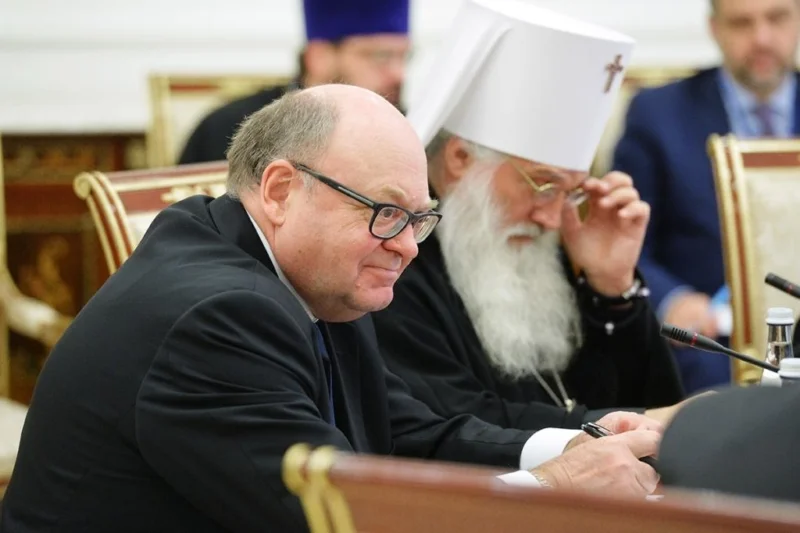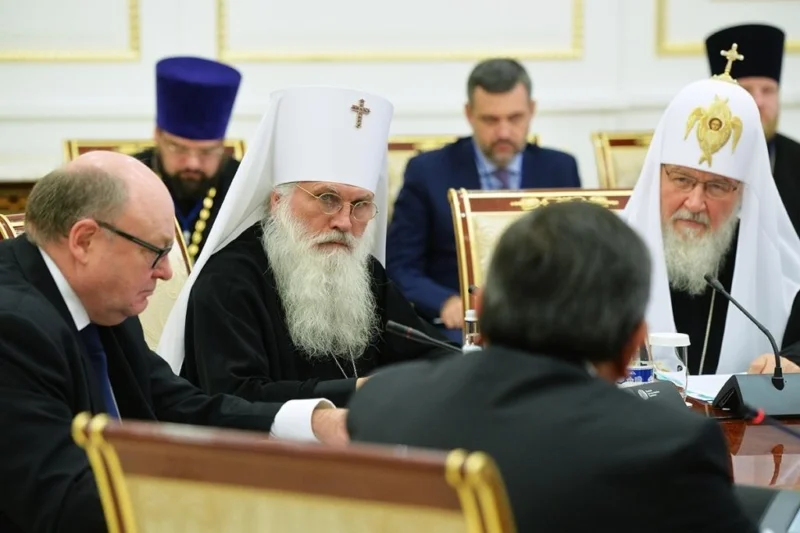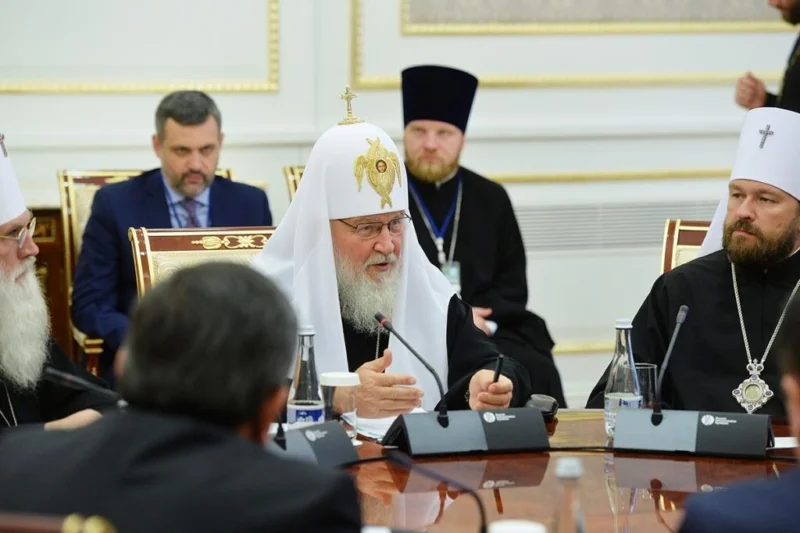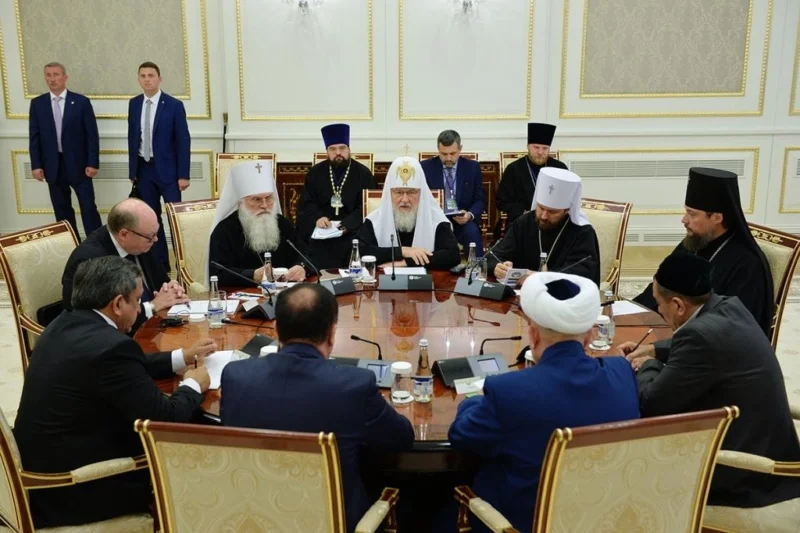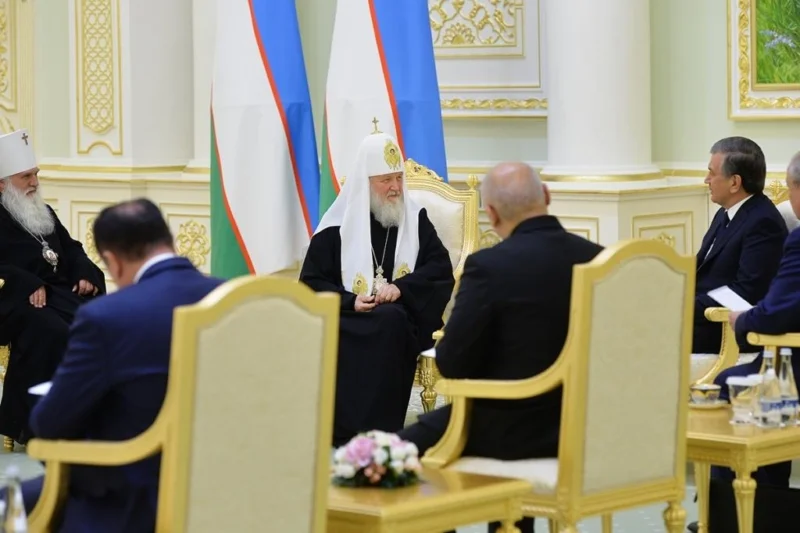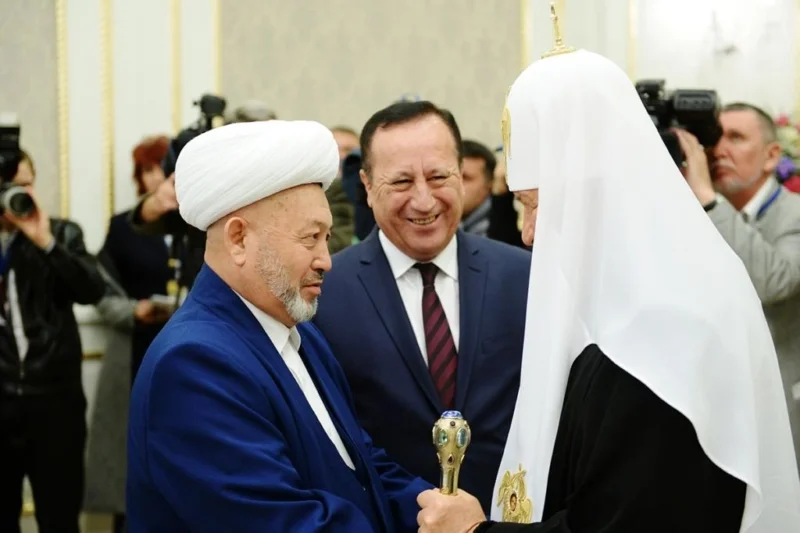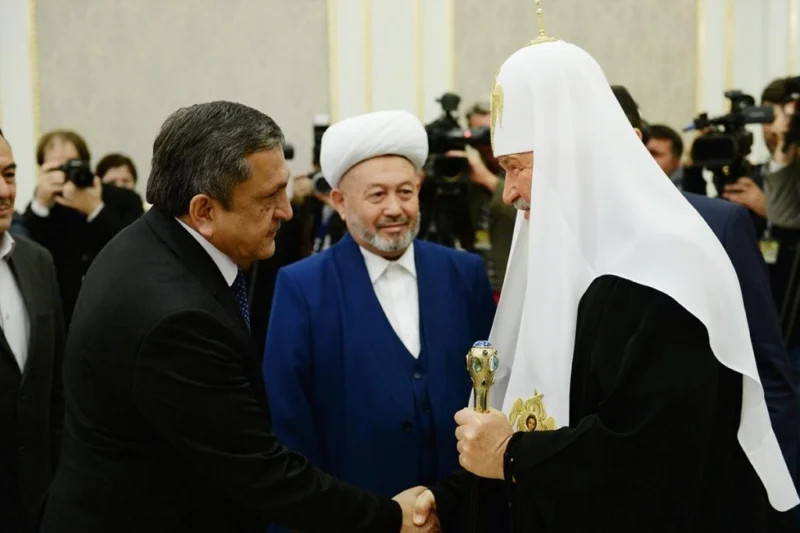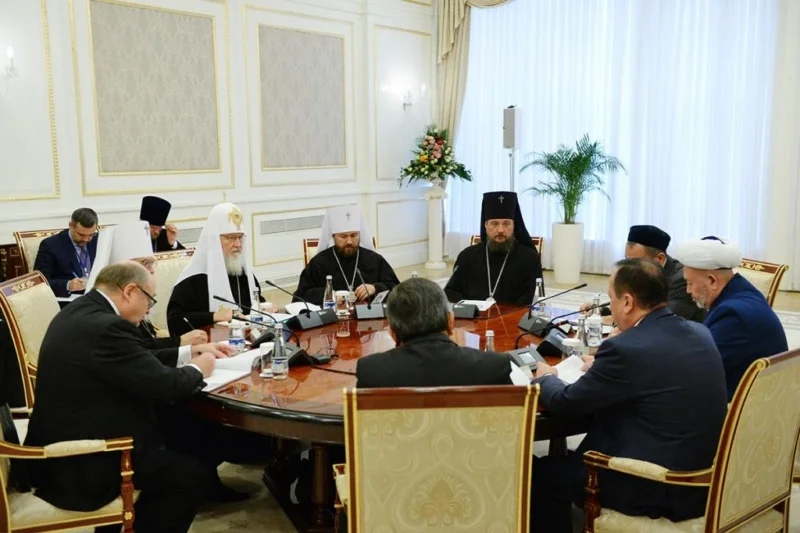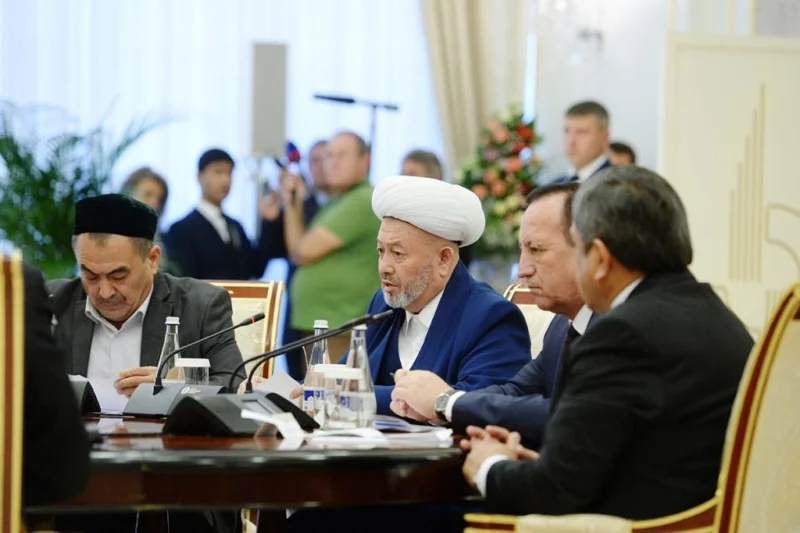
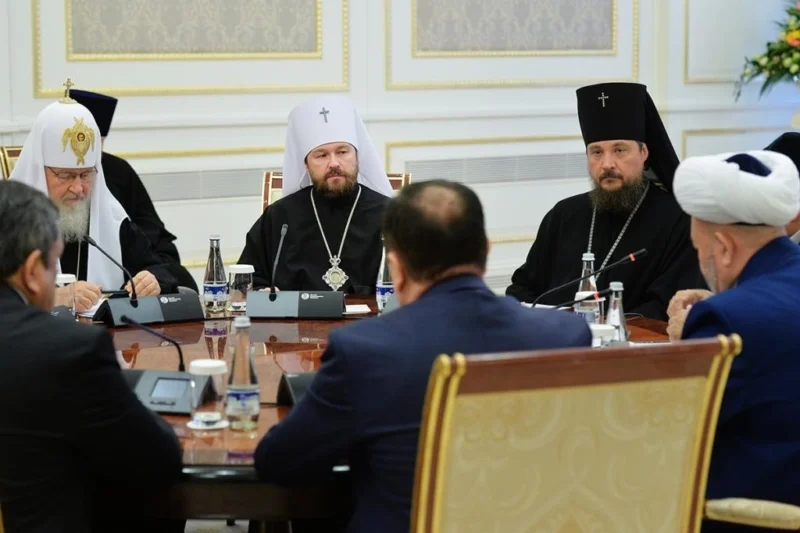
On 29 September 2017 in Tashkent, His Holiness Patriarch Kirill of Moscow and All Russia met with the chairman of the Muslim Board of Uzbekistan, Mufti Usmonkhon Alimov, and the chairman of the Committee for Religious Affairs under the Cabinet of Ministers of the Republic of Uzbekistan, A. A. Yusupov.
Also taking part in the meeting were, on the Uzbek side, the director of the Center for Islamic Culture under the Cabinet of Ministers of the Republic of Uzbekistan, Sh. Minovarov; the head of the international department of the Muslim Board of Uzbekistan, M. Shakirov; an adviser to the Department for Religious Affairs under the Cabinet of Ministers of the Republic of Uzbekistan, B. Kadyrov; and the press secretary of the Department for Religious Affairs under the Cabinet of Ministers of the Republic of Uzbekistan, Sh. Khamdamov; and, on the side of the Russian Orthodox Church and the Embassy of the Russian Federation, the head of the Central Asian Metropolitan District, Metropolitan Vikenty of Tashkent and Uzbekistan; the chairman of the Department for External Church Relations, Metropolitan Hilarion of Volokolamsk; the head of the Administrative Secretariat of the Moscow Patriarchate, Archbishop Sergiy of Solnechnogorsk; the Ambassador Extraordinary and Plenipotentiary of the Russian Federation to the Republic of Uzbekistan, V. L. Tyurdenev; the chairman of the Synodal Department for Church Relations with Society and the Media, V. R. Legoida; and the DECR secretary for interreligious relations, Priest Dimitry Safonov.
Welcoming the Primate of the Russian Orthodox Church, the chairman of the Committee for Religious Affairs under the Cabinet of Ministers of the Republic of Uzbekistan, A. A. Yusupov, expressed confidence that His Holiness’s visit would bring “great joy and spiritual enrichment to our Orthodox citizens and also strengthen the friendly ties between our fraternal peoples.”
The head of the Committee for Religious Affairs spoke about the cooperation between the leadership of the Republic of Uzbekistan and the Diocese of Tashkent, as well as about the state of interreligious relations in the country.
“The state welcomes the fact that, through the efforts of Metropolitan Vikenty, a center of Orthodox education and culture and a museum of Christianity in Central Asia are planned to be built at the diocesan administration,” A. A. Yusupov noted in particular. He also reported on the state’s work to counter religious extremism and terrorism. According to A. A. Yusupov, this year, on the initiative of the President of Uzbekistan, “the priority in preventing religious extremism has been defined as reaching out to persons mistakenly drawn into religious-extremist activity, showing them trust and comprehensive help in returning to peaceful life, and also forming in society a humane attitude toward this category of persons.”
Mufti Usmonkhon Alimov addressed His Holiness Patriarch Kirill. He spoke about the work of the Muslim Board of Uzbekistan and about the cooperation between the Islamic and Orthodox communities of the country, stressing that “today’s world requires the cooperation of all religious communities and all peoples in the fight against extremism and international terrorism.”
The director of the Center for Islamic Culture under the Cabinet of Ministers of the Republic of Uzbekistan, Sh. Minovarov, also spoke at the meeting.
His Holiness Patriarch Kirill then addressed the participants of the meeting.
“I have been to your country many times, even when it was part of the Soviet Union. Already at that time wonderful traditions of our cooperation and interaction were laid down. Every time I came to Uzbekistan and met your predecessors, I felt at home. We were like-minded, and this like-mindedness stemmed from our common experience. We lived through the difficult years of state atheism and far from always felt goodwill toward us on the part of the authorities, although in Uzbekistan the attitude toward religious communities was milder than in Russia. It was precisely at that time that a system of solidarity took shape, which we valued very highly. We gathered at various conferences, expressed our point of view on various problems that troubled our society then, and this laid the foundation for real interaction and cooperation,” said the Primate of the Russian Church.
“When the republics of the Soviet Union became sovereign states, at some point we felt our ties weakening. But we were always told, including by the Muslims of Uzbekistan: ‘We need to be together again; we live in different countries, but we face common problems.’ In keeping with this tradition of good cooperation, the first Patriarchal visit to independent Uzbekistan took place — in 1996 my predecessor of blessed memory, His Holiness Patriarch Alexy II, came to the country, and I accompanied him. We had very good contacts with our Muslim brothers, with the leaders of the Islamic community at that time. I recall a meeting with Mufti Mukhtar-hajji Abdullaev, a great friend of our Church. We had a lengthy conversation, as a result of which the idea of holding a summit of religious leaders in Moscow was agreed upon. In 2006 the late Mufti Abdurashid Bakhromov took part in that summit, heading a large delegation from Uzbekistan. Already then, in 2006, the summit spoke out firmly against believers falling under the influence of extremism. I think that work to prevent radical sentiments in religious communities must constantly remain at the center of our common attention,” His Holiness the Patriarch noted.
“We conduct dialogue with various religions and Christian confessions, but for us Orthodox, who live in Russia not merely next to but side by side with a large Islamic community, dialogue with Islam holds a special place. Twenty years ago we began a theological dialogue between the Russian Orthodox Church and theologians of Iran. When a commonality of positions on a whole range of issues became apparent, the idea arose of creating a permanent Russian Orthodox Church — Iran Commission. We discuss difficult problems, and the result is a remarkable like-mindedness. Of course, we did not arrive at this like-mindedness at once, but today we can say that we have reached a common understanding of the significant problems of our time. This is very important, since the results of the dialogues are communicated to the public. We are developing very close relations with the Muslims of Turkey, Syria, Iraq, Egypt, Azerbaijan and other countries. That is why I very much wanted to come to Uzbekistan as well and meet with you in order to renew good relations within the framework of both bilateral and perhaps also multilateral contacts,” His Holiness said.
“In Russia we attach great importance to holding regular consultations among the main traditional religions — for us these are Orthodoxy, Islam, Judaism and Buddhism. These four traditional religions make up the Interreligious Council of Russia, and we discuss many issues,” the Primate of the Russian Church said. “First, we work out a common point of view on questions related to legislation and on dialogue with the authorities. After all, problems arise from time to time, although today Russia is a country with the highest standard of religious freedom. We feel no restrictions — neither we, nor the Muslims, nor anyone. Nevertheless, difficulties sometimes arise, for example if someone initiates laws that do not fully meet the interests of religious communities. We have understood that it is best to enter into dialogue with legislators from a common position, so we first agree on a position among the traditional religions within the Interreligious Council and then present it in dialogue with the state.”
According to His Holiness, the Interreligious Council of Russia takes up a whole range of practical questions of interaction between religions. For example, in cases when the mass media “treat people’s religious feelings without sufficient sensitivity and offend the religious feelings of Orthodox Christians, Muslims, Jews and Buddhists, we respond to all this in solidarity.”
“We believe this is a very right response, because insulting religious feelings is also one of the forms of extremism; it is something that shakes the foundations of social life, provoking internal conflict. And the traditional religions are called to strengthen the foundations of national life,” His Holiness the Patriarch stated. “Each of us is called to work with his own flock, to bring it up in a spirit of mutual respect, of care for the stability of social life and for the good of the state and the people. This is what is being carried out within the framework of a broad dialogue in the Interreligious Council.”
“Another of the topics we are working on today is the protection of personal and public morality and, especially recently, the protection of family values,” His Holiness continued. “We are deeply convinced that the traditional family must be preserved and that parents must be given priority in bringing up the family — removing children from the family is possible only as a last resort. Parents bear the main responsibility for a child’s upbringing, while society and religious communities are called to help make this upbringing effective and directed toward good ends.”
“I know that in its activities the Muslim Board of Uzbekistan pays special attention to combating pseudo-religious extremism and terrorism. I know that the state of Uzbekistan, in the person of the President and the relevant agencies, is also very concerned about this,” the Primate of the Russian Church added. “As it seems to us, the main cause of extremism is the uncritical attitude of Islamic youth toward the information signals coming from outside. Young people are not always able to assess them critically, especially when they lack knowledge. That is why we consider questions of religious education very important. It is sometimes said that religious education can divide society and provoke conservatism and even radicalism, but this is not true, because everything depends on how the education system is built.”
“Our schools have largely lost their educational, character-forming function; it is all about instruction alone,” His Holiness Patriarch Kirill noted with regret. “Today schools do not bring children up, and universities even less so. A student comes to a higher educational institution for educational services, and few professors think that, besides a body of knowledge in a particular subject, they also need to pass on convictions, to pass on certain moral positions that would help young people not only to gain knowledge but also to build their lives wisely. After all, knowledge does not make a person happy. What makes a person happy is the state of his soul, regardless of education, work or level of income. Therefore, passing on moral values through education is the key to forming a prosperous society. And without such upbringing a person can become easy prey for all kinds of extremists, and in general, without moral foundations it is very easy to make many mistakes. It is enough to look at what is happening in the sphere of marriage — divorces, children orphaned while their parents are alive, a growing number of abortions, and so on.”
The Primate of the Russian Church thanked the participants of the meeting “for their support of the many programs carried out by Metropolitan Vikenty and our clergy.” “In 2003, with the support of the President and with your participation, the Spiritual and Administrative Center of the Diocese of Tashkent was built. Everything was done with the most benevolent attitude of the authorities of Uzbekistan; we value this very much and are grateful to you,” His Holiness stated. “The country has an Islamic university and an Orthodox theological seminary — this testifies to the attention the authorities of Uzbekistan pay to questions of education, and I would like to express my gratitude.”
“We need to restore joint intellectual work and hold academic conferences with the participation of the clergy and representatives of the state. After all, many important topics concern the republics of the former Soviet Union equally. For this kind of work, which we could carry out together, we should bring in orientalist scholars, specialists in Islam, political figures concerned with the issue of religious extremism, and public figures. In any case, we should put down on paper a list of all the problems we face today and think about how we can solve these problems today, so that our world may be more peaceful,” His Holiness Patriarch Kirill said in conclusion.