The Primate of the Russian Orthodox Church was accompanied by the head of the Central Asian Metropolitan District, Metropolitan Vikenty of Tashkent and Uzbekistan; the chairman of the Department for External Church Relations, Metropolitan Hilarion of Volokolamsk; the head of the Administrative Secretariat of the Moscow Patriarchate, Archbishop Sergiy of Solnechnogorsk; the Ambassador Extraordinary and Plenipotentiary of the Russian Federation to the Republic of Uzbekistan, V. L. Tyurdenev; the chairman of the Synodal Department for Church Relations with Society and the Media, V. R. Legoida; and the head of the Press Service of the Patriarch of Moscow and All Russia, Priest Alexander Volkov.
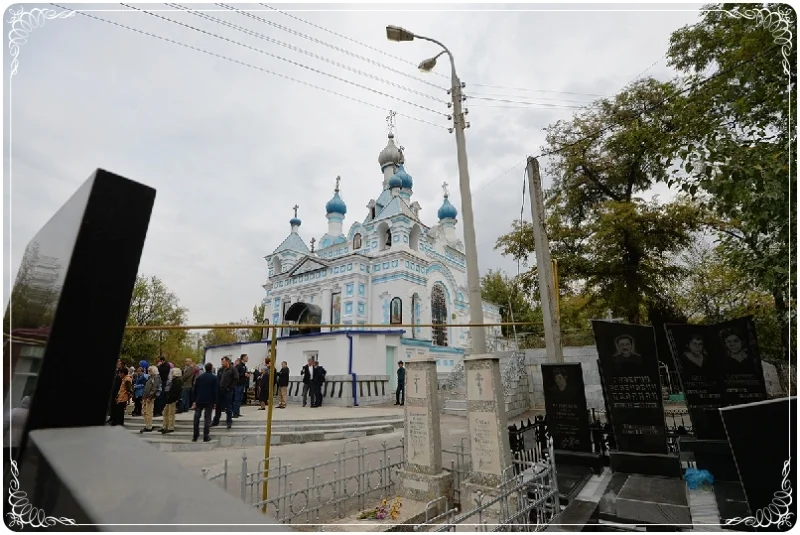
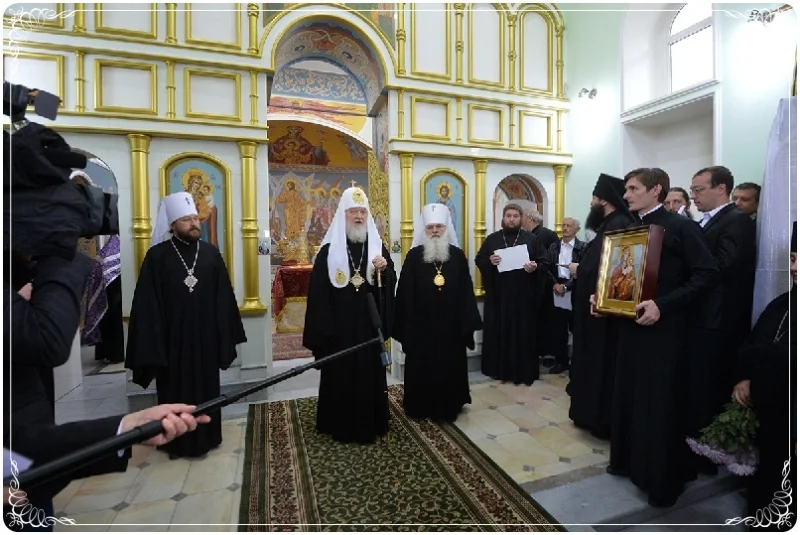
His Holiness Patriarch Kirill visited the Church of the Holy Right-Believing Grand Prince Alexander Nevsky, built in 1902–1905. It is one of the three churches that remained open in Tashkent during the Soviet period.
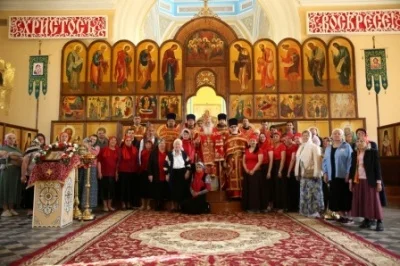
At the church His Holiness was met by the rector of the Church of St. Alexander Nevsky, Archpriest Sergiy Statsenko, and the clergy of Tashkent.
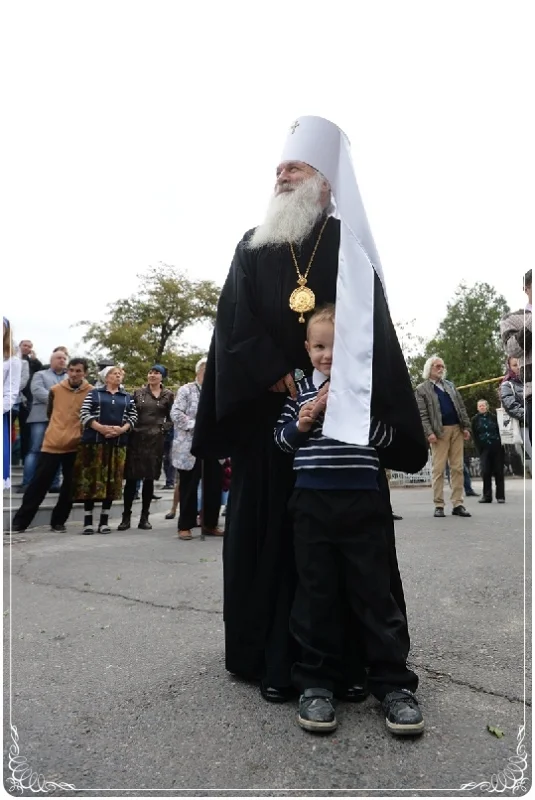
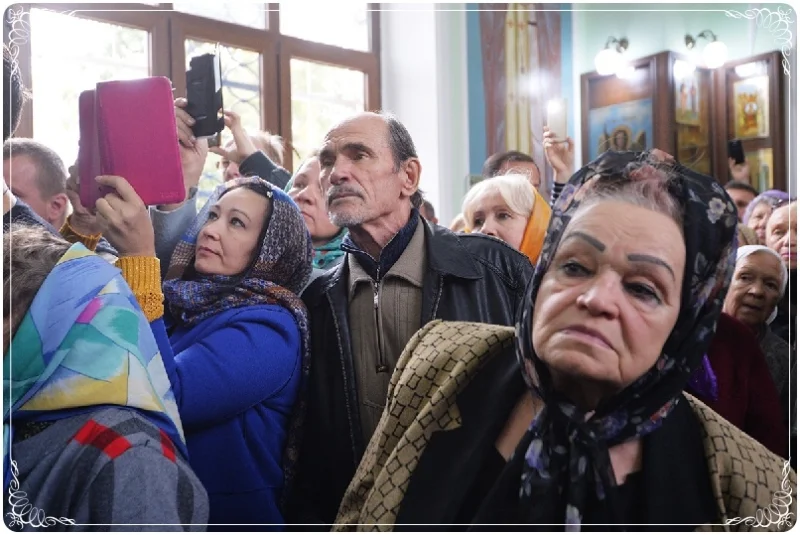
The Primate of the Russian Church addressed those present:
“Your Eminences! Dear fathers, brothers and sisters!
I am very glad to visit the historic Church of Alexander Nevsky at the Botkin Cemetery in Tashkent, where more than one generation of Orthodox Russian people lie buried — a cemetery that is in itself a monument to the presence of our people in this land. Among those buried here are outstanding people who worked in various fields of knowledge and public life, as well as simply remarkable individuals linked with the history of the Russian presence in Tashkent.
When we touch the past, even through contemplating gravestones, something important always happens in our minds. First, each person understands that he too will be buried in the same way. ‘There is no man who lives and does not sin,’ and there is not a single person who could escape death. That is why contemplating gravestones and praying in a cemetery always matter for those who pray, for nothing brings us into contact with eternity as death does.
Sometimes people are afraid of death, they shield children from seeing the dead, and they do not like to talk about this subject. This comes from unbelief, from a person’s excessive attachment to this life and from an unwillingness to think about the future. But a believer is obliged to think about the future, because the life to come is the goal of our earthly life, and in order to attain the Kingdom of God one must live in such a way that after death the blessed gates of eternity open before us.
The Church preserves the memory of the departed and celebrates services for the dead; this is done with particular solemnity on the days of commemoration of the departed. We must remember previous generations, we must pray for our parents and for all those we remember in the succession of relatives and loved ones who went before us, and, of course, always reflect on our own life.
May the Lord keep you all and strengthen in your hearts faith and the memory of the departed generations who came before us.”
As a gift to the Church of Alexander Nevsky at the Botkin Cemetery, His Holiness presented a copy of the Smolensk icon of the Mother of God.
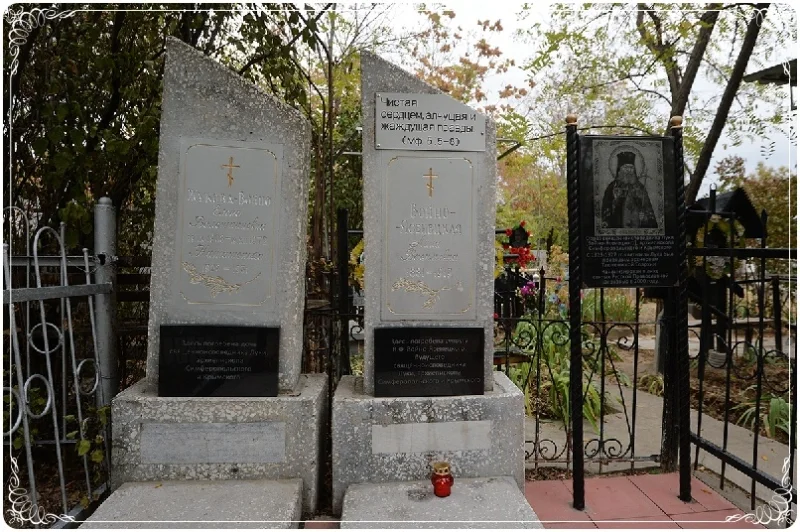
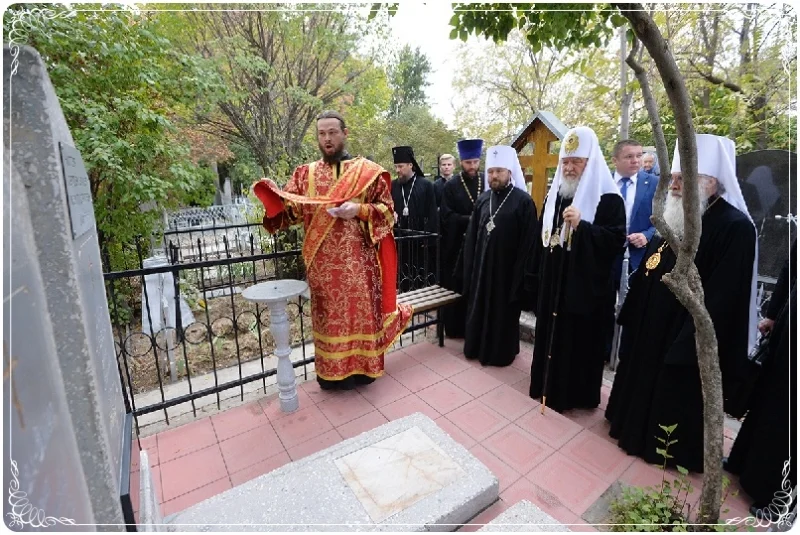
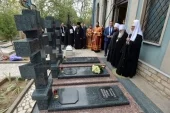
After visiting the church, His Holiness Patriarch Kirill laid flowers at the grave of relatives of St. Luke (Voino-Yasenetsky). In 1919 the future saint, V. F. Voino-Yasenetsky, buried his wife, Anna Vasilievna Lanskaya, not far from the Church of Alexander Nevsky. In 1931 a little girl, Natashenka, a granddaughter of St. Luke, was buried next to her grave, and in 1972 Elena Valentinovna Zhukova-Voino, the only daughter of Valentin Feliksovich and Anna Vasilievna. Today modest gravestones stand here. His Holiness also visited the grave of Archimandrite Boris (Kholchev, 1895–1971).
The Primate of the Russian Church laid flowers at the graves, and “Memory Eternal” was proclaimed.
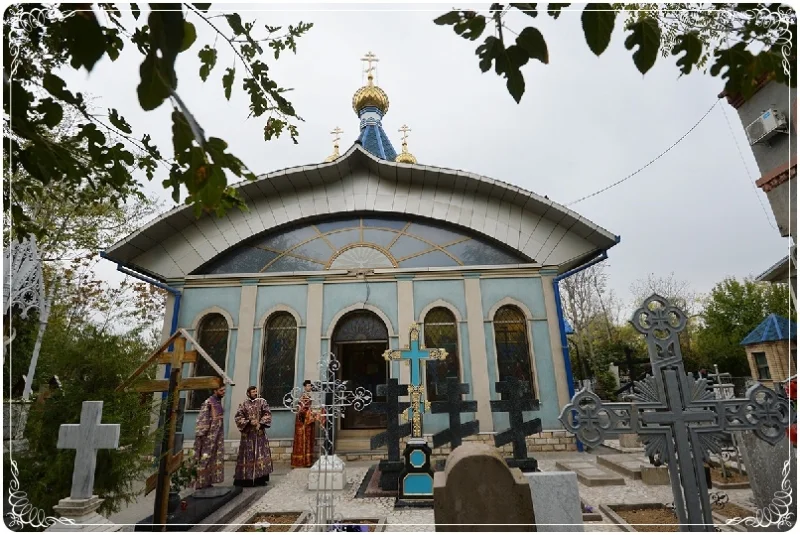
His Holiness Patriarch Kirill then visited the chapel dedicated to the icon of the Mother of God “Joy of All Who Sorrow,” built in the early 1870s, soon after the cemetery was established on this site. In the early 1920s, after the Church of Alexander Nevsky had been seized by the Renovationists, the Orthodox parishioners were forced to hold services in this chapel. Near the chapel are the graves of prominent hierarchs of the Diocese of Tashkent and Uzbekistan — Metropolitans Arseny (Stadnitsky, † 10 February 1936) and Nikandr (Fenomenov, † 18 February 1933) and Archbishop Gavriil (Ogorodnikov, † 28 February 1971).
Greeting those gathered, the Primate of the Russian Church said that he visits this place with special feeling, for here “canonical Orthodoxy was preserved, and here gathered the people who refused to accept the Renovationist schismatics, even though the Renovationists were supported by the authorities, who drove the faithful out by force.”
“On this spot, under an awning, services were celebrated until the Renovationist heresy and the Renovationist schism fell. We must preserve the memory of the courage of our predecessors, who in the most difficult conditions remained faithful to canonical Orthodoxy, prayed for Patriarch Tikhon and never betrayed the Russian Church,” His Holiness noted.
“And today, in these difficult times, the unity of the Church is the essential guarantee of preserving the unity of our people. Without the unity of the Church it is hard to speak of the true unity of the people. And if a people is divided, the state too loses its strength. May the Lord keep us all in like-mindedness, in unity and in firm Orthodox faith,” the Primate said.
His Holiness Patriarch Kirill celebrated a litiya for the departed archpastors and clergy of the Diocese of Tashkent. After flowers were laid on the graves of the Tashkent hierarchs, “Memory Eternal” was sung.
His Holiness Patriarch Kirill of Moscow and All Russia then visited the Synodal Administrative Center of the Central Asian Metropolitan District.
The Synodal Center was built on the site of the old diocesan administration, the residence of the ruling bishops of the Diocese of Tashkent. This plot in the city center was bought from the state in the mid-1940s. The diocesan administration building long went without repair and over time fell into disrepair. In 2012 the decision was taken to demolish the existing single-storey buildings. In January 2013 the foundation stone was laid for a new two-storey building, in which it was later decided to house the Synodal Administrative Center, where the sessions of the Synod of the Central Asian Metropolitan District are held. The building also serves as a guesthouse for bishops who come to Tashkent to take part in the sessions of the Synod of the District, and for those accompanying them.
After touring the Synodal Center, His Holiness Patriarch Kirill left Tashkent for Bukhara.
Press Service of the Patriarch of Moscow and All Russia