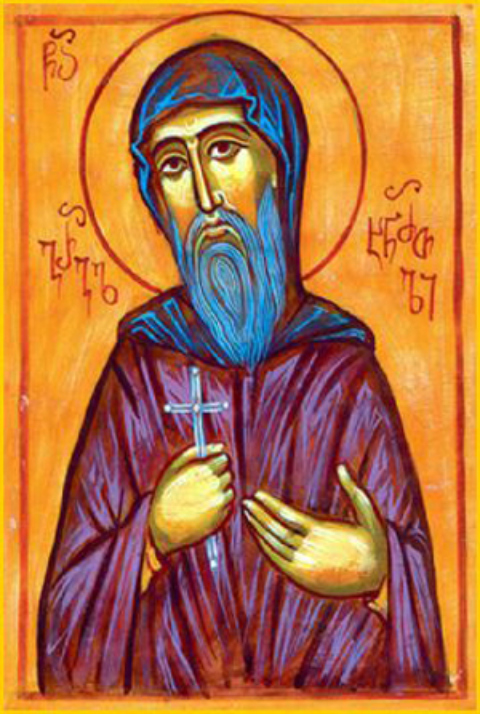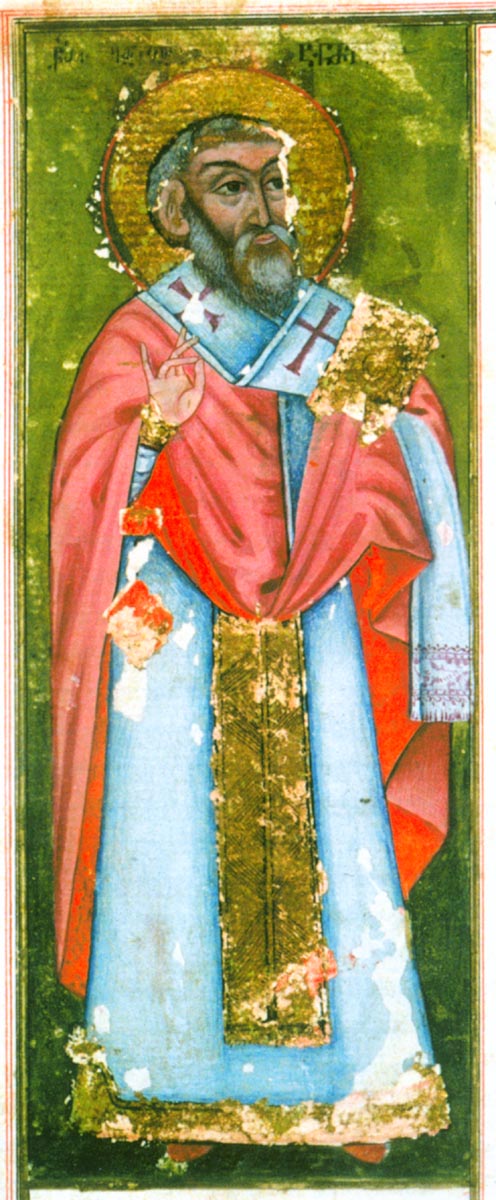
Venerable
Venerable Gregory of Khandzta
758/759 — †861
Also known as: Григол Хандзтели
Venerable Gregory of Khandzta (Grigol Khandzteli) — the greatest Georgian monastic reformer of the 8th-9th centuries, founder of the Khandzta Monastery and several other monasteries in Tao-Klarjeti, archimandrite over twelve monasteries, a key figure in the revival of Georgian monasticism and a defender of the autocephaly of the Georgian Church at the Council of Javakheti.
Venerable Gregory was born in 758/759 to a noble Meskhetian-Kartlian family and was raised at the court of the ruler Nerse Eristavi, receiving an extensive education in the Psalter, patristic writings, languages, and philosophy. Avoiding family pressure toward the priesthood or episcopacy, he fled with his cousin Saba (later Bishop of Ishkhani) and the monks Christopher and Theodore to the wilderness lands of Klarjeti, laboring first at the Opiza monastery. Around 780-782, together with the hermit Khvedios (Evodius) and with the support of the nobleman Gabriel Dapanchuli and King Ashot I Kuropalates, he founded the Khandzta Monastery, later becoming archimandrite over roughly twelve monasteries of Klarjeti and Tao (five of which he personally founded or restored, including Shatberdi — a major center of manuscript production endowed by Ashot I — and Ubisi, founded at the request of King Demetre II). He instituted a strict Sabaite (Jerusalem-style) monastic rule, played a decisive political role in defending the election of the young Catholicos-Patriarch Arseny I at the Council of Javakheti, and contributed to strengthening the autocephaly of the Georgian Church and the Georgian national-monastic revival after the 780s. He died peacefully at Shatberdi and was buried at Khandzta on October 5, 861, having lived about 102 years. His Life was written in the 10th century by the monk Giorgi Merchule and is considered a masterpiece of medieval Georgian hagiography.
Icons and images