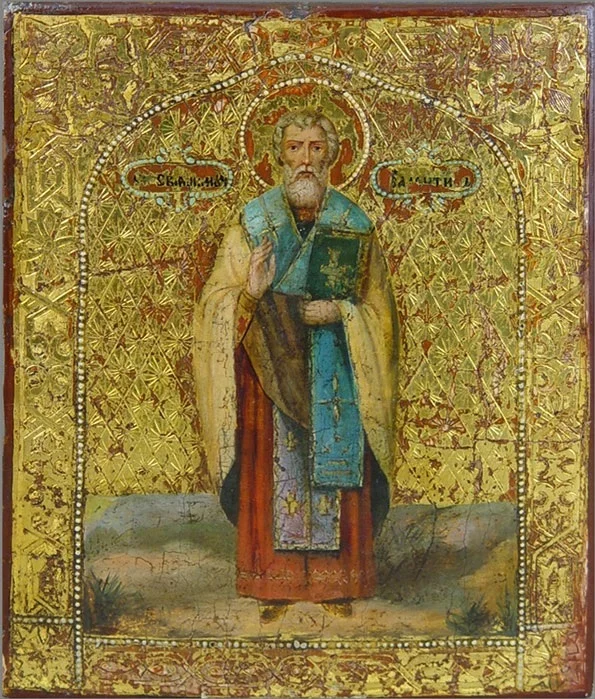
Hieromartyr
Hieromartyr Valentine, Bishop of Interamna (Terni)
III век — †ок. 269-273
Also known as: Валентин Тернийский, Валентин Интерамский
Hieromartyr Valentine, Bishop of Interamna (Terni) — renowned for the gift of healing, he was beheaded in Rome around 269-273 under Emperor Aurelian (other accounts say under Claudius Gothicus); the romantic "Valentine's Day" tradition developed considerably later and has no basis in the ancient hagiographic sources.
Hieromartyr Valentine was bishop of the city of Interamna (modern Terni) in Umbria, Italy, renowned for the gift of healing. According to tradition, three young men from Athens — Proculus, Ephebus, and Apollonius — who had come to study in Rome, lodged with their tutor Craton, whose son Chorimon suffered from a severe spinal deformity. Valentine came to Rome and, after spending a night in prayer over the youth, healed him — leading to the conversion of many to Christianity.
The hierarch was subsequently seized, tortured, and pressured to renounce Christ and sacrifice to idols; he was imprisoned. When it became known that his spiritual "children" continued to visit him in confinement, the authorities ordered him beheaded. His disciples carried his body and buried it near Interamna, at the 63rd milestone of the Via Flaminia. A basilica was later built over the tomb.
IMPORTANT NOTE ON THE COMMEMORATION DATE: in the Western (Catholic) tradition his feast is kept on February 14 — it is this date that became the basis of the secular "Valentine's Day." In the Orthodox tradition, however, the hierarch is commemorated on July 30/August 12, together with Martyrs Proculus, Ephebus, Apollonius, and the Righteous Abundius — this date has been adopted as primary for this entry, with February 14 noted separately as the Western date.
IMPORTANT NOTE ON IDENTITY: the question of whether "Valentine of Terni" (bishop) and "Valentine of Rome" (priest, also commemorated February 14) are the same person remains a matter of scholarly debate — some researchers consider them one and the same person (a bishop from Terni who came to Rome and was buried there), others regard them as two distinct martyrs who happened to share a name and feast day. The modern Roman Martyrology (2001/2004 edition) lists only one St. Valentine for February 14, leaning toward the "single person" reading, though this is not a definitively established historical fact.
IMPORTANT NOTE ON "VALENTINE'S DAY": the romantic associations (secret marriages for soldiers, love notes) are a late-medieval and early-modern legendary tradition (spread especially through Chaucer and later English/French courtly culture), with no basis in the ancient hagiographic sources, which contain only accounts of healing and martyrdom.
Icons and images