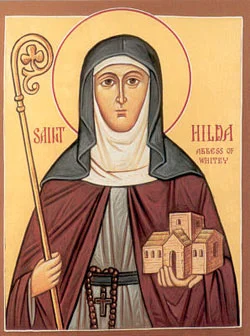
Venerable
Venerable Hilda of Whitby
614 — †17 ноября 680
Also known as: Хильд Уитбийская
Venerable Hilda of Whitby — abbess of the famous double monastery at Whitby (Northumbria), where in 664 the historic Synod took place that determined the English Church's transition to Roman (rather than Celtic) Easter-dating and customs; mentor of Caedmon, the first Anglo-Saxon Christian poet.
Venerable Hilda was born in 614, the daughter of Prince Hereric, nephew of King Edwin of Northumbria (making her the king's great-niece). She was baptized together with King Edwin by St. Paulinus of York, probably at Easter 627 in York. At age 33 (647) she took monastic vows, inspired by the example of her elder sister Hereswith; she was recalled by St. Aidan to lead monastic life in England.
She governed the monastery at Hartlepool, then in 657 founded (or took charge of) the famous double monastery (for monks and nuns) at Whitby, which became a center of scriptural study and later produced five bishops among its monastics.
At the Whitby monastery in 663-664 the historic Synod took place: although Hilda herself initially favored the Celtic (Ionan) customs of Easter-dating and tonsure, she accepted the Synod's decision (championed by Bishop Wilfrid) to follow Roman practice — this decision determined the future course of the English Church.
The venerable one recognized and fostered the poetic gift of the cowherd Caedmon — she received him into the monastery and instructed him in sacred history, which he turned into verse; Caedmon is venerated as the first Anglo-Saxon Christian poet.
The venerable one suffered a severe illness for the last seven years of her life. She died on November 17, 680.
Icons and images