Venerable
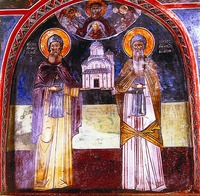
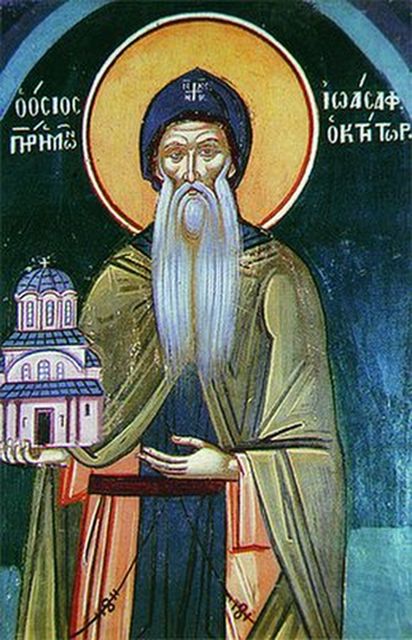
Venerable Ioasaph of Meteora (John Uroš)
ок. 1349/50 — †1422/23
Also known as: Иоанн Урош, Урош Палеолог
Venerable Ioasaph of Meteora — in the world John Uroš, the last ruler of Thessaly from the Serbian Nemanjić dynasty, who abdicated the throne for monasticism and became the second abbot-ktitor of the Great Meteoron (Transfiguration) Monastery after its founder, Venerable Athanasios of Meteora.
Venerable Ioasaph was born around 1349-1350 as John Uroš, son of Simeon Uroš, ruler of Epirus and Thessaly, and Theodora (Thomais) Orsini — a descendant of the Serbian royal Nemanjić dynasty. He was proclaimed co-ruler around 1359-1360, and then sole ruler of Thessaly (c. 1370-1373).
Around 1372-1373 he abdicated the throne, transferring secular power to Caesar Alexios Angelos Philanthropenos, and took monastic vows at the Great Meteoron Monastery under the influence of its founder, Venerable Athanasios of Meteora, receiving the name Ioasaph. After Venerable Athanasios's repose he became the monastery's second abbot-ktitor, continuing his work: he rebuilt and expanded the monastery's Transfiguration Cathedral (1387/88) and helped establish the neighboring Hypsilotera Skete (1389/90). According to some accounts, around 1394 he withdrew to Mount Athos due to the Ottoman threat, returning to lead the monastery around 1401.
He is venerated as a saint by the Greek and Serbian Orthodox Churches, as well as by the Russian Church. The venerable's head is preserved as a relic in the katholikon of the Great Meteoron Monastery.
His feast is kept on April 20, together with St. Athanasios of Meteora, whose spiritual successor and continuer of work he became.
IMPORTANT NOTE ON POSSIBLE CONFUSION: this Venerable Ioasaph of Meteora should be distinguished from an entirely different, fictitious "Ioasaph of Borovichi" — an entry under that name (see the separate batch tracker note) turned out to be contamination from the legend of Barlaam and Ioasaph (about an Indian prince) and has no connection either to Meteora or to any real Russian saint.
Icons and images