Hierarch
Hierarch John Chrysostom
ок. 347 — †14 сентября 407
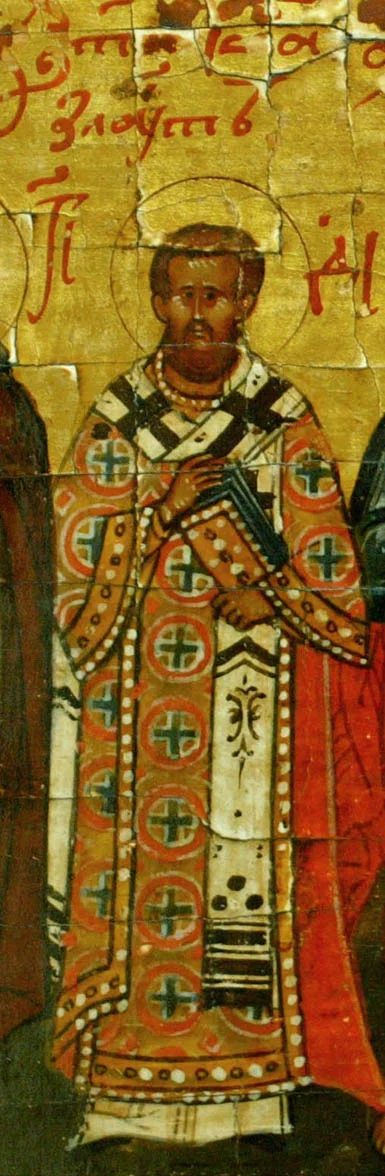
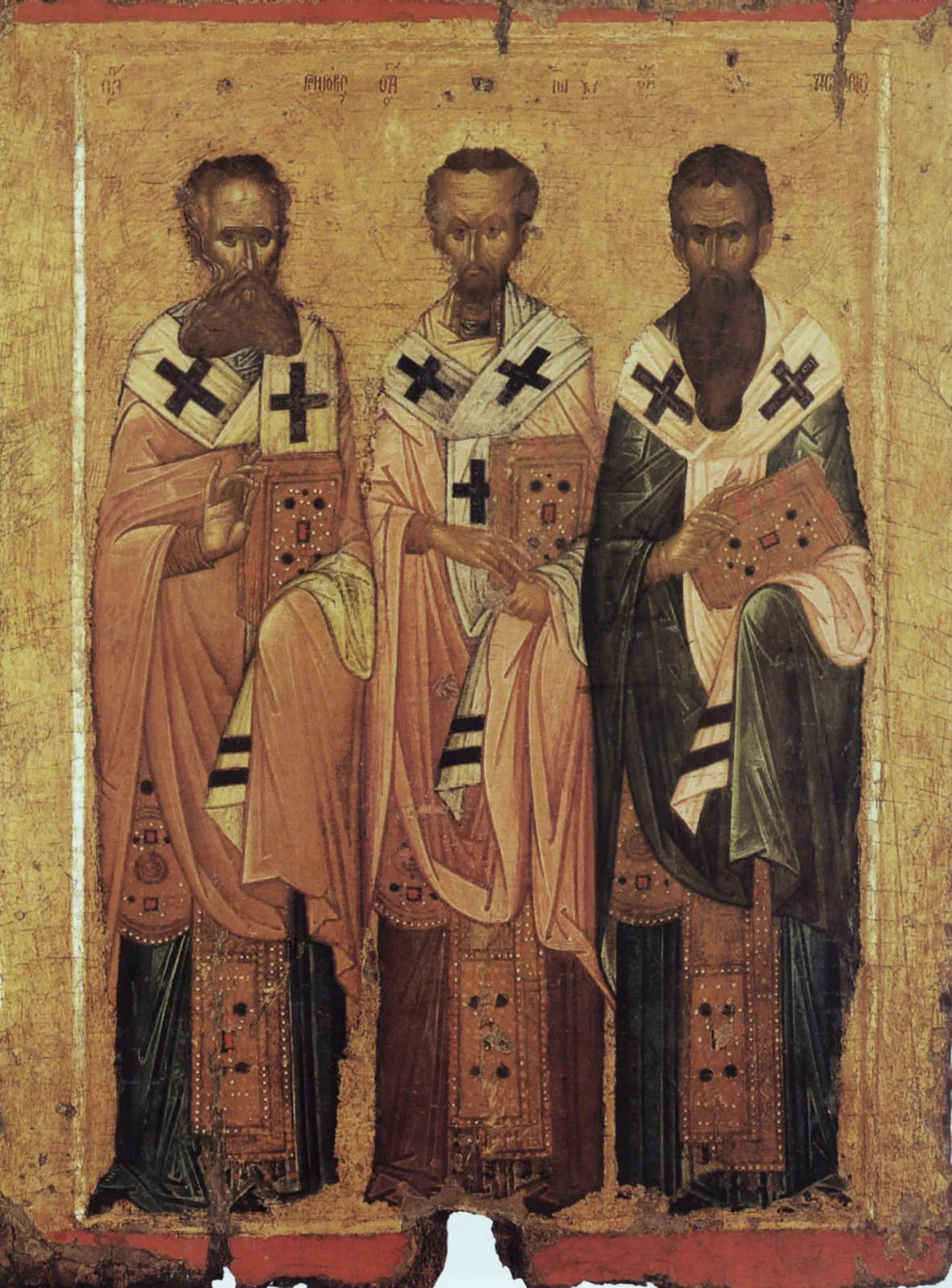
Hierarch John Chrysostom — Archbishop of Constantinople, one of the Three Holy Hierarchs (together with St. Basil the Great and St. Gregory the Theologian), the greatest preacher and expositor of Scripture, author of the most widely used rite of the Divine Liturgy in the Orthodox Church; twice sent into exile for denouncing injustice at the imperial court, he died en route to a third exile in 407.
Hierarch John was born around 347 in Antioch, Syria, to the military commander Secundus, who died shortly after his birth, and Anthusa, who devoted herself to raising her son and refused to remarry. He received a brilliant education under the celebrated pagan rhetorician Libanius, of whom a tradition survives: asked whom he would wish as his successor, he replied — "John, had the Christians not stolen him from us."
He was baptized around 367-370 by Bishop Meletius of Antioch and soon made a reader. After his mother's death he withdrew to the mountains near Antioch among hermits, then spent about two years in solitary cave asceticism, undermining his health (chronic stomach and kidney ailments that plagued him his whole life) and being forced to return to the city around 378.
He was ordained deacon by Bishop Meletius (c. 381) and presbyter by Bishop Flavian of Antioch (386). Over twelve years as a presbyter in Antioch he became famous for his exceptional gift of preaching and scriptural interpretation, for which contemporaries and posterity named him Chrysostom ("Golden-Mouthed"). The best-known work of this period is the cycle of 21 homilies "On the Statues," delivered during Lent 387 amid the crisis caused by the citizens' destruction of imperial statues; John's sermons calmed the terrified city while Bishop Flavian sought clemency from Emperor Theodosius I.
After the death of Archbishop Nectarius of Constantinople in 397, John was (reportedly against his own will, secretly removed from Antioch to avoid popular protest) chosen and consecrated Archbishop of Constantinople on December 15, 397, solemnly enthroned on February 26, 398.
As archbishop he immediately imposed strict discipline on his own household and clergy, cutting his predecessor's lavish expenses in favor of works of mercy — establishing shelters and hospitals for the poor and lepers. He denounced the luxury, avarice, and injustice of the nobility and imperial court, most sharply Empress Eudoxia, which, together with his interference in other sees' affairs and his sheltering of the Egyptian "Tall Brothers" monks fleeing the persecution of Patriarch Theophilus of Alexandria, earned him powerful enemies.
In September 403, Theophilus of Alexandria, arriving in Constantinople ostensibly to answer for himself, instead convened the Synod "of the Oak" in a suburb of Chalcedon, where John, refusing to appear before a tribunal hostile to him, was deposed in absentia. Popular outrage was so strong that Emperor Arcadius soon recalled him from his brief exile.
Relations soured again after a silver statue of Eudoxia was erected near Hagia Sophia, which John denounced from the pulpit. A new synod demanded his removal; on Holy Saturday 404 the emperor forbade him to celebrate the Paschal service, and imperial troops dispersed those gathered for the vigil. On June 20, 404, John was sent into permanent exile — first to Cucusus in Armenia Secunda, where he spent about three years enduring illness and bandit raids, maintaining an extensive correspondence (including with the deaconess Olympias and Pope Innocent I of Rome, who protested in vain against his deposition).
In 407, fearing his continuing influence and the stream of pilgrims to Cucusus, his enemies had him sent further still, to Pityus on the Black Sea coast. Exhausted and ill, he did not survive the journey, dying at Comana in Pontus on September 14, 407, with the words: "Glory to God for all things!" (Δόξα τῷ Θεῷ πάντων ἕνεκεν).
The hierarch's memory was restored within the next generation: his name was returned to the diptychs of Constantinople under Patriarch Atticus (c. 417) and especially honored under Patriarch Proclus. In 438, under Emperor Theodosius II (son of Arcadius and Eudoxia) and at Patriarch Proclus's urging, his relics were solemnly translated from Comana to Constantinople and laid in the Church of the Holy Apostles — a public act of imperial and ecclesiastical repentance for his persecution.
He left an immense homiletic and exegetical legacy — commentaries on Genesis, the Psalter, the Gospels of Matthew and John, Acts, and the Epistles of Paul, as well as treatises (most famously "On the Priesthood") and hundreds of letters. The rite of the Divine Liturgy bearing his name (a reworking of an earlier Antiochene-Constantinopolitan rite) remains the most frequently celebrated liturgy of the Byzantine rite.
IMPORTANT CORRECTION: the original stub erroneously listed the category "righteous" with text word-for-word indistinguishable from the template for laypeople "who did not take monastic vows" — directly contradicting the hierarch's biography, which included strict eremitic asceticism before his ordination. The date of the Synaxis of the Three Holy Hierarchs (January 30/February 12), absent from the original list, has also been added.
Icons and images