

Martyr
Martyr Christopher of Lycia
† ок. 250
Also known as: Репрев (дохристианское имя)
Martyr Christopher of Lycia — a soldier of gigantic stature and strength, who before baptism bore the name Reprebus, and who suffered during the persecution of Emperor Decius (c. 250) in Lycia; his famous dog-headed (cynocephalic) iconography is owed not to a literal physical appearance but to a symbolic depiction of his bestial, savage state before his conversion to Christ, according to the interpretation of the Constantinopolitan Synaxarion.
Martyr Christopher suffered for Christ in Lycia (Asia Minor) around 250, during the reign of Emperor Decius. Before baptism he bore the name Reprebus ("worthless," "reprobate"); he was distinguished by gigantic stature and enormous physical strength. According to tradition, praying to God to deliver him from temptations connected with his attractive appearance, he asked to have his face disfigured.
Brought to trial before the emperor, along the way he converted about 200 soldiers to Christ through miracles he performed. Decius sent two women to seduce him into apostasy — but both, instead, came to believe and suffered a martyr's death. Christopher himself endured cruel torture (including, according to tradition, being placed in a heated bronze vessel) and was beheaded.
THE "DOG-HEADED" ICONOGRAPHY: one of the most recognizable and disputed features of Russian and Balkan iconography of Christopher is his depiction with a dog's head (cynocephalus). Several explanations exist for this tradition: (1) the similarity of the word "Canaanite" (according to tradition, Christopher came "from the land of the Canaanites") to the Latin "canineus"/"canis" ("canine," "dog") may have led to a semantic contamination; (2) identification with the legendary "cynocephali" — mythical dog-headed peoples long placed at the edge of the known world, underscoring his origin from a barbarian, "foreign" tribe of giants; (3) a possible corruption of the place name Cynoscephalae (hills in Thessaly). The Constantinopolitan Synaxarion explicitly indicates a SYMBOLIC reading of the dog's head — as an image of his bestial, savage state BEFORE his conversion to Christ, not a literal physical appearance. The Old Believers continued (and continue) to venerate the cynocephalic iconography; the Sviyazhsk icon-painting tradition instead gave him a horse's (not dog's) head; later 18th-century Synodal restrictions contributed to the gradual softening of the image toward a fully human face.
THE WESTERN LEGEND OF CARRYING THE CHRIST CHILD ACROSS A RIVER: the widely known Western story (set out in Jacobus de Voragine's "Golden Legend," 13th century) of a giant who carried the Christ Child, who grew heavier with each step, across a river, is a later Western medieval addition, NOT part of the authentic early Eastern/Greek life of the Lycian martyr. It is the source of the Western etymology of the name "Christopher" = "Christ-bearer," later attached to the earlier Eastern martyrdom account.
His feast is kept on May 9/22.
Icons and images
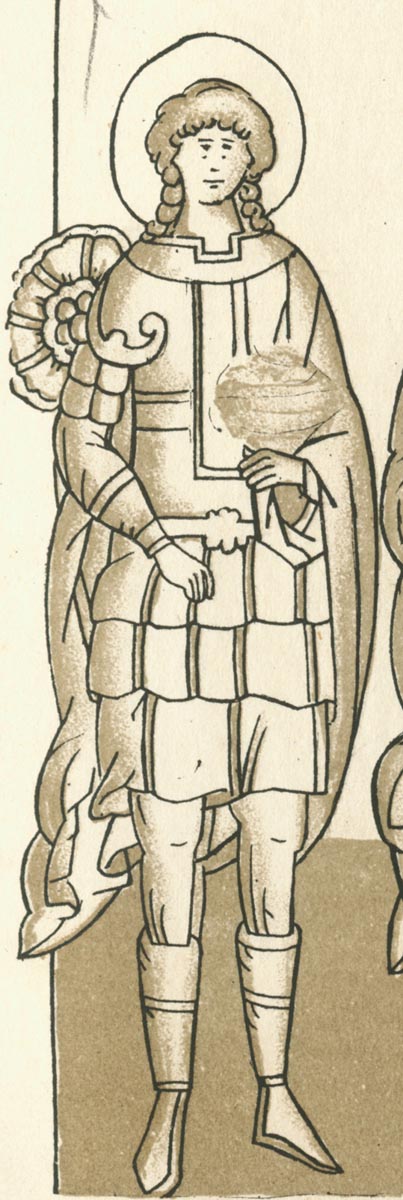
![Икона с надписью «ΧΡCΤΟΦΟΡ[ΟΣ]», датированная 1987 г. — святой несёт Младенца Христа через реку (западный мотив в греческом исполнении)](https://media.sobor.uz/sobor-media/saints/icons/khristofor-likiyskiy-2.jpg)