Hieromartyr
Hieromartyr Cyriacus of Jerusalem
† 362/363
Also known as: Иуда (дохристианское имя)
Hieromartyr Cyriacus of Jerusalem — according to Church tradition, a Jew named Judas who revealed to Empress Helena the location of the finding of the Cross of the Lord in 326, after which he was baptized with the name Cyriacus and became Bishop of Jerusalem; he suffered under Emperor Julian the Apostate (361-363), enduring cruel torture for refusing to renounce Christ.
Hieromartyr Cyriacus is known from Church tradition that took shape no later than the first half of the 5th century (preserved in Greek, Latin, Syriac, Coptic, Ethiopic, Armenian, and Georgian — evidence of widespread medieval veneration). According to tradition, before baptism he bore the name Judas and came from the Jews of Jerusalem, according to some versions a descendant of the Protomartyr Stephen.
When Empress Helena, mother of St. Constantine, arrived in Jerusalem (c. 326) seeking the Cross of the Lord, Judas, as the only one who knew (or was believed to know) the location of the relic, was handed over to her by the Jewish community; after refusing to reveal the place he was thrown into a dry well without food for seven days, after which he agreed and pointed to the site by the pagan temple of Venus built over Golgotha. Of the three crosses found in the excavation, the true one was distinguished by the miracle of raising a dead man (in another version, healing a sick woman) upon contact. Judas came to believe, was baptized with the name Cyriacus ("of the Lord"), and was later, according to tradition, ordained Bishop of Jerusalem.
IMPORTANT CLARIFICATION: modern scholarly criticism (including the Bollandist D. van Papebroch) notes that ancient lists of the bishops of Jerusalem from this period do not contain the name "Cyriacus" — the historicity of his episcopate (and to some extent the entire "Judas Cyriacus" legend) remains a matter of scholarly debate; what is presented here is an established Church tradition, not documented history.
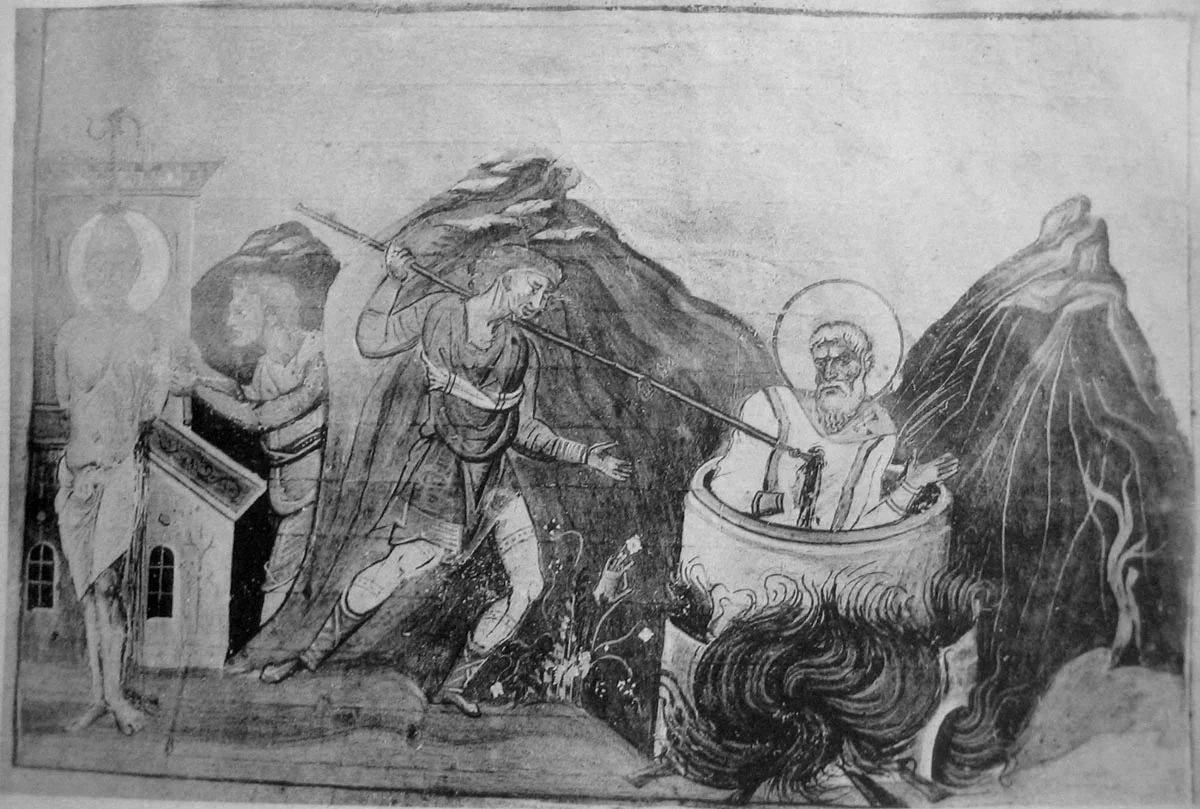
Under the reign of Emperor Julian the Apostate (361-363), during his Persian campaign, Cyriacus was seized together with his mother Anna and pressed to sacrifice to Zeus. Both refused; Anna died under torture. Cyriacus himself, according to tradition, had his right hand (which had written against the pagan gods) cut off, was thrown into a pit of venomous snakes and remained unharmed, then had molten lead poured into his mouth, was laid on a heated bed, and finally was boiled in oil (or lead) and pierced with a spear. His death occurred in 362 or 363.
His feast is kept on October 28/November 10.
Icons and images