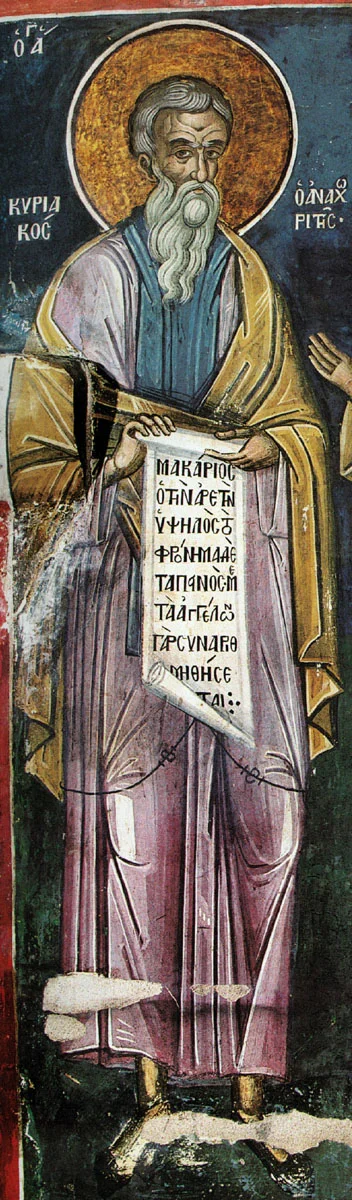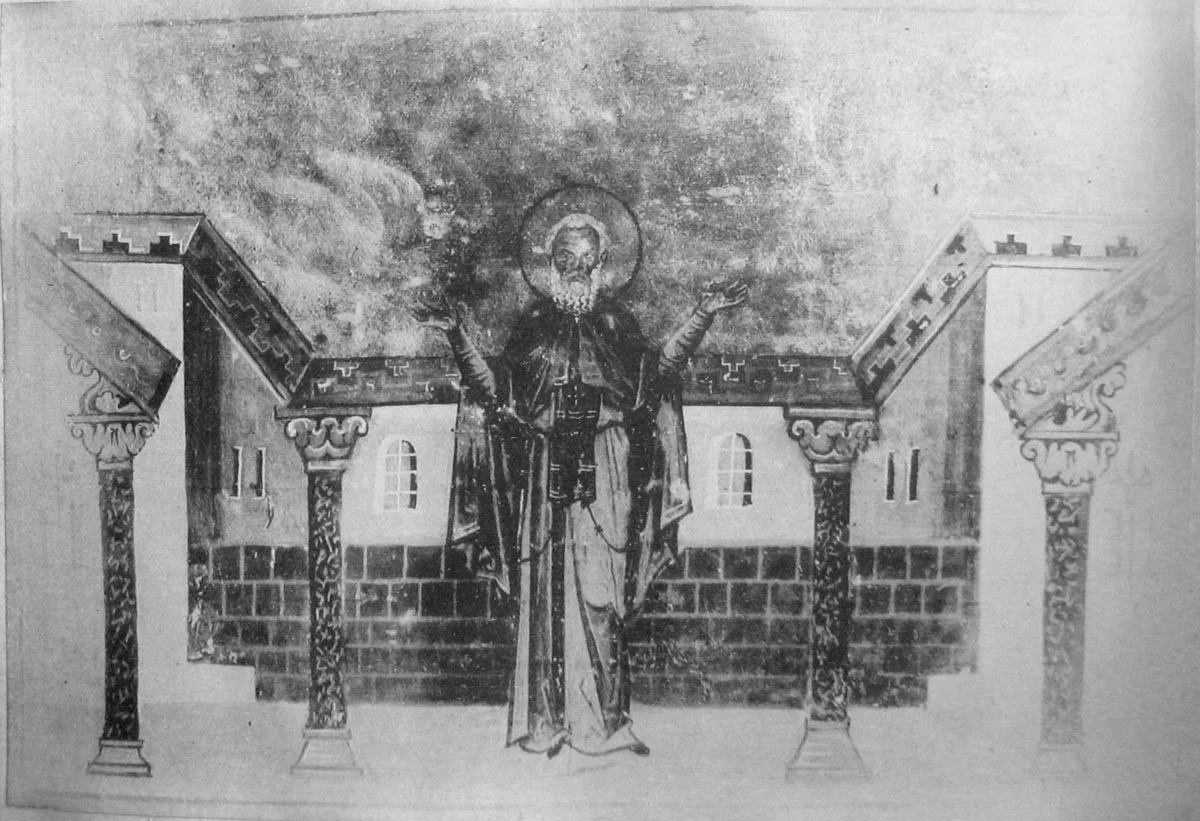
Venerable
Venerable Cyriacus the Hermit of Palestine
9 января 449 — †556/557
Venerable Cyriacus the Hermit — a native of Corinth, tonsured by Venerable Euthymius the Great and a disciple of Venerable Gerasimus of the Jordan, who spent ten years in silent seclusion, later labored for 30 years at the Souka (Old) Lavra of Venerable Chariton, and spent his final years in even deeper seclusion in the Judean desert; a zealous opponent of the Origenist heresy, he died at the age of 107-109.
Venerable Cyriacus was born on January 9, 449, in Corinth, to the presbyter John and his wife Eudocia. At 18, moved by the Gospel words (Matt. 16:24), he secretly left home and went to Jerusalem, where he venerated the holy places and spent the winter at a monastery near Mount Zion under Abba Eustorgius. He then came to the desert lavra of Venerable Euthymius the Great, who himself tonsured him a monk but, judging him too young for the strict lavra life, sent him to the coenobium of Venerable Theoctistus under Venerable Gerasimus of the Jordan. There he led a strict ascetic life, allowing himself almost no sleep, reading the Psalter daily.
After the repose of Venerable Gerasimus, the 27-year-old Cyriacus returned to the now-deceased Euthymius's lavra and took up ten years of silence in seclusion, communicating only with the monk Thomas (later bishop in Alexandria). At 37 he was ordained deacon. He later moved to the Souka (Old) Lavra of Venerable Chariton, where he spent a total of 30 years — ordained presbyter 4 years after his arrival, and serving 18 years as cantor. During the discord between the lavras of Euthymius and Theoctistus connected with the Origenist controversies, he withdrew specifically to Souka.
At about age 70 he withdrew into even stricter seclusion, moving through the deserts of Natoufa, Rouva, and Sousakim; he spent his final two years in the cave of Venerable Chariton.
He performed a number of miracles: healing a demon-possessed boy through prayer; during a famine, making bitter wild herbs sweet and edible through prayer; obtaining rain for a dried-up spring; according to tradition, a lion guarded him from robbers while leaving the brethren unharmed. He zealously opposed the Origenist heresy through prayer and teaching, predicting, according to tradition, the deaths of its leaders Nonnus and Leontius.
He died in 556 or 557 at the Souka Lavra (Tekoa) at the age of 107-109.
His feast is kept on September 29/October 12.
NOTE: not to be confused with Hieromartyr Cyriacus of Jerusalem (4th century) — an entirely different person, era (5th-6th c. vs. 4th c.), and form of struggle (ascetic hermitage vs. martyrdom); the distinction is confirmed by the established Greek epithet "Ὁ Ἀναχωρητής" ("the Anchorite/Hermit"), attached specifically to Venerable Cyriacus of Palestine.
Icons and images