Hierarch
Hierarch Kirill Turovsky
ок. 1130 — †ок. 1182
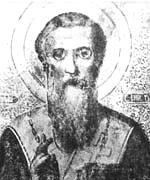
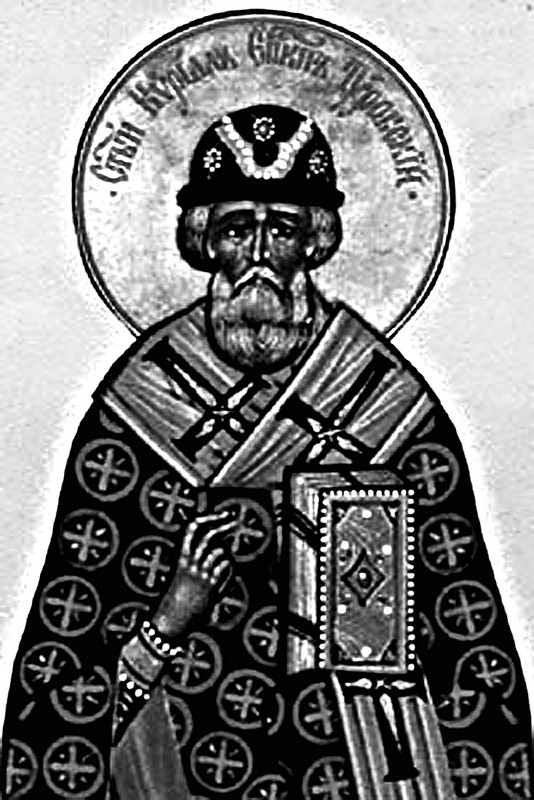
Hierarch Cyril, Bishop of Turov — the foremost preacher, theologian, and writer of 12th-century Kievan Rus, called by contemporaries "the Golden-Mouthed one, who has shone forth above all in Rus"; formerly a stylite recluse, made Bishop of Turov against his own wishes; author of eight solemn "Words" for the major feasts of the church year, parables (including the famous "Parable of the Soul and the Body"), prayers, and canons; wrote epistles against Bishop Theodore of Rostov, who attempted to break the Rostov diocese's independence from the Kiev metropolitanate.
Hierarch Cyril was born around 1130 in the city of Turov (Polesia, now Belarus) to a wealthy, prominent family — his father, according to tradition, administered Turov on behalf of the Grand Prince of Kiev. From his youth he displayed exceptional gifts, studying sacred texts in Slavonic and Greek. Renouncing a secular career and his inheritance, he entered the Sts. Boris and Gleb Monastery in Turov.
Around 1144, according to some accounts, he became abbot of the St. Nicholas monastery, but, seeking still greater ascetic labor, he withdrew into stylite seclusion — a severe form of hermitage rare in Rus, in which the ascetic, shut up in a tower-"pillar," devoted himself to fasting, prayer, and writing.
His reputation for holiness and learning led the Prince of Turov and the people to entreat him to leave his pillar and accept the episcopate; the hierarch was consecrated Bishop of Turov no later than 1169. That same year, 1169, he took part in the church proceedings against Bishop Theodore of Vladimir-Suzdal (Rostov), who, relying on Prince Andrei Bogolyubsky's political ambitions to establish a separate metropolitanate at Vladimir, attempted to withdraw the Rostov-Suzdal diocese from the authority of the Kiev metropolitanate. Cyril sent Prince Andrei epistles skillfully exposing Theodore's false teaching and ecclesiastical insubordination; Theodore was later deposed, sent to Kiev, and executed for his defiance. Around 1182, already advanced in years, he left his see and returned to a solitary life and literary labors.
LITERARY LEGACY: Hierarch Cyril is the author of eight solemn "Words" for the major feasts of the church year (Palm Sunday, Holy Pascha, the Sunday of the Myrrh-bearing Women, the Sunday of Thomas, the Sunday of the Paralytic, Mid-Pentecost, the Sunday of the Blind Man, and the Ascension) — models of Old Rus oratorical art, built on the canons of Byzantine patristic rhetoric, rich in metaphor, dialogue, antithesis, and lament. Among his parables, the best known is the "Parable of the Soul and the Body" (in short and extended versions) and the "Tale of the Monastic Order," addressed to Vasily, hegumen of the Kiev Caves Monastery. He also composed about 30 prayers for each day of the week and three canons, including a penitential alphabetic canon. For the depth of his theology and the beauty of his style, contemporaries called him "the Golden-Mouthed one, who has shone forth above all in Rus" — comparing him to St. John Chrysostom. His works were widely copied for centuries alongside translated Byzantine patristic texts, exerting a defining influence on the entire Old Rus literary-rhetorical tradition.
His feast is kept on April 28/May 11 (repose), and also separately in the Synaxis of Belarusian Saints (a movable date, the 3rd Sunday after Pentecost).
CRITICAL CORRECTIONS: category righteous→hierarch — Cyril was a consecrated bishop, not a layman. The feast_days field previously contained SIX dates, NONE of which belong to Cyril of Turov: January 18/31 and June 9/22 are the feast days of St. Cyril of Alexandria (5th c.); February 8/21 matches no source for Cyril of Turov at all — all six dates turned out to be contamination from a different "Cyril cluster." These have been removed and replaced with the single correct date — April 28/May 11 (day of repose, confirmed by all sources).
Icons and images