Hierarch
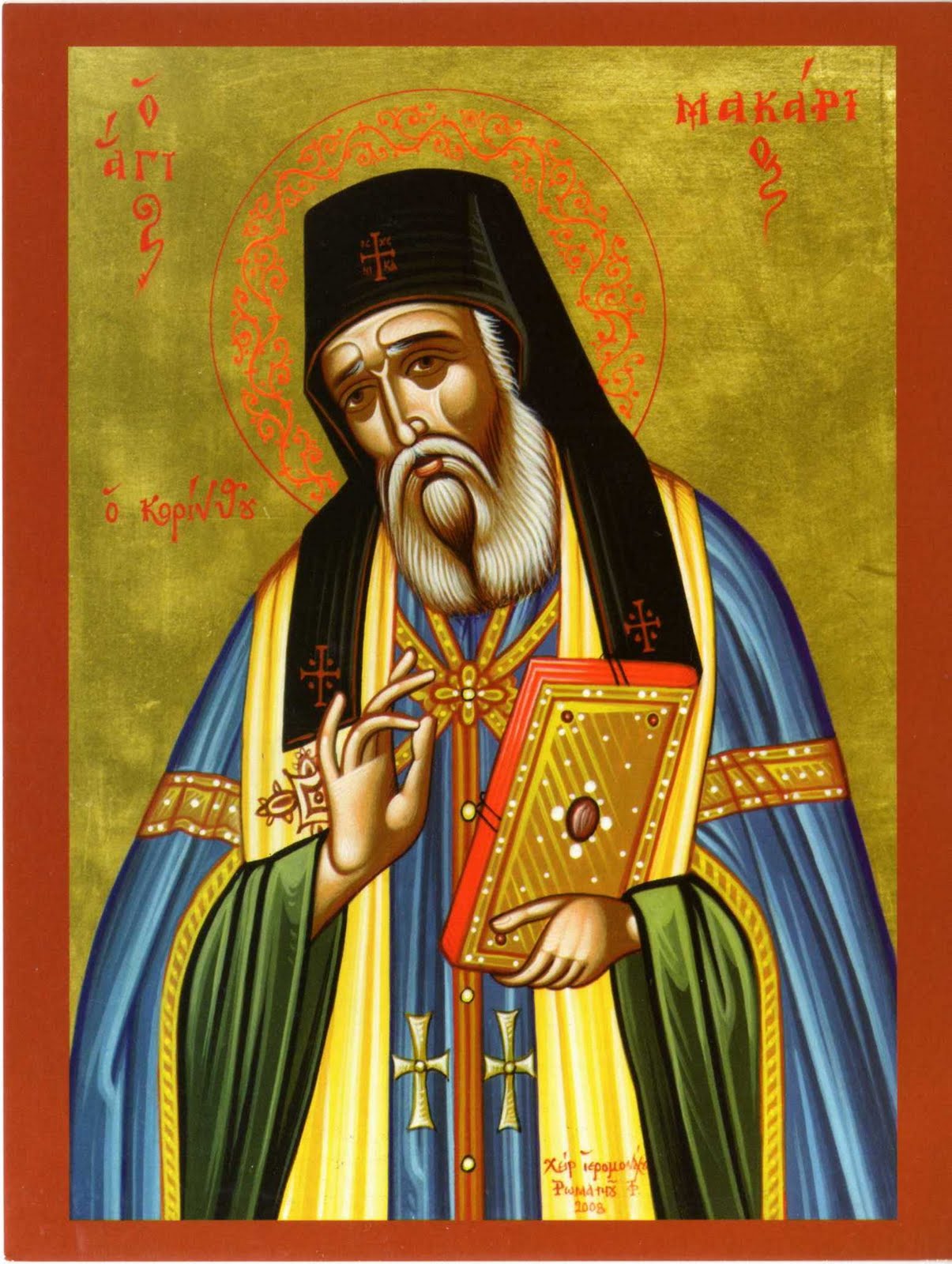
Hierarch Macarius of Corinth
1731 — †17 апреля 1805
Hierarch Macarius of Corinth (Notaras) — Archbishop of Corinth, one of the principal leaders of the Kollyvades movement, who together with St. Nicodemus the Hagiorite compiled the famous "Philokalia" (Venice, 1782) — an anthology of patristic ascetic texts that became one of the most important sources of the hesychast revival.
Hierarch Macarius, of the Notaras family, was born in 1731 in Tripoli (near Corinth). In January 1765 he was consecrated Archbishop of Corinth by Patriarch Samuel I Chatzeris.
He became one of the principal leaders of the "Kollyvades" movement — a current of zealous Athonite monks who advocated frequent communion and the revival of the patristic ascetic tradition (the name derives from a dispute over memorial kollyva). Greek church tradition calls him "the father of Kollyvades philokalism."
The chief work of his life was compiling, together with St. Nicodemus the Hagiorite, the "Philokalia" (Φιλοκαλία): St. Macarius gathered and systematized the corpus of ascetic writings of the Church Fathers from the 4th-15th centuries, while St. Nicodemus did the editorial work and wrote the authors' biographies. Published in Venice in 1782, it subsequently had an enormous influence on the revival of hesychasm both in Greece and in the Slavic countries (through the translation of St. Paisius Velichkovsky). Besides the Philokalia, Macarius and Nicodemus together compiled the "Evergetinos" and the then-controversial book "On Frequent Communion," as well as the "New Leimonarion" (a hagiographic collection).
Veneration of the hierarch began soon after his death without a formal act of canonization of the time; his relics, uncovered in 1808, exuded fragrance and effected healings. He reposed on April 17, 1805, on the island of Chios.
His feast is kept on April 17 (New Style, date of repose).
NOTE ON THE DATE: the exact Old Style equivalent of this date is not confirmed by a second independent source — an approximate conversion gives April 4/5 O.S., but this has not been finally verified; only the reliably confirmed date, April 17, is given in this entry.
IMPORTANT CORRECTION: one of the entry's former images (macarius_of_corinth_3.jpg) turned out to be an icon of a COMPLETELY DIFFERENT saint — St. Nicodemus the Hagiorite (co-author of the Philokalia), with the direct inscription "Ο ΑΓΙΟΣ ΝΙΚΟΔΗΜΟΣ Ο ΑΓΙΟΡΕΙΤΗΣ" — removed from the entry as a gross file-attachment error.
Icons and images