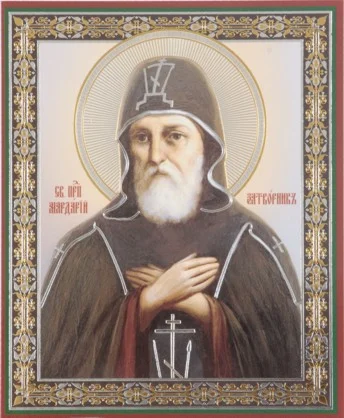
Venerable
Venerable Mardarius of the Kiev Far Caves
по преданию, XIII век; впервые письменно засвидетельствован в 1638 г.
Also known as: Мардарий Затворник, Мардарий Нестяжательный, Мардарий Бескелейный
Venerable Mardarius, recluse of the Kiev Caves — an ascetic of the Far Caves, renowned for his extreme non-possessiveness (he owned not even a cell of his own, nor more than the single garment he wore), who shut himself into a narrow cave cell and remained in reclusion there until his death.
Venerable Mardarius struggled in the Far Caves of the Kiev Caves Lavra. Having taken monastic vows, he strove for perfection not only in fasting, prayer, and obedience, but especially in non-possessiveness — he owned nothing but the single garment he wore; in ancient handwritten menologia the troparion and kontakion call him "the non-possessive one," and the inscription at his relics calls him "the cell-less one," since he had no cell of his own.
The crown of his asceticism was voluntary reclusion: he shut himself into a narrow cave cell, where he remained enclosed until his death, pleasing God.
HONEST CAVEAT ON DATING: church tradition places his feat in the 13th century, but the scholarly side of the question (the Orthodox Encyclopedia) candidly acknowledges that he is not mentioned in any early monastic source — he is first attested in writing only in Athanasius Kalnofoysky's "Teraturgima" (1638). His local glorification took place under Archimandrite Varlaam (1684-1690), with church-wide recognition confirmed by Synodal decrees of 1762, 1775, and 1784.
His relics rest in a niche of the Far Caves, near the site of his former reclusion.
His feast is kept on December 13/26 (personal), August 28/September 10 (in the Synaxis of the Venerable Fathers of the Far Caves), and on the movable day of the Synaxis of All the Venerable Fathers of the Kiev Caves (2nd week of Great Lent).
IMPORTANT CORRECTION: the impossible dating "11th-17th century" (which conflated the ranges of different Kiev Caves saints) has been removed — the honest formulation "traditionally 13th century, first attested in 1638" has been adopted.
Icons and images