Right-Believing
Right-believing Prince Mstislav Rostislavich the Brave
ок. 1148/1150 — 1180
Also known as: Мстислав Храбрый, Новгородский и Смоленский
Right-believing Prince Mstislav Rostislavich the Brave — grandson of Grand Prince Mstislav the Great, celebrated defender of Vyshgorod in 1173–1174, Prince of Smolensk and Novgorod, an ancestor of St. Alexander Nevsky.
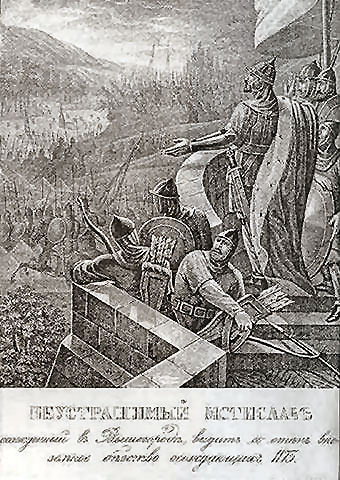
IMPORTANT IDENTITY AND DATE CORRECTION: visual inspection of the image revealed a clear caption: "Fearless Mstislav, besieged in Vyshgorod, sees from the walls the sudden flight of the besiegers. 1173" — the engraving directly depicts the famous defense of Vyshgorod in 1173–1174, which unambiguously belongs to Mstislav Rostislavich the Brave (grandson of Mstislav the Great), NOT to his father Rostislav Mstislavich (baptized Michael), whose feast is kept March 14/27 and to whom the date previously listed in this card ("March 27") actually belonged. These two people — father and son with mirror-image names — were mistakenly confused when the original data was entered; the date has been corrected to the one that actually belongs to Mstislav the Brave.
Right-believing Prince Mstislav Rostislavich, grandson of Grand Prince Mstislav the Great, is first mentioned in the chronicles in 1161/62. In 1168 he fought the Cumans; in 1173–1174 he defended Vyshgorod for nine weeks against a coalition army led by Andrei Bogolyubsky — a feat that earned him the epithet "the Brave" (first appearing in the younger recension of the Novgorod First Chronicle). In 1175 he was elected Prince of Smolensk, and in 1179 was invited to rule Novgorod — tradition holds he initially refused ("I will not leave my brothers and my patrimony"), but then accepted; he led a campaign against Estonian (Chud) raids threatening Pskov.
The chronicles describe him as a generous ruler free of avarice, who avoided princely feuds and was beloved by the people. He died suddenly on June 13/14, 1180, and was buried in Novgorod's St. Sophia Cathedral.
His feast is kept on June 14/27, and he is also commemorated in the Synaxis of Novgorod Saints.
Icons and images