Venerable
Venerable Nilus the Myrrh-streamer of Athos
кон. XVI в. — 1651
Also known as: Нил Мироточивый Мироточец
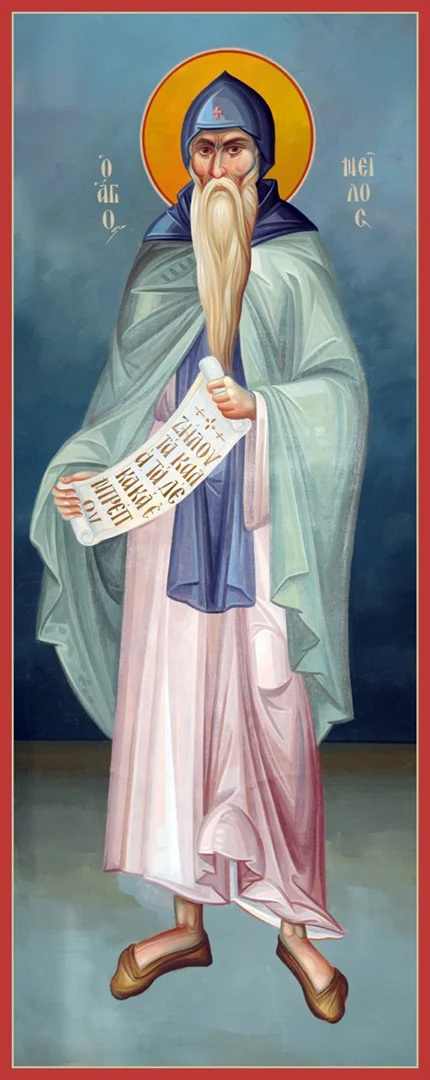
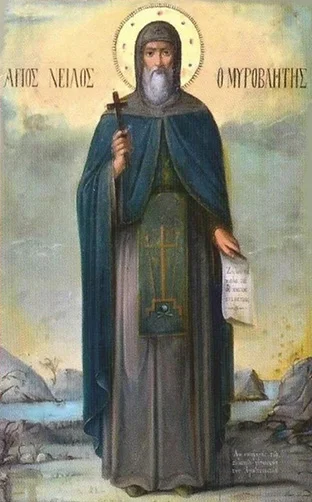
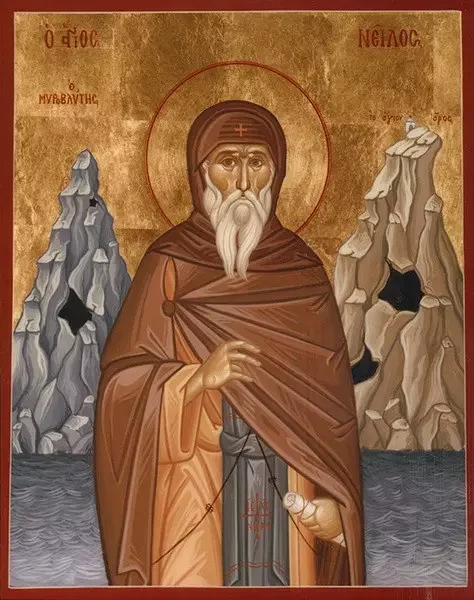
Venerable Nilus the Myrrh-streamer of Athos — a 17th-century hermit who settled in a hard-to-reach cave near the Skete of St. Anne, whose relics after his death began to exude fragrant myrrh, drawing pilgrims from across the Orthodox East.
HONEST NOTE ON THE DISPUTED PROPHECIES: the body of apocalyptic prophecy attributed to him, known as "The Posthumous Utterances of Venerable Nilus the Myrrh-streamer," was NOT personally written by him during his lifetime. According to the tradition itself, between 1813 and 1819 — more than 160 years after his death — Nilus allegedly appeared in visions to a barely literate Athonite monk named Theophanes, who dictated these "conversations" to hieromonk Gerasimos, who recorded them in writing. The Orthodox Encyclopedia explicitly characterizes this as "mediumistic visions" rather than directly authored texts — clearly distinguishing these posthumous utterances from genuine, contemporaneous ascetic writings (and distinguishing this Nilus from the unrelated, much earlier and textually well-attested Venerable Nilus of Sinai). A substantial portion of these "utterances" is devoted to denouncing the moral laxity of 18th–19th century Athonite monks, suggesting a strong polemical/hortatory purpose layered onto (or possibly driving) the prophetic content. Given this, the prophetic corpus should be regarded as popular devotional literature of disputed/unverified authenticity, clearly distinct from the historically documented facts of his life and the myrrh-streaming of his relics.
Venerable Nilus was born in the village of Agios Petros in the diocese of Lakedaimonia (Morea, Peloponnese), in the late 16th century (exact year unknown). Orphaned young, he was raised by his uncle, the hieromonk Makarios, at Malevi Monastery. He was tonsured, ordained hierodeacon, then hieromonk; after about 15 years as a hermit he joined his uncle on Mount Athos, settling at a place called "the Holy Stones" near the Skete of St. Anne. After his uncle's death he withdrew further — into a hard-to-reach rocky cave, where he spent the rest of his life in strict solitary asceticism until his death in 1651.
Soon after his burial, his grave/cave began to exude fragrant myrrh, drawing pilgrims by boat from across the Orthodox East; the landing spot below his cave became known as "karavostasion" ("ship-landing"), and he became known as "the Myrrh-streamer." His relics were formally uncovered on May 7, 1815, reportedly exuding an extraordinary fragrance.
His feast is kept on November 12/25 (repose); also May 7/20 (finding of relics, 1815).
Icons and images