Venerable
Venerable Peter of Koriša
XIII в.
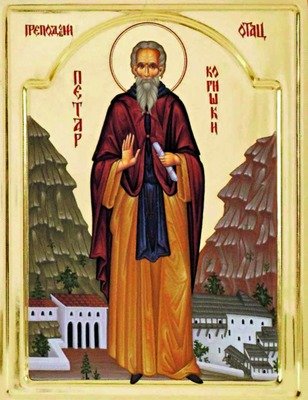
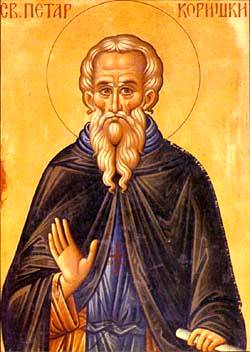
Venerable Peter of Koriša — a 13th-century Serbian hermit who lived in a cave on Mount Koriša near Prizren, who endured fierce demonic assaults in the form of his dead sister and overcame them through years of ascetic struggle.
CRITICAL IMAGE NOTE: of 6 image files, 3 contaminated ones have been removed — "peter_of_koris_1.jpg" (a photo of Trier Cathedral in Germany, unrelated to the Serbian saint; the same photo was mistakenly used elsewhere in this database for the card of Paulinus of Trier), "venerable_peter_of_korisha_1.jpg" (an icon captioned "VENERABLE SOPHRONIUS" — a completely different saint), and "venerable_peter_of_korisha_2.jpg" (an ancient icon of the Apostles Peter and Paul, labeled "PETER"/"PAUL" — this is the Apostle Peter, not Peter of Koriša, despite the shared first name). Three genuinely confirmed images remain, with Serbian captions "(SVETI/SV.) PETAR KORIŠKI."
IMPORTANT DATE CORRECTION: the previous date "August 8" was not confirmed — the correct date, agreed by four independent sources, is June 5/18.
Venerable Peter of Koriša (13th century) was a Serbian hermit who lived in a cave on Mount Koriša near Prizren. Born in a village in the Hvosno region to a pious family, he sought monastic life after his parents' deaths. His sister wished to join his ascetic struggle, but he left her alone in the wilderness — according to tradition she died of despair.
Settling in an inaccessible cave, he spent many years in complete solitude, enduring fierce demonic assaults: demons repeatedly appeared to him in the form of his dead sister, reproaching him for abandoning her to wild beasts. Through prolonged struggle he overcame these temptations.
In his later years monks came to him for guidance; sensing his death approaching, he carved his own stone coffin. King Stefan Dušan built a church over his relics. In the early 14th century, the Hilandar hieromonk Theodosius — also the noted biographer of St. Sava of Serbia — compiled his vita and liturgical service (hence the stylistic closeness of the two services, though not evidence the two saints personally met). In 1572 his relics were moved to the cave monastery of Crna Reka, where they remain.
Icons and images