Hierarch
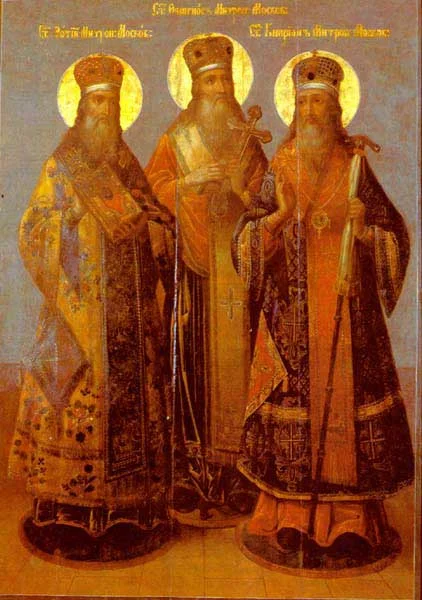
Hierarch Photius, Metropolitan of Kiev and All Russia
? — 1431
Saint Photius, Metropolitan of Kiev and All Russia — a Greek who spent 22 years restoring plundered church property, combating the Strigolniki heresy and a schism among the Lithuanian dioceses, and preserving the unity of the metropolitanate; his relics were found incorrupt in 1472.
CRITICAL IMAGE NOTE: of 4 files, 2 have been removed — a completely unrelated infographic poster "BYZANTINE EMPRESSES / CLOTHING RECONSTRUCTION" (a fashion-history chart of empresses from the 6th–15th centuries, with no connection to the hierarch), and a large low-value July menaion sheet without individual labeling. Two genuinely confirmed images remain.
ADDITION: the biography has been substantially expanded with reliable historical facts, replacing the previous generic boilerplate text. Clarification: a mention of "tensions related to the Council of Florence" does not apply to Photius himself — he died in 1431, seven years before the Council of Ferrara-Florence (1438–39); that topic belongs to his successor, Metropolitan Isidore.
Saint Photius, Metropolitan of Kiev and All Russia, was a Greek from Monemvasia in the Peloponnese, tonsured in his youth by the elder Akakios, later Metropolitan of Monemvasia. Consecrated Metropolitan of Kiev by Patriarch Matthew I of Constantinople on September 1, 1408, he arrived in Rus' the following year. After six months restoring order in Kiev and the southern dioceses, he transferred his see to Moscow at Pascha 1410.
Over 22 years he restored church property plundered during the preceding interregnum, suppressed the Strigolniki heresy in the Novgorod-Pskov lands (eradicated by 1427), and composed a rite for the installation of bishops (1423). In 1415 the Lithuanian-diocese bishops, backed by Grand Duke Vytautas, broke away and elected Gregory Tsamblak as a rival metropolitan; Photius restored the unity of the metropolitanate in 1420 after Tsamblak's death.
He also played a role in Muscovite politics, supporting the young Grand Prince Vasily II against the succession claims of Prince Yury of Zvenigorod. He reposed on July 2, 1431. In 1472, during the rebuilding of the Dormition Cathedral in the Moscow Kremlin, his incorrupt relics were uncovered; two of his vestments are preserved in the Kremlin Armory.
Icons and images