Righteous
Righteous Saint Praxedes of Rome
I–II вв.
Also known as: Праксида
Righteous Praxedes of Rome — a virgin, daughter of the senator Pudens and sister of St. Pudentiana, who sheltered and buried persecuted Christians under Emperor Marcus Aurelius; the Basilica of Santa Prassede in Rome, with its famous Byzantine mosaics, is her namesake shrine.
CRITICAL: category corrected from "martyr" to "righteous" — no source attests a violent death for Praxedes; English-language Orthodox lists of Western saints call her simply a "holy virgin," not a martyr; Praxedes herself, by tradition, repeatedly prayed for the grace of martyrdom, but the circumstances and exact date of her death are unrecorded — she appears to have died peacefully.
Praxedes was a Roman virgin, traditionally the daughter of the senator Pudens (identified with the Pudens of 2 Timothy 4:21, "a friend of the Apostles" and disciple of St. Paul) and sister of St. Pudentiana. By tradition she was baptized as a child by St. Peter himself. During the persecution of Christians under Emperor Marcus Aurelius (161–180), the sisters used their inherited wealth and family estate on the Esquiline Hill in Rome to aid the persecuted: seeking out Christians in hiding, giving them money and comfort, sheltering them in their own home, encouraging the steadfast, and secretly gathering and burying the bodies of martyrs (by tradition even collecting martyrs' blood with a sponge — hence her traditional depiction holding a sponge and vessel). Together with the future Pope Pius I and the presbyter Pastor, the sisters built a baptistery on the family estate.
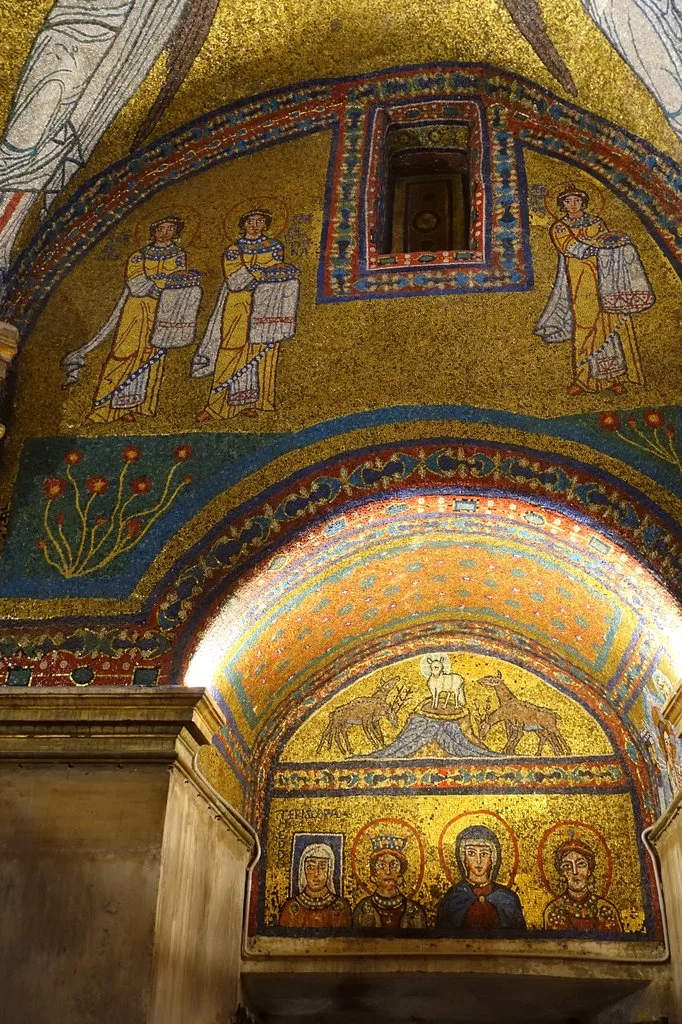
She was buried beside her father in the Catacombs of Priscilla. Her cult is tied to a titular church on the Esquiline — the Basilica of Santa Prassede, first documented in 491, restored by Pope Hadrian I (772–795), and rebuilt on its present plan by Pope Paschal I (817–824), who on July 20, 817, translated both sisters' relics into it. Paschal I's rebuilding produced the famous Byzantine-style mosaics: the apse shows Christ blessing, with Sts. Peter and Paul presenting Praxedes and Pudentiana; the triumphal arch depicts the Heavenly Jerusalem; and the adjoining San Zeno Chapel (a mausoleum for Paschal I's mother, Theodora) has a vault mosaic of Christ in a medallion held by four angels — among the finest surviving Carolingian-era Byzantine-style mosaics in Rome.
Icons and images