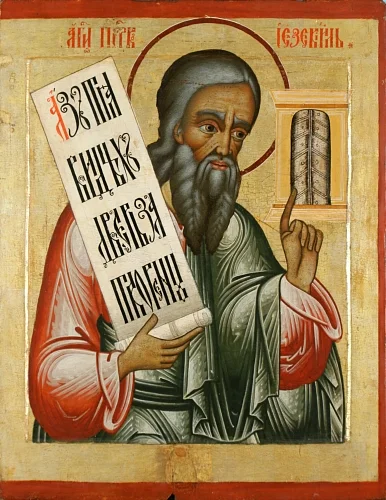
Prophet
Prophet Prophet Ezekiel
VII–VI вв. до Р.Х.
Prophet Ezekiel — one of the four Major Prophets, a priest of the tribe of Levi taken into Babylonian captivity, author of the visions of the chariot of cherubim, the valley of dry bones, and the shut gate, interpreted by the Fathers as a type of the Theotokos.
CRITICAL: date corrected "July 21/August 4" → the correct New Style equivalent "August 3" (21+13 = August 3, not the 4th).
Ezekiel, son of the priest Buzi, of the tribe of Levi, was born c. 623–622 BC near Jerusalem (by tradition, in a place called Sarira), and was himself trained as a priest. He was deported to Babylon with King Jeconiah during Nebuchadnezzar's second capture of Jerusalem (597 BC), settling among the exiles at Tel-Aviv on the river Chebar; he was married (his wife died during the siege of Jerusalem, Ez. 24:15–18).
At age 30 (593 BC) he received the call vision of the "chariot" (Ezekiel 1): a storm-cloud with fire, four living creatures (with the faces of a man, a lion, an ox, and an eagle) beside four intersecting wheels full of eyes, and a sapphire throne with a fiery human likeness above it — a manifestation of God's glory that patristic tradition reads as prefiguring the four Evangelists and the Incarnation.
He performed extended symbolic prophetic acts foretelling Jerusalem's fall: lying bound and mute, depicting the city under siege on a clay tablet, lying on his side (390+40 days) bearing Israel's and Judah's sin, eating rationed unclean food, and shaving his head and beard to symbolize the city's fate. He prophesied doom against Jerusalem and neighboring nations, then, after the city's fall (588–586 BC), turned to prophecies of restoration.
In the vision of the valley of dry bones (Ezekiel 37), scattered bones are commanded to come together, are covered with flesh, and receive the breath of life — a vision of Israel's national restoration from exile, read by the Church as a type of the universal bodily resurrection of the dead. In the vision of the restored Temple (Ezekiel 40–48, 573 BC) he sees the shut east gate of the sanctuary, through which "the Lord, the God of Israel, has entered," which "shall remain shut, because the Lord... has entered by it" (Ez. 44:1–2) — the Church Fathers, especially in Theotokos hymnography, unanimously interpret this gate as a type of the Mother of God's perpetual virginity, conceiving and bearing the Lord while remaining a virgin before and after birth.
By tradition (Pseudo-Epiphanius, "Lives of the Prophets"), he was martyred in Babylon by a prince of a tribe of Judah whom he had rebuked for idolatry — torn apart by wild horses, or dragged over rocks. He was buried, by tradition, in the tomb of Shem and Arphaxad near Baghdad; his traditional tomb is venerated at al-Kifl, Iraq.
Icons and images