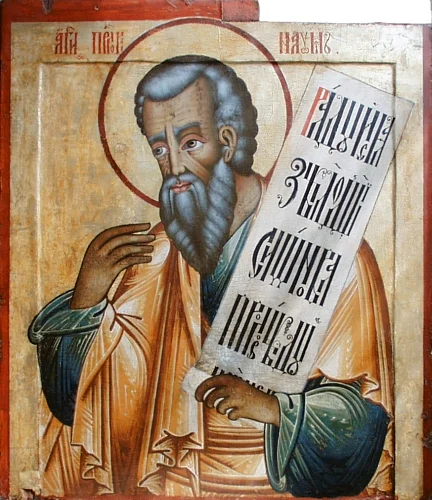
Prophet
Prophet Prophet Nahum, the Elkoshite
VII в. до Р.Х., † 45 лет
Also known as: не путать со свт. Наумом Охридским (IX-X вв., память 23 декабря)
Prophet Nahum, the Elkoshite — seventh of the Twelve Minor Prophets, who proclaimed the imminent destruction of Nineveh, capital of the Assyrian Empire, fulfilled in 612 BC.
CRITICAL IMAGE NOTE: one of three images (with an inscription mentioning a ktitor/donor and "Ohrid") apparently depicts a COMPLETELY DIFFERENT, much later saint — St. Naum of Ohrid (c. 830–910), a Bulgarian enlightener, disciple of Sts. Cyril and Methodius, founder of the Monastery of St. Naum on Lake Ohrid — with his own separate feast day (December 23). A ktitor (donor) portrait is a characteristic feature specifically of the Ohrid monastery's fresco tradition, atypical for the iconography of an Old Testament Minor Prophet. The image has been removed as contamination; popular piety sometimes confuses the two saints due to their similar names, but they are distinct saints with different feast days.
Nahum, seventh of the Twelve Minor Prophets, came from the village of Elkosh (located by tradition either in Galilee or near ancient Nineveh). His Hebrew name means "comfort" or "the Lord consoles." He lived in the 7th century BC, during the period of Assyrian domination over Judah.
The sole surviving record of his ministry is a short but poetically vivid book devoted entirely to proclaiming the imminent destruction of Nineveh, capital of the Assyrian Empire, which had enslaved many nations through cruelty, idolatry, and sorcery. Unlike most prophets, Nahum issues no rebuke directed at Israel itself — his oracle is aimed entirely at the oppressor, offering comfort to Judah suffering under the Assyrian yoke. The prophecy was fulfilled in 612 BC, when the combined armies of the Medes and Babylonians razed Nineveh. Nahum died at the age of forty-five and was buried in his native land.
Icons and images