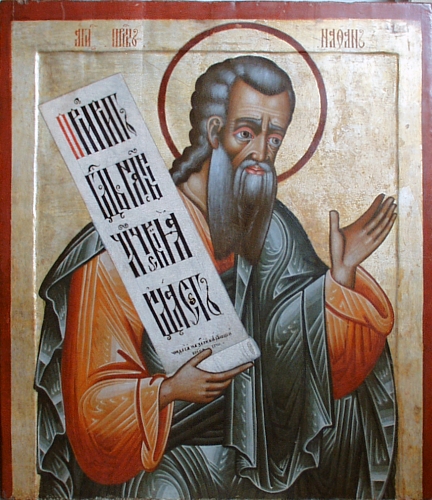
Prophet
Prophet Prophet Nathan
X в. до Р.Х.
Also known as: Натан
Prophet Nathan — court prophet and closest counselor to King David, who rebuked him with the parable of the stolen ewe lamb after his sin with Bathsheba and proclaimed the eternity of the house of David.
CRITICAL ON THE DATE: the previous record "December 24" (with no O.S./N.S. pairing) finds no support in any authoritative liturgical source. The Orthodox Encyclopedia states explicitly that Nathan has no individually fixed feast day — he is commemorated only within the movable Sunday of the Holy Forefathers (in the troparion of the 8th ode of that feast's Matins canon). Other secondary sources give mutually inconsistent December dates (27th, 28th, 29th) with no citation to a primary source — this internal inconsistency confirms the absence of a genuine, separately fixed commemoration. Honestly reflected: only the movable Sunday of the Forefathers (window December 11–17 O.S./December 24–30 N.S.).
Nathan was a court prophet and closest counselor to King David, mentioned in 2 Samuel and 1–2 Chronicles. He first appears when David resolves to build a permanent Temple for the Ark of the Covenant: Nathan initially approves, but then by direct divine revelation tells the king that not David but his son will build the House of the Lord, and that God will establish David's house, throne, and kingdom forever (2 Samuel 7) — a prophecy of the eternal Davidic dynasty underlying the messianic "Davidic covenant."
Nathan's most famous act came after David's adultery with Bathsheba and his killing of her husband, Uriah the Hittite: Nathan confronted the king with the parable of a rich man who stole a poor man's only ewe lamb, and when the outraged David condemned the rich man, Nathan declared, "Thou art the man!" (2 Samuel 12:7), bringing David to repentance. Late in David's reign, when Adonijah attempted to seize the throne, Nathan, together with Bathsheba and the priest Zadok, secured the anointing of Solomon as king (1 Kings 1). He is also credited with authoring historical records of the reigns of David and Solomon (1 Chronicles 29:29; 2 Chronicles 9:29).
Icons and images