
Antimension
A silk cloth showing the burial of Christ, signed by the ruling bishop and containing a relic; without it no Liturgy may be served.
Reading options
The antimension is a cloth of silk or linen about the size of a newspaper sheet, lying on the altar table folded in four. On it is printed the Placing of Christ in the Tomb, in the corners the four Evangelists, and at the bottom the bishop has written in his own hand for which church this antimension was issued, when and by whom. In the edge of the cloth is sewn a particle of the relics of a martyr.
Why it cannot be done without
The Liturgy is not celebrated without an antimension — neither in a new church, nor in an old one, nor in field conditions. The reason is historical and very concrete: in the first centuries the Eucharist was celebrated on the tombs of martyrs, in the catacombs. When churches became many and there were not enough tombs for all, a particle of relics began to be sewn into a cloth and sent out to the parishes. The word itself is Greco-Latin and means “in place of the table”: the antimension replaces the altar table where there is no consecrated altar table.
Hence the second point: the antimension is issued by the ruling bishop and signed by him personally. It is his permission to serve in this church — and, if need be, he can take the antimension back, and the Liturgy here will cease. The parish receives from the bishop not a paper but a cloth.
How it is handled
The antimension is kept on the altar table, wrapped in another cloth — the eiliton. It is unfolded at the Liturgy, nearer the middle, and on it — and not directly on the altar table — stand the chalice and the diskos. After Communion the priest with a special sponge gathers every last crumb from the antimension and shakes them into the Chalice; the sponge remains lying inside the folded cloth.
In a fire the antimension is the first thing carried out of the church.
See also
The church building
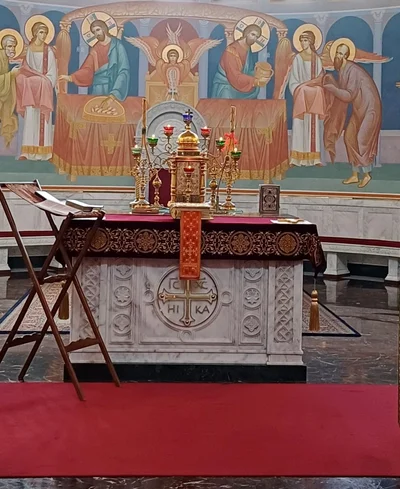
Altar table (holy table)
The four-sided table in the middle of the sanctuary on which the Liturgy is celebrated — the chief holy thing of the church.
Divine services
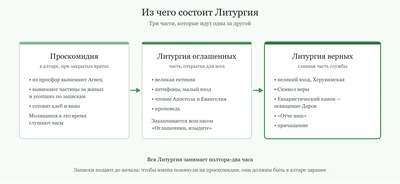
Divine Liturgy
The principal service of the Church, at which the Eucharist is celebrated and the faithful receive Communion. Served in the morning, lasting one and a half to two hours.
Church utensils
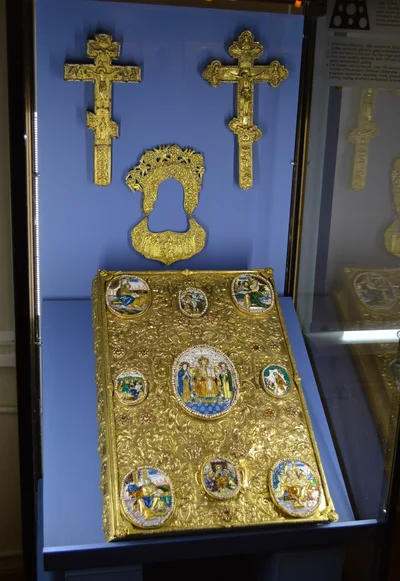
Altar Gospel book
The service Gospel in a heavy metal cover, kept on the altar table and carried out at the Little Entrance.
Clergy and ranks
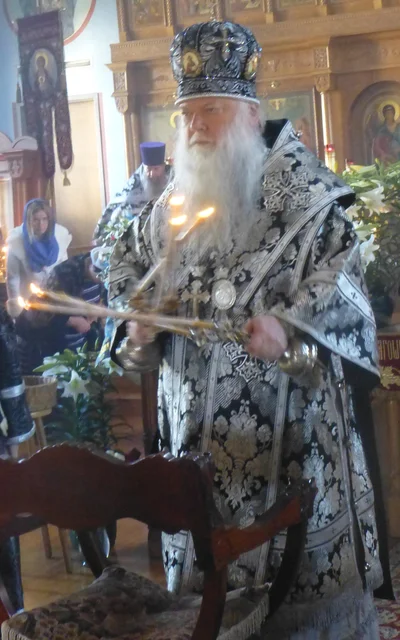
Bishop
The highest degree of priesthood: only a bishop ordains clergy and governs a diocese. Recognised by the omophorion, panagia and staff.