
Epitaphios
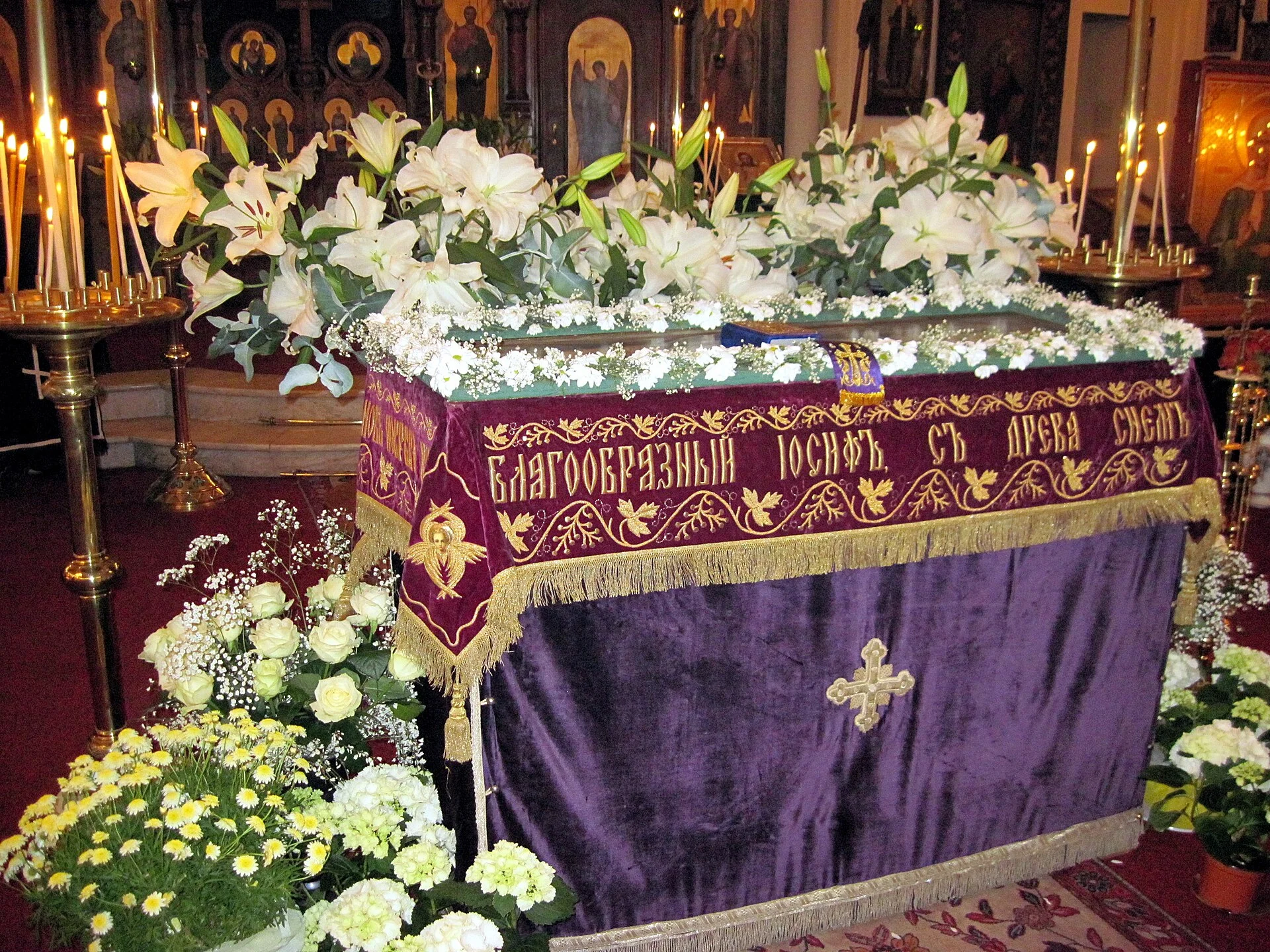
A large cloth depicting Christ laid in the tomb, brought out to the centre of the church on Great Friday.
Reading options
The epitaphios is a large cloth, usually embroidered with gold and silks, with the image of Christ taken down from the cross and lying in the tomb; around Him are the Mother of God, John the Theologian, the myrrh-bearing women. The word itself, plashchanitsa, is Church Slavonic and means the funeral cloth in which the Body was wrapped.
Great Friday
All year the epitaphios is kept in the altar or the sacristy and is not shown. It is brought out once — at Vespers of Great Friday, which is served in the second half of the day. The clergy lift the epitaphios from the altar table, carry it around the altar table and bring it out through the Royal Doors to the middle of the church, where a tomb decorated with flowers has been prepared in advance. Then it is venerated — people come up, bow and kiss the depicted wounds.
On the night of Saturday or early in the morning Matins of Great Saturday is served with the rite of burial: they sing “Blessed are the blameless” with the Praises, and then go around the church with the epitaphios — this is that same procession of the cross which proceeds slowly and in silence, still without Paschal joy.
The epitaphios lies in the middle of the church until the Paschal Midnight Office. Just before Pascha, as “Thy Resurrection, O Christ our Saviour” is sung, it is carried back into the altar and laid on the altar table — and there it remains until the leave-taking of Pascha.
The epitaphios of the Mother of God
There is also a second one, with the image of the Dormition of the Mother of God. With it, in those churches where this is the custom, the rite of the burial of the Mother of God is performed — in the days after the feast of the Dormition, at the end of August. The service is built on the pattern of that of Great Saturday, with the same Praises and procession of the cross.
Images
See also
Feasts and fasts
Pascha
The Resurrection of Christ, the feast of feasts. Its date moves between 4 April and 8 May on the civil calendar.
Feasts and fasts
Great Lent
The longest and strictest fast of the year: 48 days before Pascha, made up of the Forty Days, Lazarus Saturday, Palm Sunday and Holy Week.
Parish practice
How to venerate an icon
Cross yourself twice with a bow, kiss the icon, then cross yourself once more; one kisses the hand or hem, not the face.
Church utensils
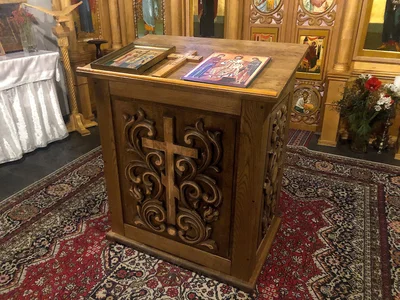
Analogion
A tall stand with a sloping top: it holds the icon of the day, books for reading, and the cross and Gospel at confession.
Feasts and fasts
The Dormition Fast
A two-week fast before the Dormition, 14–27 August: the shortest of the multi-day fasts and as strict as Great Lent.