
Holy myrrh (chrism)
Other names: Chrism
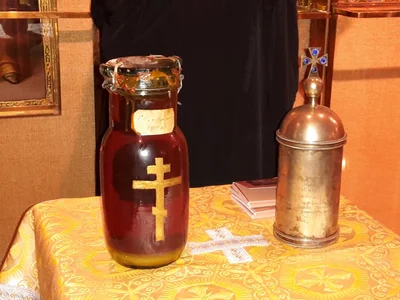
The fragrant oil prepared and consecrated by the Patriarch, used for chrismation — once in a lifetime, immediately after baptism.
Reading options
Holy myrrh (chrism) is a thick, fragrant oil of complex composition: olive oil, white wine and several dozen aromatic substances, such as resins, roots, herbs and flower oils. Its scent is dense and like nothing else, and a person who has been anointed with myrrh smells it on himself for some time afterwards.
How it is prepared
Myrrh is not bought or boiled in the parish. It is prepared centrally, in Moscow, and consecrated by the Patriarch; this is done not every year but as the Church’s supply runs low. The boiling takes place in Holy Week and the consecration on Great Thursday at the Liturgy, after which the myrrh is sent out to the dioceses, and each diocese distributes it to its parishes. So in any church, whether in Samarkand or in a remote village, the myrrh is the same and goes back to a single vessel.
Myrrh and oil are not the same thing
They are constantly confused, because in both cases the priest anoints the forehead in the form of a cross.
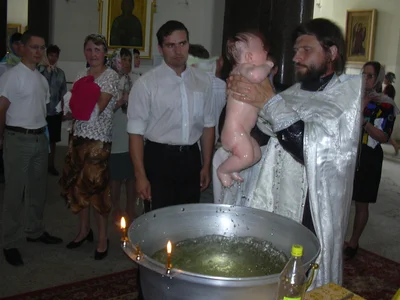
Chrismation is a Sacrament. It is performed once in a lifetime, right after baptism: the priest anoints the forehead, eyes, nostrils, lips, ears, breast, hands and feet with the myrrh, each time pronouncing “The seal of the gift of the Holy Spirit”. It cannot be repeated, just as baptism cannot be repeated.
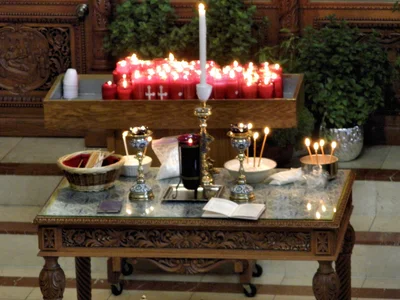
Anointing with oil at the All-Night Vigil is not a Sacrament but a blessing. At the polyeleos the priest stands by the festal icon and anoints the forehead of those who come up with blessed oil, most often from the lamp before that icon. It may be received as many times as one likes, even every Saturday, and no special preparation is needed for it. Oil is also used for anointing in the Sacrament of Holy Unction, but this too is a different oil and a different rite.
Separately, myrrh is used at the consecration of a church: the altar table and the walls are anointed with it, and the antimension signed by the bishop is made holy by it.
See also
Sacraments
Chrismation
The sacrament that follows baptism at once: the priest anoints forehead, eyes, ears, breast, hands and feet with holy myrrh, saying 'The seal of the gift of the Holy Spirit'.
Sacraments
Baptism
The sacrament by which a person enters the Church: threefold immersion in water in the name of the Trinity. It happens once and is never repeated.
Sacraments
Unction
The sacrament in which the sick are anointed seven times with blessed oil, with prayer for healing and for forgiveness of forgotten sins. It is not only for the dying.
The church building
Church (temple)
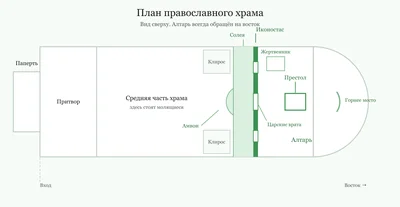
A building consecrated for divine service, divided into narthex, nave and sanctuary, with the sanctuary facing east.