
Chrismation
The sacrament that follows baptism at once: the priest anoints forehead, eyes, ears, breast, hands and feet with holy myrrh, saying 'The seal of the gift of the Holy Spirit'.
Reading options
Chrismation follows immediately after baptism and is usually perceived as part of it — in fact it is a separate Sacrament. If in baptism a person is born, here he is given strength to live this new life.
The priest anoints with holy chrism the forehead, eyes, nostrils, lips, ears, breast, hands and feet, repeating the same words: “The seal of the gift of the Holy Spirit.” What is anointed is precisely that with which a person acts and perceives the world: so that not an abstract “heart” is sanctified, but the eyes that look, the hands that do, and the feet that go somewhere.
Where the chrism comes from
Chrism — a fragrant oil of complex composition — is not bought or prepared in a parish. It is boiled centrally in Holy Week and consecrated at a Patriarchal service, and then sent out to dioceses and parishes. There is a direct meaning in this: a person in a distant church is received into the same Church, and not into a separate community — the chrism with which he was anointed is one for all.
A second time
Chrismation, like baptism, is not repeated. But there is a rite of reception into Orthodoxy of those who were baptized outside it — they are received through chrismation, without being baptized anew. This is not a repetition of the Sacrament but its completion.
See also
Sacraments
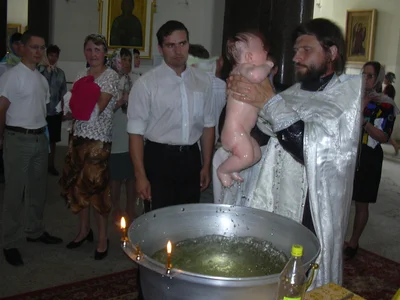
Baptism
The sacrament by which a person enters the Church: threefold immersion in water in the name of the Trinity. It happens once and is never repeated.
Church utensils
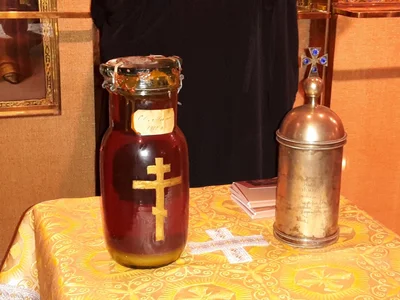
Holy myrrh (chrism)
The fragrant oil prepared and consecrated by the Patriarch, used for chrismation — once in a lifetime, immediately after baptism.
Sacraments
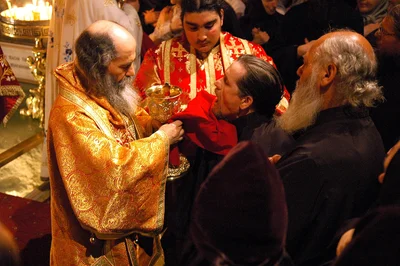
Communion
The central sacrament of the Church: at the Liturgy bread and wine become the Body and Blood of Christ, received by the faithful from the chalice.
Sacraments
Catechumenate
Preparation for baptism — the talks explaining what a person is about to enter. In the Russian Church they are required before an adult is baptised.