
The iconographic canon
The rules by which an icon is painted — reverse perspective, light without a source, conventional space — and why an icon is not meant to look like a painting.
Reading options
The first thing noticed by a person accustomed to painting: on an icon everything is “wrong”. The figures are flat, the buildings do not meet at their corners, there is no shadow, the faces do not look alive. This is not lack of skill; almost all of it is done on purpose.
Reverse perspective
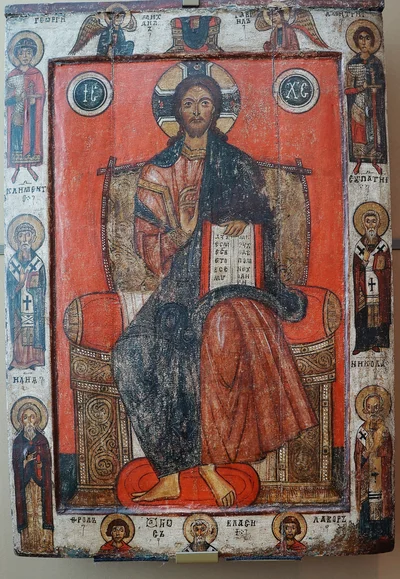
In a picture the lines converge in the distance, at a point behind the canvas: the viewer stands outside and looks in. On an icon the lines, on the contrary, diverge into the depth of the image and converge somewhere in front of the board, where the beholder stands. A table or a Gospel book is often shown so that both the top and both sides are visible at once. It turns out that it is not the person who examines the icon, but what is depicted that is turned toward him.
Light from nowhere
On an icon there are no shadows, no sun, no lamp: it is unclear where the light falls from, because it does not fall. It comes from within, from the figures themselves, and the gold background is neither sky nor wall but a designation of light in which there is neither time nor place. For the same reason the faces are lightened toward the middle, not from one side, and thin golden lines, the assist, are run along the garments.
Space and time are conventional
The chambers and little hills on an icon are not scenery but a sign: the action takes place in a house, in the wilderness, in a city. Size depends not on distance but on importance: the main figure is larger. Different moments live peacefully together in a single image: on the icon of the Nativity there are at once the Magi on their way and the washing of the Infant, although time lies between these events.
Why a face is not a portrait
An icon paints a person not as he would be met in the street but as he has become before God. Hence the large eyes, thin lips, and absence of facial expression and age: no mood is read from an icon. At the same time recognizability is preserved (St. Nicholas cannot be mistaken for John the Forerunner), but it rests on stable marks, not on portrait likeness.
See also
Icons
Icon
An image of Christ, the Mother of God, a saint or a sacred event, made for prayer — not a painting and not a portrait.
Icons
Nimbus (halo)
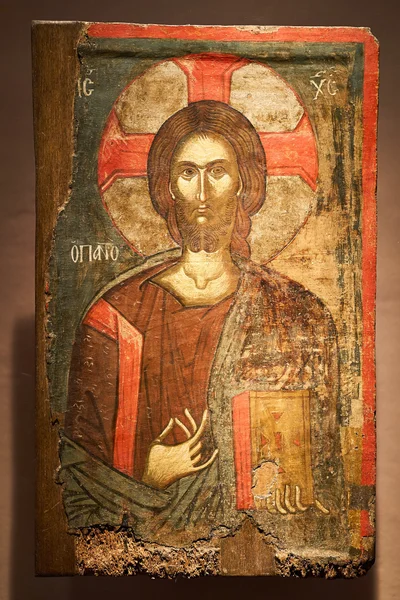
The circle of light around the head. Christ's always contains a cross and the letters Ο ΩΝ; everyone else's does not.
Icons
Inscriptions on icons
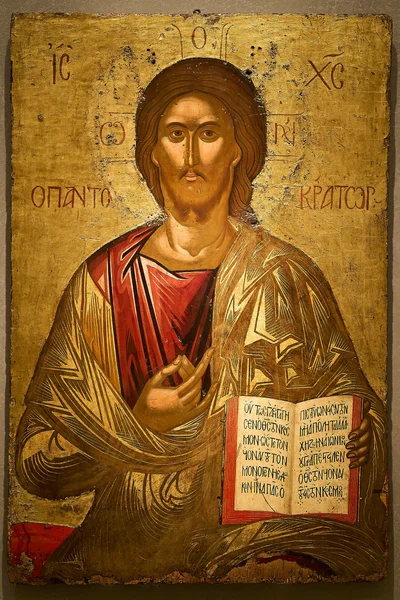
IC XC, MP ΘΥ, NIKA, Ο ΩΝ — the short inscriptions that complete an icon and let you read it rather than merely look at it.
Icons
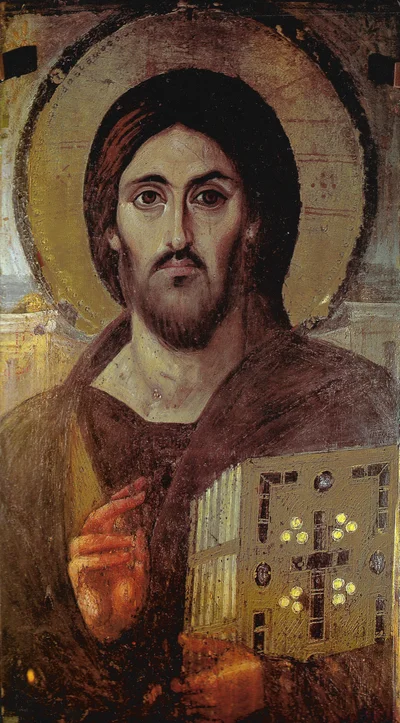
Christ Pantocrator
The principal image of Christ: the right hand blessing, the Gospel in the left. Found in the dome, to the right of the royal doors and at the centre of the deisis.