
Oranta
Other names: Our Lady of the Sign
The Mother of God with hands raised in prayer; with the Child in a medallion on her breast the image is called the Sign.
Reading options
Oranta is a Latin word meaning “one who prays”. The type is the oldest of all: in this posture, standing, with arms spread and raised to shoulder height, palms forward, Christians of the first centuries prayed, and so they were depicted in the catacombs long before icon painting took shape.
How to recognize it
The Mother of God is depicted alone, frontally, full-length or half-length, with hands raised. There is no Child in Her arms. If on Her breast a circle (medallion) is painted, and in it the blessing Saviour Emmanuel, that is, Christ as a youth, this version is called in Russian “the Sign”, and in Greek the Blachernitissa or the Great Panagia. The circle here is not an ornament: it shows the Incarnation, the Child before His birth.
Where it is found
The Oranta is traditionally painted in the conch of the altar apse, in the semi-dome above the high place, and from there she is visible from every point of the church. The best-known example is the 11th-century mosaic in St. Sophia in Kyiv, which received the name “the Unbreakable Wall”.
Famous images
Of the Russian icons of this type, the most often named are the Novgorod “Sign” (12th century) and the Yaroslavl Oranta, also called the “Great Panagia”. The Kursk Root icon also belongs to the “Sign” version.
See also
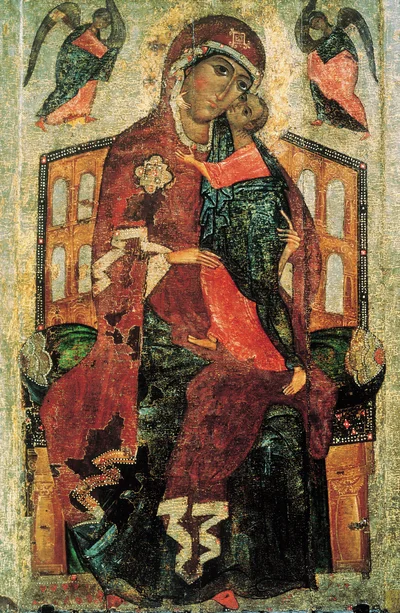
Icons
Icons of the Theotokos: the main types
There are hundreds of Marian icons but only a few types — Hodegetria, Eleusa, Oranta and the enthroned Theotokos — enough to identify almost any of them.
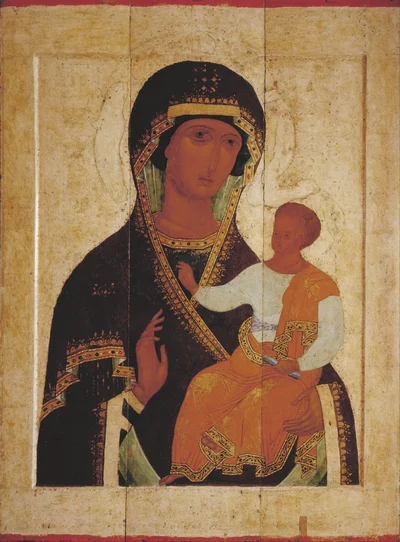
Icons
Hodegetria
The Mother of God holds the Child and points to him with her other hand — the most widespread type, including the Smolensk, Tikhvin and Iveron icons.
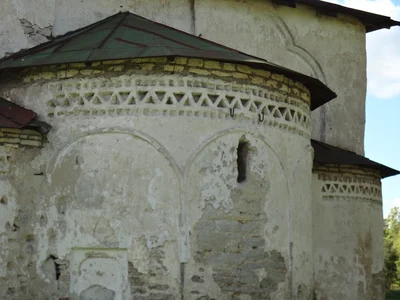
The church building
Apse
The rounded projection on the east wall of a church that houses the sanctuary.