
Icons of the Theotokos: the main types
There are hundreds of Marian icons but only a few types — Hodegetria, Eleusa, Oranta and the enthroned Theotokos — enough to identify almost any of them.
Reading options
The icons of the Mother of God have very many names: Vladimir, Kazan, Tikhvin, Iveron, Feodorov. A person naturally thinks these are hundreds of different images. In fact the names usually speak not of what is painted but of where the icon became famous or where it came from. There are few iconographic types themselves.
The four main ones
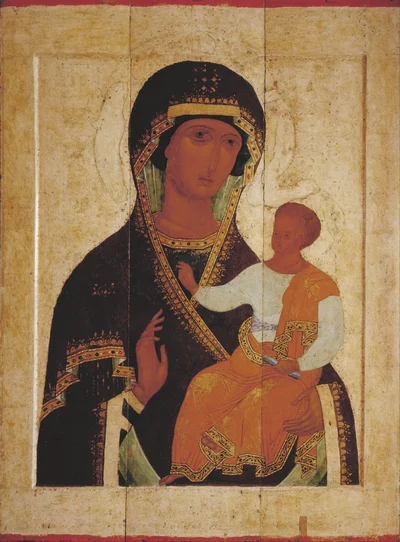
- Hodegetria, the Guide. The Mother of God holds the Child and points to Him with Her hand; He sits upright and blesses. Their faces do not touch.
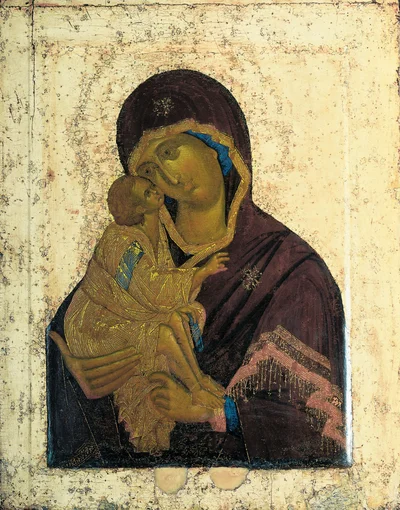
- Eleusa (Tenderness): the Child presses His cheek to His Mother’s cheek. Here there is not teaching but closeness.
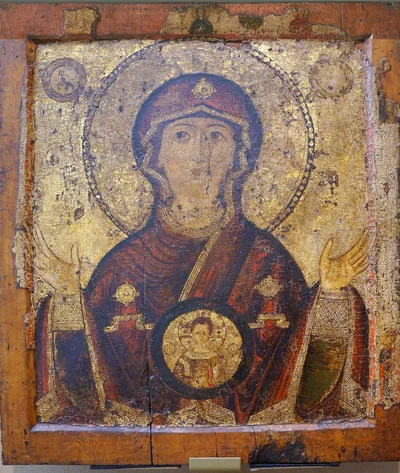
- Oranta: the Mother of God alone, with hands raised in prayer; if the Child is depicted on Her breast in a circle, this image is called “the Sign”.
- Panagia (Panachranta): the Mother of God sits on a throne with the Child on Her lap, often with angels at the sides. The image of the Queen.
What lies beyond the four
There are icons that fit into none of the types: “The Unburnt Bush”, “Joy of All Who Sorrow”, “Helper of Sinners” (Surety of Sinners), “Softener of Evil Hearts”. These are usually images that grew out of a text, a hymn, a prophecy or a prayer, and they must be read not by the pose but by the subject.
Finally, the same icon has different names in different inventories, and copies of a venerated image sometimes depart from the original. Therefore the type is determined from the image, and the name is learned from the inscription.
See also
Icons
Hodegetria
The Mother of God holds the Child and points to him with her other hand — the most widespread type, including the Smolensk, Tikhvin and Iveron icons.
Icons
Eleusa (Tenderness)
The Child presses his cheek to his Mother's — the warmest of the types, including the Vladimir, Don and Feodorov icons.
Icons
Oranta
The Mother of God with hands raised in prayer; with the Child in a medallion on her breast the image is called the Sign.
Icons
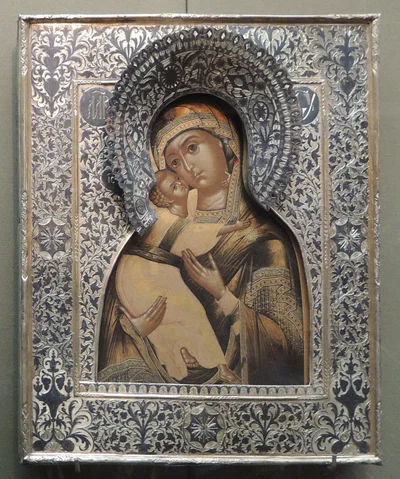
Miraculous icon
An icon linked with attested answers to prayer. It is the Church's veneration that makes an icon miraculous, not a property of the board itself.