
Typikon
Other names: Rule, Ordo
The book of rules: what to serve when, and how the other liturgical books fit together. It contains no prayers of its own.
Reading options
The Typikon is the only liturgical book that is not read aloud. It contains no prayers and no hymns: only instructions on what to take from the other books for each day of the year and in what order to combine it. Hence the Russian name — Ustav (“Rule”).
Why it is needed
A service is almost never sung from a single book. An ordinary Sunday is overlaid with the memory of a saint, and sometimes with a feast and a Lenten day as well. Each of them has its own stichera, troparia and canons — and someone has to decide how much to take from here, how much from there and what to omit this time. The Typikon decides this.
Who works with it
A parishioner never sees the Typikon. It is worked with by the rector, the ustavshchik (the cantor in charge of the order of services) and the choir director — usually not with the book itself, but with the liturgical directions for the current year, where everything is already set out by date.
The Russian Church serves according to the Jerusalem Typikon, which took shape in the monasteries of Palestine. It is a monastic rule, designed for services lasting a whole night, and so in a parish it is almost always performed in abbreviated form — and the Typikon itself assumes this, stipulating “if the rector so wishes.”
See also
Books and chant
Octoechos
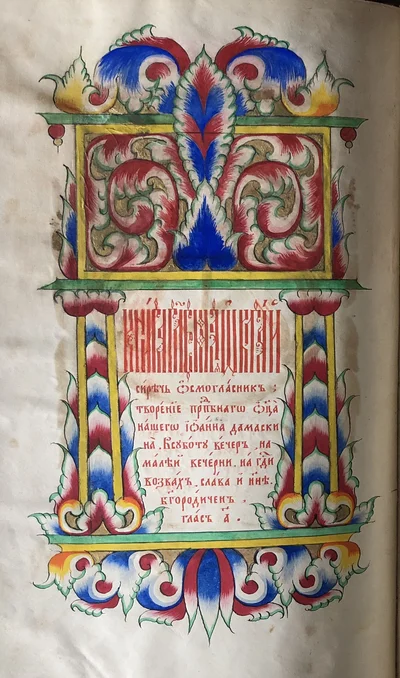
The book of the weekly cycle: eight tones, each with services for every day of the week.
Books and chant
Menaion
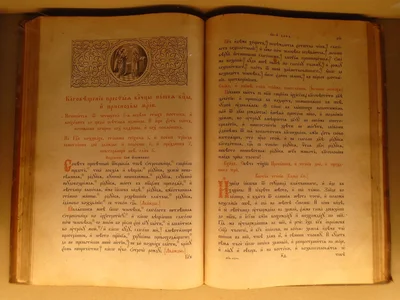
The book arranged by calendar date: for each day, the service to its saint or feast. Twelve volumes, one per month.
Books and chant
Sluzhebnik (Priest's Service Book)
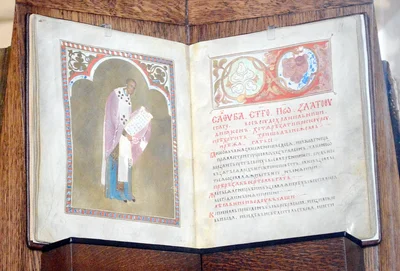
The book of the priest and deacon: their prayers and parts at Vespers, Matins and Liturgy.
Divine services
Divine service
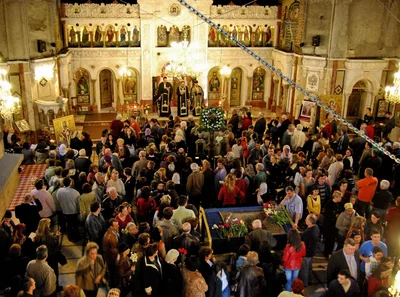
The common prayer of the Church served according to a fixed order: an evening service the day before, and the Liturgy in the morning.
Feasts and fasts
The church year
The yearly round of feasts and fasts. It begins on 14 September and is woven from two overlapping cycles: one fixed to calendar dates, one moving with Pascha.