
The church year
Other names: Liturgical year, Annual cycle
The yearly round of feasts and fasts. It begins on 14 September and is woven from two overlapping cycles: one fixed to calendar dates, one moving with Pascha.
Reading options
The church year is the order in which the Church lives through the year: which feasts, which fasts, what is read and sung on each day. It begins on 14 September (1 September Old Style). This day is called the church New Year, or the indiction; the reckoning from September came from Byzantium, where the economic and tax year began in September.
Two cycles laid over each other
The fixed cycle is tied to the dates of the month: the Nativity is always on 7 January, the Dormition always on 28 August. Its schedule is the menologion, and the texts of the services are in the Menaia, one book for each month.
The movable cycle is tied not to a date but to Pascha, and moves each year with it. It includes the preparatory weeks, Great Lent, Pascha itself, the Ascension, Trinity and all the Sundays between them. Its texts are in two books: the Lenten Triodion before Pascha and the Pentecostarion after it.
Both cycles run simultaneously, overlapping. On 7 April, the Annunciation, Great Lent may be under way, or it may be Bright Week, and each time the service is put together anew. The rule by which such coincidences are resolved is called the Typikon.
The day begins in the evening
Another peculiarity of the reckoning: the church day begins not at midnight but on the evening of the previous day, as in the Book of Genesis, “So the evening and the morning were the first day.” Therefore the service of a feast begins on its eve: the All-Night Vigil on Saturday evening already belongs to Sunday.
See also
Feasts and fasts
Old and new style
The Church keeps the Julian calendar, now thirteen days behind the civil one — which is why Christmas falls on 7 January: by church reckoning it is still 25 December.
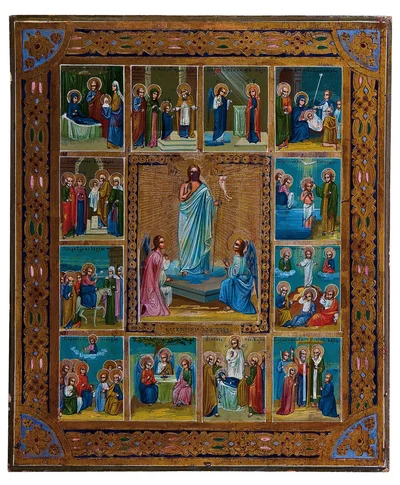
Feasts and fasts
The Twelve Great Feasts
The twelve chief feasts of the year after Pascha: nine fall on fixed dates, three are counted from Pascha.
Feasts and fasts
Movable feasts
Days with no fixed date: they are counted from Pascha and cover some eighteen consecutive weeks of the year.
Feasts and fasts
Sedmitsa and nedelya
In church language nedelya means Sunday, while the seven-day week is a sedmitsa — without this no notice board in a church makes sense.
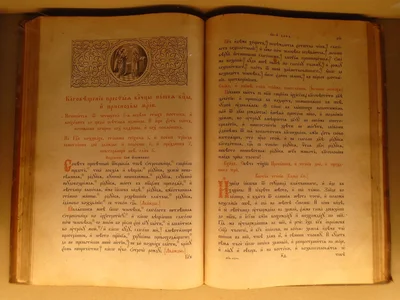
Books and chant
Menaion
The book arranged by calendar date: for each day, the service to its saint or feast. Twelve volumes, one per month.