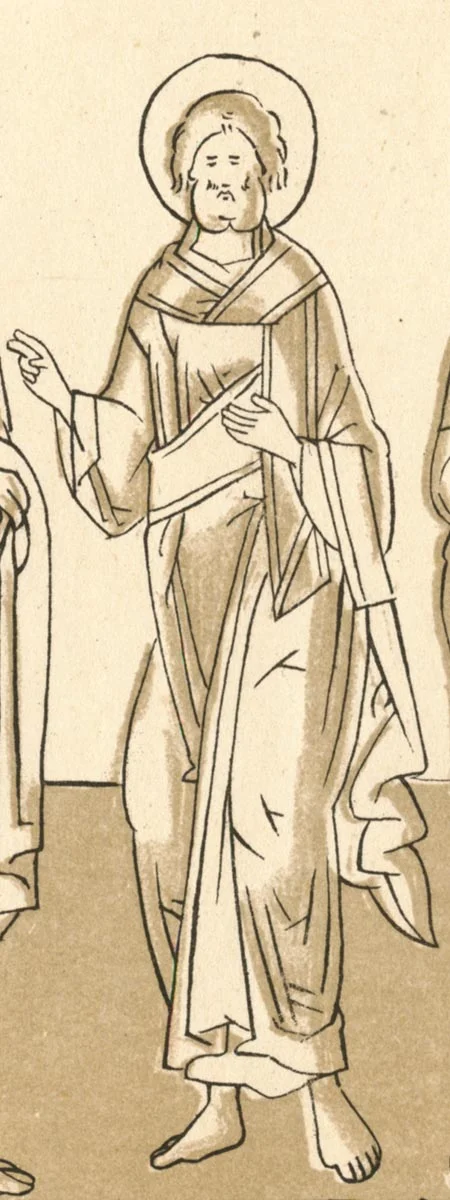
Apostle of the Seventy
Apostle of the Seventy Cephas, Bishop of Iconium
I век
Apostle of the Seventy Cephas — according to Church tradition, traceable to Clement of Alexandria (early 3rd c.) and preserved by Eusebius of Caesarea, a person distinct from the Apostle Peter, whom the Apostle Paul rebuked at Antioch (Gal. 2:11); ancient tradition assigns him the bishopric of Iconium (in other lists, Colophon); the question of whether Cephas and Peter are the same person or different remains debated both in antiquity and in modern biblical scholarship.
Apostle of the Seventy Cephas is known from ancient Church tradition, traceable to Clement of Alexandria (late 2nd–early 3rd c., in the lost 5th book of his "Hypotyposeis," preserved in summary by Eusebius of Caesarea, "Church History" 1.12.2). According to this tradition, the Cephas whom the Apostle Paul "opposed to his face" and rebuked in the Epistle to the Galatians (Gal. 2:11) for hypocrisy over table-fellowship with Gentiles at Antioch is NOT identical to the Apostle Peter (whose Aramaic surname "Cephas," "rock," Simon Peter also bears, per John 1:42), but is a SEPARATE person among the seventy disciples of Christ. The apparent motive for this distinction was a desire to avoid the theologically uncomfortable impression that Paul openly and sharply rebuked the chief Apostle Peter himself.
Later apostolic catalogues (Pseudo-Hippolytus, 3rd c.; Pseudo-Dorotheus) enshrine this tradition, naming Cephas the 51st of the seventy apostles and linking the Antioch episode specifically to him; according to these lists, Cephas later became bishop of Iconium. Pseudo-Epiphanius (possibly 9th c.) calls him the 45th of the seventy, "Peter's namesake." The geographic location of his see is likewise not entirely stable across sources: alongside Iconium (Lycaonia) one also finds Colophon (Ionia) — a discrepancy honestly reflected in the Russian-language tradition as well ("Cephas of Iconium (Colophon)").
IMPORTANT NOTE ON THE SCHOLARLY DEBATE: the overwhelming majority of ancient and modern commentators understand all New Testament mentions of "Cephas" (1 Cor. 1:12; 3:22; 9:5; 15:5; Gal. 1:18; 2:9, 11, 14) as referring to the Apostle Peter himself — this is the prevailing position. However, the view distinguishing Cephas from Peter has not remained a purely ancient curiosity: in 1990 the American biblical scholar Bart Ehrman published an article in the peer-reviewed "Journal of Biblical Literature" with independent linguistic argumentation in favor of distinguishing the two figures — a modern scholarly echo of the ancient tradition, not proof of it, but evidence that the question remains unresolved to this day.
His feast is kept on January 4/17, in the Synaxis of the Seventy Apostles, and also on December 8/21 and March 30/April 12 — in a group of Paul's apostolic co-workers (Sosthenes, Apollos, Tychicus, Epaphroditus, and others) mentioned in the Apostle Paul's epistles.
Icons and images