
Commemoration note
Other names: Commemoration list, Remembrance book
A slip of names handed in at the church shop so that those people are commemorated at the service.
Reading options
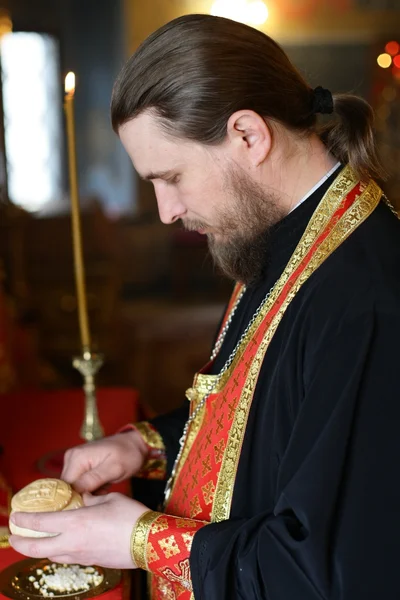
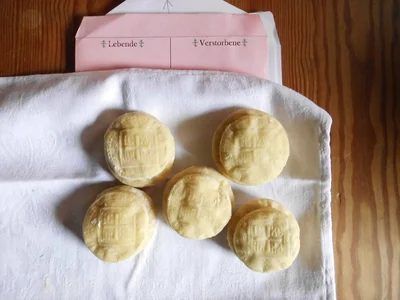
A note is the most ordinary way of asking that a person be prayed for in church. It is written by hand on a form or on any sheet of paper, a cross is put at the top and it is inscribed with what it is for: “For health” or “For the repose.” Then the names follow in a column. The note goes into the altar, and during the Proskomedia the priest takes out a particle from a prosphora for each name, and at the end of the Liturgy lowers these particles into the Chalice.
How to write the names
The names are put in the genitive case — the note answers the question “whom to commemorate”: of John, of Mary, of Sergius. The Church name given at baptism is written: not Ivan but John, not Yury but George, not Natalya but Natalia, not Svetlana but Photinia. Legibly and not smaller than usual: the note will be read not by a machine but by a person at the table of oblation.
Before a name, where necessary, a mark is put: inf. — infant (under seven), child — a boy or girl (under fourteen), sick — one who is ill, trav. — one travelling, warrior. A clerical rank is not abbreviated beyond recognition: priest, archpr., monk. In a note for the repose, for forty days after death one writes newly departed, on the anniversary — ever-memorable. Surnames, patronymics, titles and the words “servant of God” are not needed: before the liturgical prayer a person is only a name.
Whom one does not commemorate in a note
There are limits that it is better to know in advance than to learn at the candle desk. Not entered in a note are the unbaptized — neither adults nor children — nor people of another faith: the Church’s prayer at the Liturgy is addressed to those who belong to the Church. Suicides are not commemorated either: this is not a sentence on the person and not an attempt to punish anyone, but a recognition that the Church cannot bear witness for him to what he himself did not seek in life. This does not mean that one cannot pray for such a person at all: home, personal prayer for him is not restricted in any way, and about a suicide that happened in mental illness it is worth speaking with a priest — here a special permission of the ruling bishop is possible.
Simple and special
A simple note is commemorated at the Proskomedia — quietly, at the table of oblation, before the beginning of the Liturgy. A special one means that the names will be commemorated once more — usually at the litany or at a moleben and panikhida after the service. The exact order differs somewhat in different churches, and to ask about it at the shop is quite normal.
See also
Parish practice
Sorokoust (forty-day commemoration)
Commemoration of a name at forty consecutive Liturgies, most often for the newly departed.
Divine services
Proskomedia
The first part of the Liturgy: in the sanctuary the priest prepares the bread and wine and takes out particles for the living and the dead.
Divine services
Panikhida (memorial service)
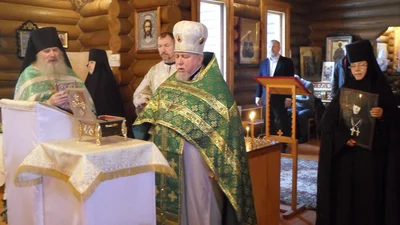
A memorial service for the departed that may be served any number of times — on the third, ninth and fortieth day, on anniversaries and memorial Saturdays.
Parish practice
Christian (baptismal) name
The name given at baptism — the one said at the Chalice and written in notes.