
Feast icon
An icon of an event rather than a person — the festal tier of the iconostasis, and the icon laid on the analogion on the day itself.
Reading options
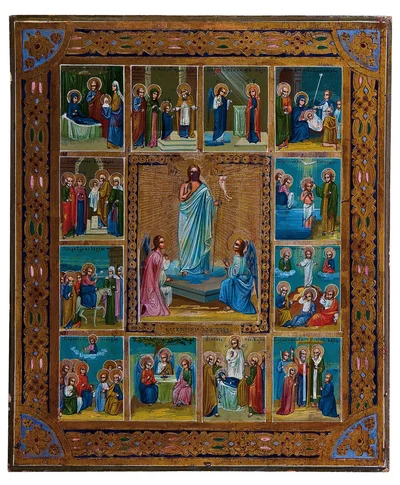
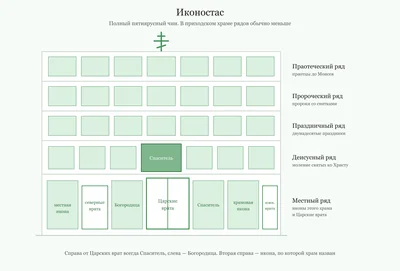
A feast icon depicts not a person but an event: the Nativity of Christ, Theophany, the Entry of the Lord into Jerusalem, the Resurrection. The twelve principal such icons form the festal tier of the iconostasis, usually the third from the bottom, above the Deisis, where they go in the order of the church year.
Not an illustration
A feast icon does not retell an event minute by minute but gathers its meaning. In the Nativity there are in a single image both the Magi, still travelling over the mountains, and the shepherds, and the washing of the Infant, and Joseph sitting to one side lost in thought: everything that happened at different times. In the Resurrection of Christ one paints not the empty tomb or the coming out of the cave, but the Descent into Hades: Christ leads Adam and Eve out by the hand from the broken gates. The event is shown from the side from which there was no one to see it.
The icon on the analogion
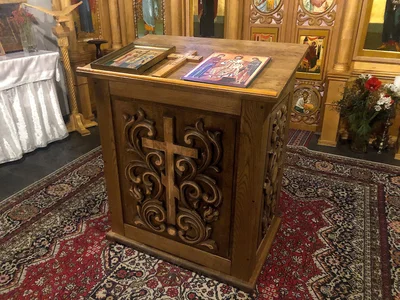
The most noticeable feast icon in a church is the one that lies in the middle of the church on the analogion. It changes: today it is the image of the feast, tomorrow of the saint whose memory is kept. It is to this that one comes to venerate on entering the church, and from it it is easiest to understand what day it is, without yet having asked anyone.
See also
Feasts and fasts
The Twelve Great Feasts
The twelve chief feasts of the year after Pascha: nine fall on fixed dates, three are counted from Pascha.
The church building
Iconostasis
The icon screen dividing sanctuary from nave; its icons are arranged in tiers, each with its own meaning.
Church utensils
Analogion
A tall stand with a sloping top: it holds the icon of the day, books for reading, and the cross and Gospel at confession.
Icons
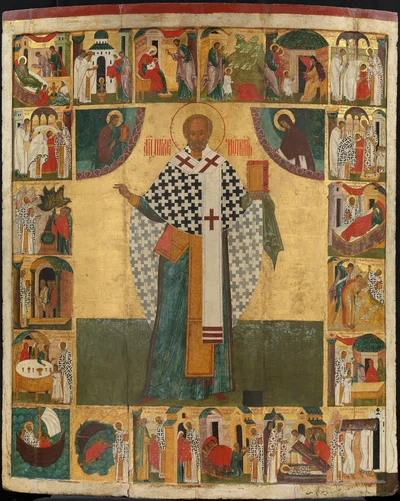
Hagiographic icon
An icon of a saint framed by small scenes telling his life in order — read like a page.