
Hagiographic icon
Other names: Icon with border scenes
An icon of a saint framed by small scenes telling his life in order — read like a page.
Reading options
In the middle of such an icon is the saint himself, full-length or half-length; this central part is called the centre panel (srednik). Around it, as a frame, run small rectangular scenes, the borders (klejma). Each border shows one episode of the saint’s life, with its own inscription.
How to read it
The order is the usual, bookish one: one begins at the upper left corner, goes along the top edge to the right, then descends the right side, passes along the bottom row from left to right, and finishes with the left column. Sometimes the bottom row is read differently, but the inscriptions in the borders will always show. The first border is, as a rule, the saint’s birth, the last his repose, the uncovering of his relics or posthumous miracles.
There may be from eight to more than thirty borders. The more famous the saint, the longer the story: hagiographic icons of St. Nicholas, Great Martyr George and Venerable Sergius of Radonezh can be very detailed.
Why it was done this way
Before lives of saints were printed and before people were generally literate, the icon was the only way to learn who this saint was and what happened to him. A person came up, examined the borders in a circle, and left with a connected story. This is why hagiographic icons are usually large: they were placed so that one could stand before them and look them over.
See also
Icons
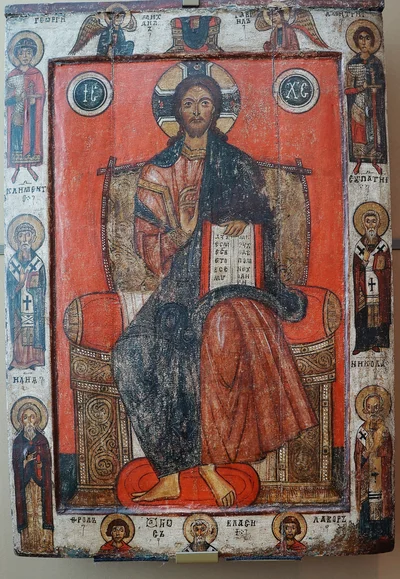
Icon
An image of Christ, the Mother of God, a saint or a sacred event, made for prayer — not a painting and not a portrait.
Icons
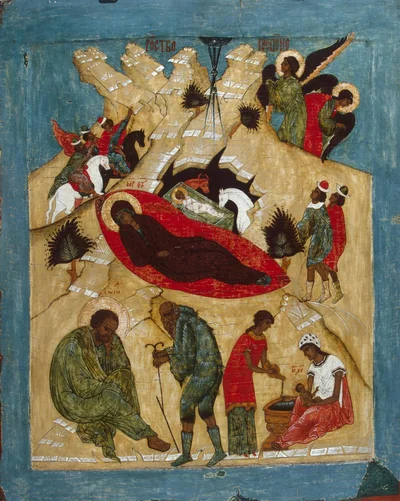
Feast icon
An icon of an event rather than a person — the festal tier of the iconostasis, and the icon laid on the analogion on the day itself.
Ranks of sanctity
Canonization
The Church's decision that a person may be openly venerated as a saint — it does not make anyone holy, it testifies to holiness already evident.
Church utensils
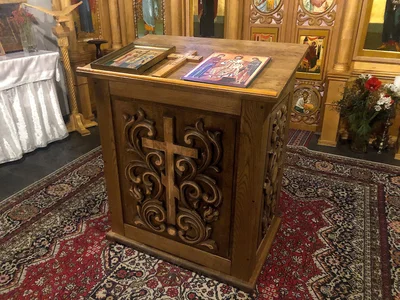
Analogion
A tall stand with a sloping top: it holds the icon of the day, books for reading, and the cross and Gospel at confession.