Sakkos
The bishop's outer vestment in place of the phelonion, its edges hung with small bells.
Reading options
The sakkos is worn by a bishop — where a priest would put on the phelonion. It is a garment with short wide sleeves, not sewn up at the sides but joined by buttons or ribbons.
A garment of humility
The name comes from the Hebrew “sak” — sackcloth, the coarse cloth that was put on as a sign of repentance. This is no accident: the sakkos recalls the same purple robe of mockery as the phelonion, and is meant to remind the bishop that the height of his rank is not about grandeur.
The bells
Small bells are hung along the edges of the sakkos — their ringing is heard when the bishop moves through the church. The model is taken directly from the Old Testament: the same bells were on the garment of the high priest Aaron, “and its sound shall be heard when he goes into the holy place.”
Until the 15th–16th centuries the sakkos was worn only by patriarchs and a few metropolitans; the other bishops served in the phelonion.
See also
Vestments
Omophorion
The broad band on a bishop's shoulders — the chief sign of his rank, signifying the lost sheep carried home.
Clergy and ranks
Bishop
The highest degree of priesthood: only a bishop ordains clergy and governs a diocese. Recognised by the omophorion, panagia and staff.
Vestments
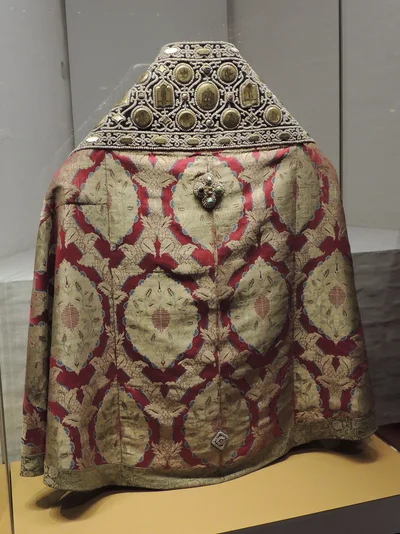
Phelonion
The priest's outermost liturgical garment: a wide sleeveless mantle covering the whole body.