
Old and new style
Other names: Julian calendar
The Church keeps the Julian calendar, now thirteen days behind the civil one — which is why Christmas falls on 7 January: by church reckoning it is still 25 December.
Reading options
There are two calendars, and the difference between them is purely astronomical.
The Julian calendar (“Old Style”) was introduced under Julius Caesar. In it the year is equal to 365 days and 6 hours, a little more than 11 minutes longer than the true solar year. Over the centuries these minutes accumulated: by the 16th century the calendar had fallen behind the sun by ten days, and the spring equinox had moved from 21 March to the 11th.
The Gregorian calendar (“New Style”) is a correction of this error, made in 1582: the ten accumulated days were dropped, and from the leap years such years as 1700, 1800 and 1900 were removed. Russia switched to it in 1918, stepping from 31 January straight to 14 February.
Where the 13 days come from
The difference between the calendars is not constant; it grows by about a day per century. In the 19th century it was 12 days, now it is 13, and from 2100 it will be 14. The Russian Church has remained with the Julian reckoning, so its dates have to be converted: 25 December Old Style is 7 January New Style. No one “moved the Nativity to January”: it was on 25 December and so it remained; the calendar shifted around it. Hence also the “Old New Year” on 14 January, and Theophany on 19 January (6 January Old Style).
Pascha is reckoned separately
The date of Pascha is not tied directly to either of these calendars: it is calculated by its own, far more ancient system, the Paschalion, and the day thus obtained is then converted into the civil calendar. That is why the Churches that adopted the “New Julian” calendar (the Greek, Romanian, Bulgarian and others) celebrate the Nativity on 25 December with everyone else, and Pascha on the same day as we do, by the same old Paschalion.
See also
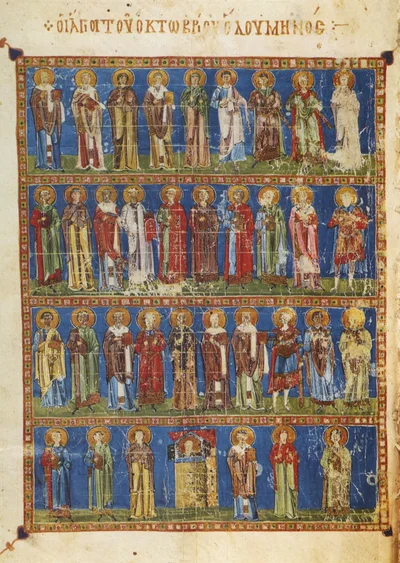
Feasts and fasts
The church year
The yearly round of feasts and fasts. It begins on 14 September and is woven from two overlapping cycles: one fixed to calendar dates, one moving with Pascha.
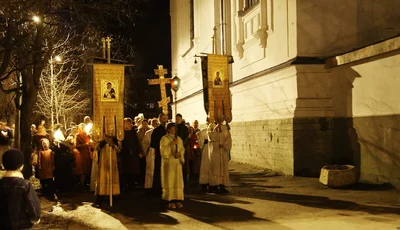
Feasts and fasts
Pascha
The Resurrection of Christ, the feast of feasts. Its date moves between 4 April and 8 May on the civil calendar.
Feasts and fasts
The Paschalion
The rule by which the date of Pascha is found — the first Sunday after the first spring full moon — and the tables that set out that rule for centuries ahead.
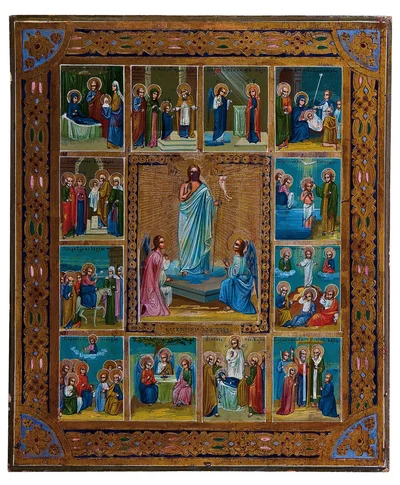
Feasts and fasts
The Twelve Great Feasts
The twelve chief feasts of the year after Pascha: nine fall on fixed dates, three are counted from Pascha.