Feasts and fasts
Bright Week
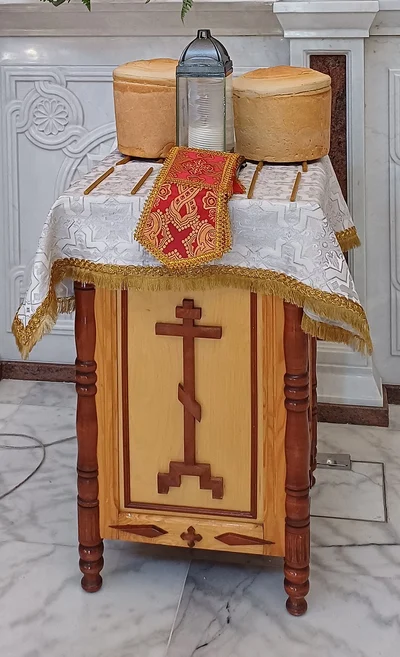
The week after Pascha, served as one unbroken day: the royal doors stand open, there is no fasting, and a procession follows the liturgy daily.

Что означают слова, которые звучат в храме: облачения, богослужения, таинства, устройство храма.
Found: 20
Feasts and fasts
The week after Pascha, served as one unbroken day: the royal doors stand open, there is no fasting, and a procession follows the liturgy daily.
Feasts and fasts
Weeks on which the Wednesday and Friday fast is lifted. There are five, each standing beside a great feast or at the threshold of a fast.
Feasts and fasts
A time of restraint — in food, amusements and habits — set aside for prayer and repentance: four multi-day fasts, several single days, and most Wednesdays and Fridays.
Feasts and fasts
Feasts served almost like the twelve, yet not counted among them: the Protection, Peter and Paul, two days of the Forerunner, and the Circumcision.
Feasts and fasts
The longest and strictest fast of the year: 48 days before Pascha, made up of the Forty Days, Lazarus Saturday, Palm Sunday and Holy Week.
Feasts and fasts
Two thresholds before Great Lent: meat is eaten for the last time on Meatfare Sunday, dairy on Cheesefare Sunday, with Maslenitsa standing between them.
Feasts and fasts
Days of general commemoration of the departed: two universal ones before Maslenitsa and Pentecost, three in Great Lent and one in early November.
Feasts and fasts
Days with no fixed date: they are counted from Pascha and cover some eighteen consecutive weeks of the year.
Feasts and fasts
The Church keeps the Julian calendar, now thirteen days behind the civil one — which is why Christmas falls on 7 January: by church reckoning it is still 25 December.
Feasts and fasts
Fast days that stand alone: most Wednesdays and Fridays, the eve of Theophany, the Beheading of the Forerunner and the Exaltation of the Cross.
Feasts and fasts
The Resurrection of Christ, the feast of feasts. Its date moves between 4 April and 8 May on the civil calendar.
Feasts and fasts
The chief day of a church — the memory of the saint or event to whom its altar is dedicated. Our cathedral keeps two, both of St Alexis of Moscow.
Feasts and fasts
In church language nedelya means Sunday, while the seven-day week is a sedmitsa — without this no notice board in a church makes sense.
Feasts and fasts
The days from the Nativity to the eve of Theophany, 7–17 January — the longest fast-free stretch of the year.
Feasts and fasts
The fast before the day of Peter and Paul. It begins a week after Pentecost and always ends on 11 July, so its length varies from eight to forty-two days.
Feasts and fasts
The yearly round of feasts and fasts. It begins on 14 September and is woven from two overlapping cycles: one fixed to calendar dates, one moving with Pascha.
Feasts and fasts
A two-week fast before the Dormition, 14–27 August: the shortest of the multi-day fasts and as strict as Great Lent.
Feasts and fasts
A forty-day fast before the Nativity, 28 November – 6 January, also called St Philip's Fast after the day on which it begins.
Feasts and fasts
The rule by which the date of Pascha is found — the first Sunday after the first spring full moon — and the tables that set out that rule for centuries ahead.
Feasts and fasts
The twelve chief feasts of the year after Pascha: nine fall on fixed dates, three are counted from Pascha.