
How to prepare for Communion
Fasting, the prayer rule, confession and the Chalice itself: what is customary before Communion and how to approach.
Reading options
People receive Communion at the Liturgy, and therefore they prepare for the Liturgy and not for a separate rite. What follows is the practice generally accepted in the Russian Church. It is not a rule with fixed figures: the measure of the fast and of the prayer rule is agreed with the priest, and for a person who is ill, who works round the clock or who receives Communion often, it will frequently be different.
Fasting
Usually one fasts for three days: without meat, dairy and eggs, and if possible without wine and entertainment. If a person receives Communion regularly and keeps all the multi-day fasts, the period is often shortened — this is exactly what one asks the priest about. Separate from this is the Eucharistic fast: from midnight before Communion one neither eats nor drinks at all, including water; one should not smoke either. Medicines needed for vital reasons are taken, and this is not a violation.
Prayer
On the eve one reads the “Rule for Holy Communion” from the prayer book, and, by established practice, three canons with it: the penitential canon to the Saviour, the supplicatory canon to the Mother of God, and the canon to the Guardian Angel. In the morning — the morning prayers and those prayers of the Rule that are appointed immediately before Communion. If strength or time is lacking, it is better to read less but attentively, and to say so at confession, than to skim everything with the eyes.
On the evening before, one goes to the All-Night Vigil. Coming to the Liturgy from the very beginning is part of the preparation, not a formality.
Confession and reconciliation
In Russian practice one confesses before Communion — usually on the evening before or in the morning before the service begins. And before the Chalice one tries to be reconciled with everyone with whom one is at odds.
At the Chalice
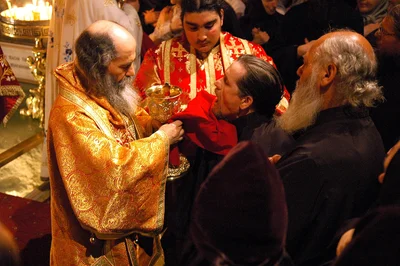
When the Royal Doors open and the Chalice is brought out, one approaches unhurriedly, letting children and the infirm go ahead. The hands are folded crosswise on the chest, the right over the left, and held so to the end. One does not make the sign of the Cross before the Chalice itself — one might knock it with one’s hand. On approaching, one clearly gives one’s Christian name, receives the Gifts from the spoon, takes everything off the spoon with the lips and, without speaking, steps away to the table with the warm drink: there warm water with wine and a piece of prosphora are given. The rim of the Chalice is kissed if that is the custom in the church.
After Communion one does not leave at once: one listens to the prayers of thanksgiving, which are read in church or at home. Infants and children under seven receive Communion without confession and without fasting; women, by established practice, do not approach the Chalice on the days of purification.
See also
Sacraments
Communion
The central sacrament of the Church: at the Liturgy bread and wine become the Body and Blood of Christ, received by the faithful from the chalice.
Parish practice
How to prepare for confession
What to do before confession and how it goes: recall your sins, name them plainly, make peace with people, and speak in your own words.
Parish practice
Govenie (preparation week)
Several days of preparation for confession and Communion: fasting, services and prayer at home.
Divine services
Divine Liturgy
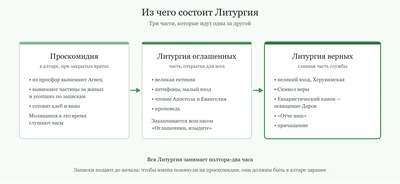
The principal service of the Church, at which the Eucharist is celebrated and the faithful receive Communion. Served in the morning, lasting one and a half to two hours.
Feasts and fasts
Fasting
A time of restraint — in food, amusements and habits — set aside for prayer and repentance: four multi-day fasts, several single days, and most Wednesdays and Fridays.